Weekly Cleaning List: 8 Room-by-Room Tasks for Busy Homes

Saturday morning in Fairhope starts with good intentions and ends in catch-up. You notice the sand tracked across the entryway, a bathroom sink that needs a scrub, and sheets that should have gone into the wash on Wednesday. By the time you've made a dent, half the day is gone and the rest of the list is still sitting there.
A written weekly cleaning list fixes the pattern rather than the mess. The U.S. Bureau of Labor Statistics' American Time Use Survey found that housework participation ran at 40% on an average weekend day versus 33% on a weekday, which tells you where all that catching up lands: the two days you were hoping to rest. The work doesn't shrink. It just compresses.
Gulf Coast conditions make the case stronger. Humid air feeds mildew on grout and window tracks, spring pollen coats screens and sills, and beach sand arrives on feet, towels, and dog paws. A list that ignores those three things will always run behind. Sweet Home Cleaning Service builds recurring visits around them, and the eight areas below follow the same room-by-room order our standard cleaning follows in homes across the Eastern Shore.
Treat this as a framework, not a rule. Families, renters, and property managers can move tasks between days, split them between people, or hand the whole thing off. What matters is that each job has a home on the calendar instead of a place on a someday list.
Table of Contents
- 1. Kitchen Counters, Tables, and Appliance Fronts
- 2. Bathroom Scrub-Down: Toilets, Tubs, Sinks, and Mirrors
- 3. Vacuuming and Mopping Hard Floors
- 4. Dusting Surfaces, Blinds, Ceiling Fans, and Glass
- 5. Changing and Laundering Bedding
- 6. Emptying Trash, Recycling, and Wiping Bins
- 7. Entryway, Doors, and Sand Control
- 8. Weekly Reset Through Consistent Routines
- How Each Weekly Cleaning List Area Compares at a Glance
- Turning the Weekly List Into a Routine That Lasts
1. Kitchen Counters, Tables, and Appliance Fronts
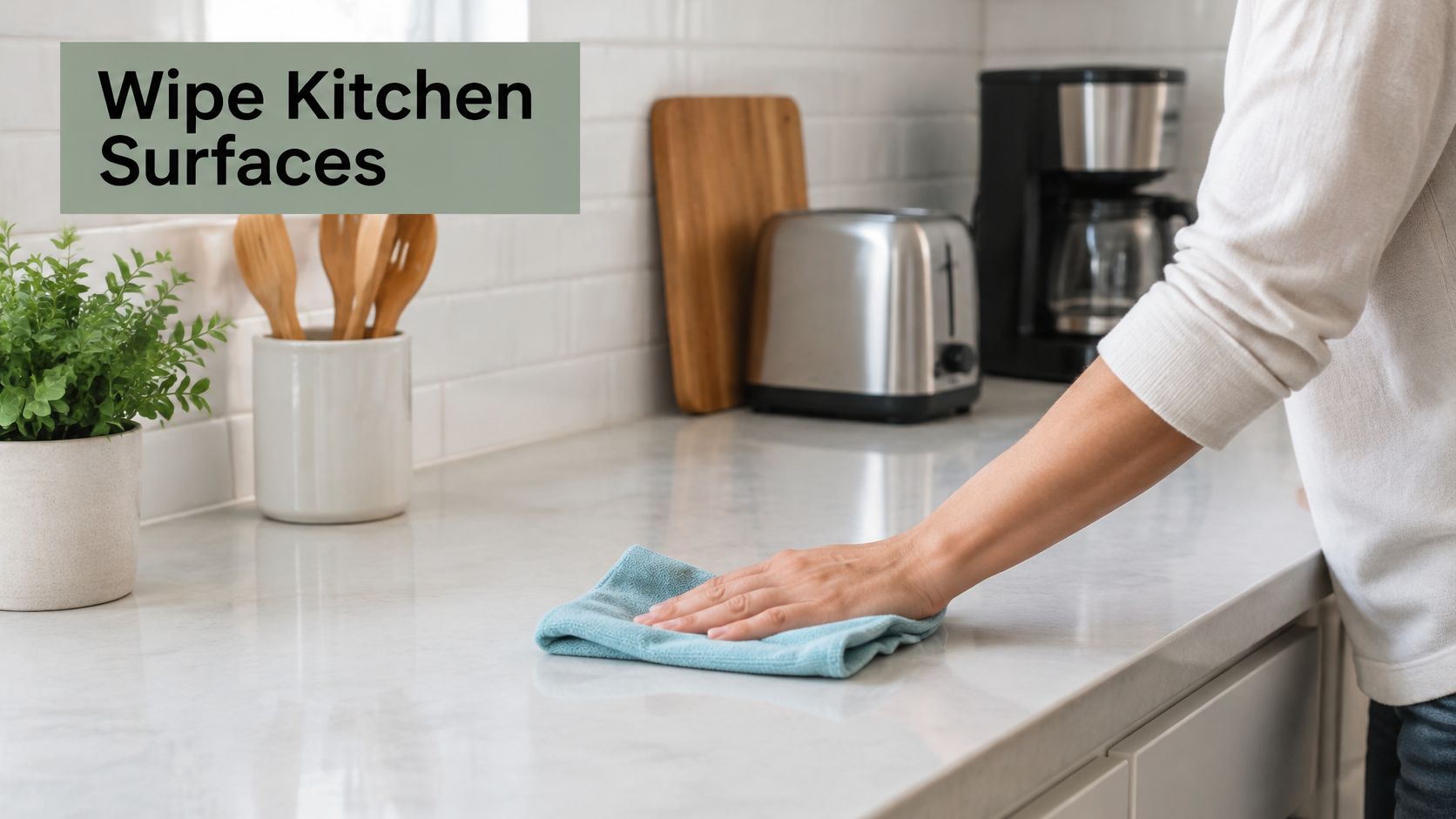
The kitchen is where a weekly list earns its keep first. Crumbs, grease splatter, fingerprints, and food residue collect faster here than anywhere else, and most of it lands on surfaces you touch before you cook.
A National Sanitation Foundation study of 22 families and 30 frequently used household items identified kitchen surfaces and objects, including sponges, sinks, and faucet handles, as important contamination points for yeast, mold, and coliform bacteria, a group that includes Salmonella and E. coli. That finding reorders the job. Wash and disinfect the sink basin, sides, and bottom once or twice a week, clean faucet handles weekly, and sanitize food-contact surfaces after soil removal. Put sponges on a schedule instead of a smell test: NSF advises daily microwave treatment for wet sponges and replacement roughly every two weeks, sooner if they've handled raw meat.
Work top to bottom, handles last
Clear the counters completely, then wipe from the backsplash forward so crumbs land where the vacuum will find them. Appliance fronts come next with a microfiber cloth you rinse often, then the dining table, then cabinet pulls and the switch plate by the door. Check the care instructions before you touch stainless steel, granite, or quartz, because the wrong product leaves a haze that takes longer to fix than the cleaning would have.
Practical rule: Wipe counters and the table after dinner, then give appliance fronts, cabinet pulls, and table edges one proper weekly pass. Daily upkeep turns the weekly kitchen job into a five-minute finish.
A Gulf Shores rental owner can run the identical sequence between guests, wiping appliance fronts and handles during turnover so the kitchen matches the photos. A family home needs the same order, just without the deadline.
2. Bathroom Scrub-Down: Toilets, Tubs, Sinks, and Mirrors
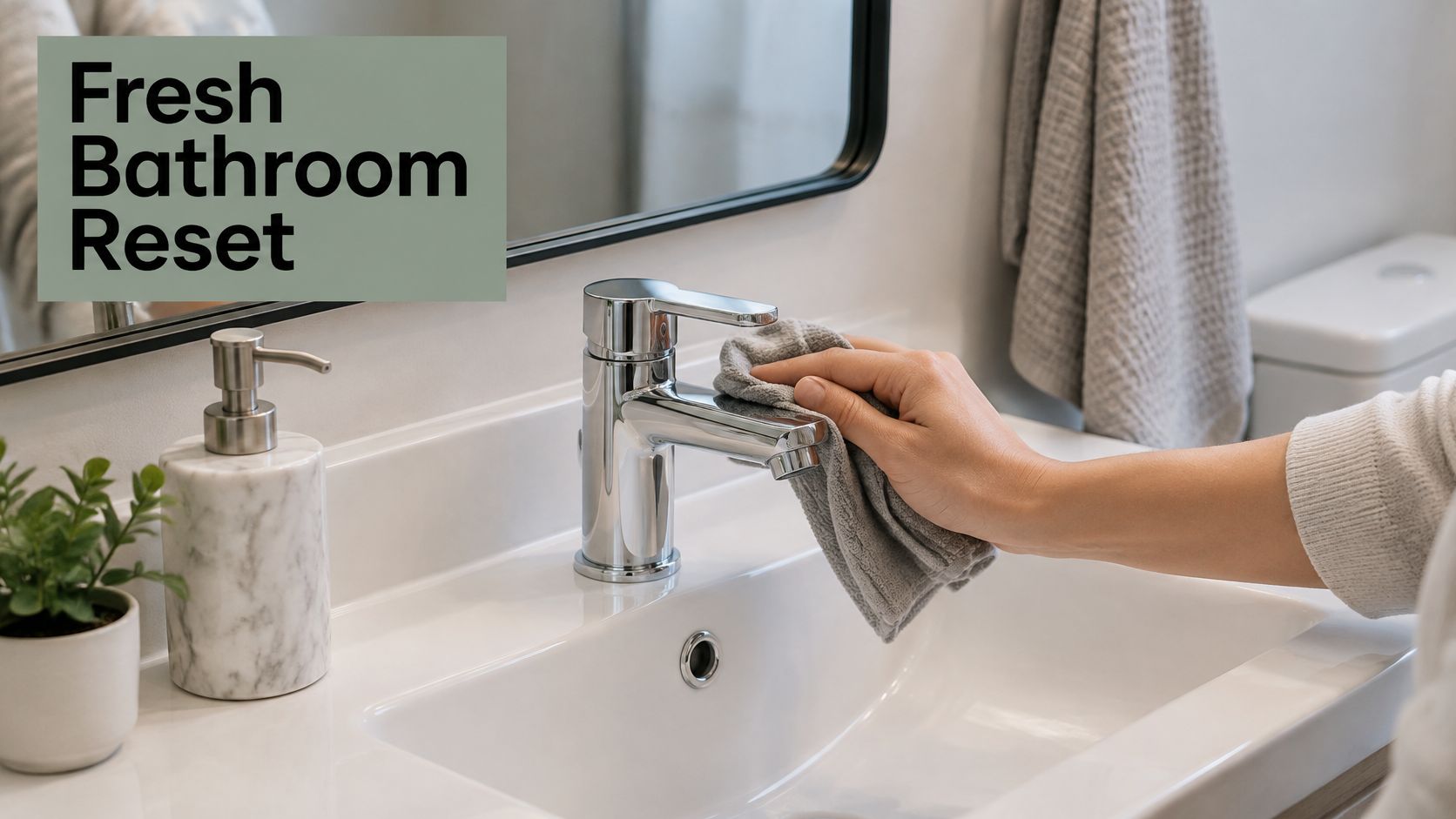
Bathrooms get priority for a simple reason. Moisture, soap residue, and hard-water deposits build in the same few square feet, and Gulf humidity gives mildew a head start on grout, caulk, and shower curtains.
The CDC guidance on cleaning and disinfecting your home draws a line worth copying onto your list. Clean with soap and water first when a surface is visibly soiled, then apply an EPA-registered disinfectant, and keep the surface visibly wet for the product's full stated contact time. Wiping disinfectant off after thirty seconds is a common habit and a wasted step.
Watch the humidity, not just the grout
EPA guidance on mold and moisture recommends keeping indoor relative humidity below 60%, ideally between 30% and 50%, and notes that an inexpensive moisture meter, typically $10 to $50, tells you where you stand. In a bathroom, that reading is the difference between a weekly wipe-down and a recurring mildew problem on the ceiling and the curtain liner. Run the exhaust fan 20 to 30 minutes after showers and wipe walls and door tracks dry.
For tubs and showers specifically, work top to bottom, rinse thoroughly, and leave the fan running while you finish the rest of the room. How to clean bathtubs and showers covers the finish-by-finish details.
Never mix two bathroom products to save a step. Rinse the surface and the cloth before switching to anything else.
In a Fairhope home with original tile, a weekly wipe of shower walls and the sink does more for the grout than a quarterly scrub. A Daphne household that runs the fan after every shower and dries the walls slows mildew between cleanings.
3. Vacuuming and Mopping Hard Floors
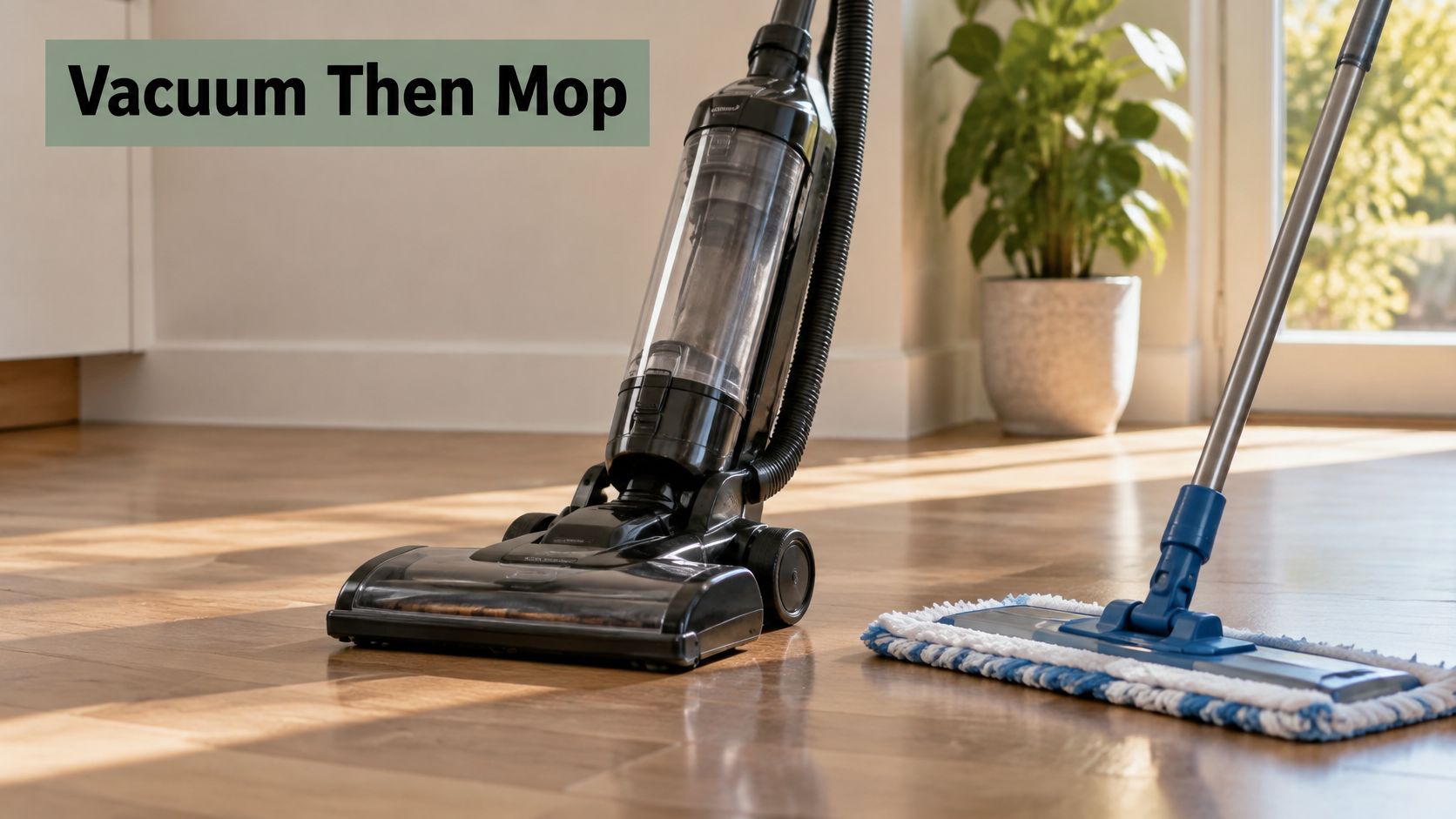
Floors take the heaviest wear of anything in the house, and in coastal Alabama much of that wear arrives as sand and fine dust from the driveway, the beach access, and the dog. Grit underfoot acts like sandpaper on grout lines, vinyl, and sealed hardwood, so a weekly pass protects the finish, not just the look.
Time is the main constraint. In 2025, U.S. residents aged 15 and older spent an average of 0.33 hours per day, about 20 minutes, on interior cleaning, according to the U.S. Bureau of Labor Statistics American Time Use Survey. Twenty minutes doesn't cover a whole house, which is exactly why a dedicated floor day beats trying to squeeze floors into every evening.
Vacuum first, then mop damp
Order matters more than product. Vacuum or sweep first so you aren't pushing grit around with a wet mop, then hit edges and corners where debris collects, then mop. Wring the mop until it's only damp, especially on hardwood and laminate, where standing water dulls the finish and can lift seams. Check the flooring manufacturer's recommended cleaner before trying something new, and spot-test a hidden area first.
Resilient floors reward a specific technique, and the best way to mop linoleum floors walks through the two-bucket method and drying order.
A Gulf Shores family that vacuums the entryway and living room every Saturday through summer stays ahead of sand season instead of chasing it. An Orange Beach rental needs the same vacuum and damp-mop pass between guest stays, or departure day turns into a flooring project.
4. Dusting Surfaces, Blinds, Ceiling Fans, and Glass
Dusting is the task most weekly lists skip, and the one guests notice within a minute of walking in. Dust, pollen, fingerprints, and salt residue settle on furniture, electronics, window sills, blinds, ceiling fans, mirrors, and glass doors. A damp microfiber cloth captures that film instead of launching it back into the air, where it settles again by evening.
The neglected spots are predictable. A December 2024 survey of 2,000 Americans found that 24% considered keeping the home clean harder than their full-time job, and parents reported about four hours of cleaning per week versus three hours for non-parents, as reported by Carolina Panorama. The same survey identified blinds, baseboards, fans, and windowsills as frequently neglected. Rotate one of those into each week rather than attempting all four on a Saturday.
Top down, both sides
- Start at the ceiling. Turn off ceiling fans and wipe each blade from base to tip before you dust furniture, so anything that falls lands on surfaces you're about to clean anyway.
- Close the blinds to clean them. A damp microfiber cloth passed over slightly closed slats reaches both sides of each blade in one motion.
- Finish glass with a dry cloth or squeegee. Use a streak-free glass cleaner on mirrors and sliding doors, and keep a small brush for the tracks where sand and salt collect.
A Fairhope household can dust from the top of each room down every Monday. A Daphne renter should check window sills weekly through the humid months and wipe away dampness before it stains the paint. Anyone with sliding glass doors near a beach path or pool knows the tracks need that brush more than the glass does.
5. Changing and Laundering Bedding

Bedding collects body oils, sweat, dust, and pet hair, and the weekly change is the item most likely to slide when the week gets busy. Sheets, pillowcases, mattress protectors, and towels all belong on a schedule you can say out loud, not one you remember at bedtime.
Laundry labor has historically fallen unevenly. In 2016, the U.S. Bureau of Labor Statistics reported that 50% of women performed housework such as cleaning or laundry on an average day, compared with 21% of men. Writing "strip and remake beds" next to a name on the list is a small thing that shifts that balance, especially in homes where one person ends up carrying all of it without anyone noticing.
Two sets per bed, and dry fully
- Keep two complete sets per bed. One goes on while the other washes, so nobody is waiting on a dryer at 10pm.
- Dry linens completely before folding. In humid months, a slightly damp sheet folded and put away comes out musty.
- Wash mattress protectors and pillow covers on the same cycle as sheets rather than trying to remember them twice a year.
Care labels beat habit, and water temperature matters as much as frequency, which is why SouthShore Fine Linens washing frequency tips are worth a read before you change a setting.
A Daphne family that strips and washes every Sunday evening starts the week with beds made. An Orange Beach rental owner keeps two complete linen sets per unit so turnover never depends on one dryer finishing in time.
6. Emptying Trash, Recycling, and Wiping Bins
Kitchen, bathroom, and office bins need a regular place on the weekly list. Empty them before food waste sits long enough to smell, replace liners, and wipe away residue from the inside and lid. In humid Gulf Coast weather, moisture and food scraps can make odors noticeable quickly. Recycling also needs attention: rinse containers that held food or drinks, then let them dry before placing them in the bin.
For routine cleaning, wash the bin with soap and water, rinse it, and dry it fully. If disinfection is needed, follow the product label. The CDC guidance on cleaning and disinfecting with bleach says never to mix bleach with other cleaners or disinfectants, since dangerous vapors can result. It gives a fallback dilution of 5 tablespoons, or one-third cup, of bleach per gallon of room-temperature water, or 4 teaspoons per quart, when manufacturer directions are unavailable. Keep the surface visibly wet for at least one minute, and mix the solution fresh daily because it becomes less effective after more than 24 hours.
Odor control without the fragrance layer
A strong fragrance can cover a bin odor without removing its source. Purdue University researchers report that fragranced household products can react with ozone and generate nanoscale particles capable of penetrating into the lungs. A 2025 observational study of two occupied homes found post-cleaning increases in approximately 60% of measured volatile organic compounds and 80% of semivolatile organic compounds during professional cleaning. Those increases were not clearly attributable only to product emissions or secondary chemistry.
Rinse and dry the bin, then leave the lid open for an hour with a window cracked, if conditions allow. This lets the bin air out without adding fragrance. Avoid leaving a damp bin closed, especially in humid weather.
For everyday upkeep, households can empty kitchen bins daily and wipe them weekly. Rental hosts can replace liners and wipe bins between guest stays, so each incoming guest finds a clean, dry bin. Adjust the routine to the amount of food waste and how quickly odors develop.
7. Entryway, Doors, and Sand Control
Every grain of sand, pollen, and dirt in the house came through a door. The entryway is where a weekly routine pays off across every other room, and it's the spot most lists treat as a doormat and nothing more.
The CDC guidance on when and how to clean and disinfect your home covers the surfaces here. Light switches, doorknobs, and countertops should be cleaned regularly and after visitors, with disinfection generally most appropriate when someone is sick or a person at higher risk has been exposed. Cleaning comes first, because dirt and other impurities can reduce the effectiveness of sanitizing and disinfecting chemicals. In practice, that means a weekly wipe of handles and switch plates, then a disinfecting step only when the household situation calls for it, following the label and the required contact time.
Where the sand stops
- Two mats, one outside and one inside. The outside mat takes the worst of it and the inside mat catches what's left.
- Shake or vacuum mats weekly and wash them according to their care labels rather than waiting for visible dirt.
- Keep a small broom or handheld vacuum by the door. Thirty seconds at the threshold saves the living room floor.
A Gulf Shores family keeps a sand bin and mat by the back door and shakes the mat every week. An Orange Beach homeowner stores beach chairs and towels near the entry so sand stays in one zone instead of migrating to the bedrooms. Entryway care is part of the standard cleaning Sweet Home Cleaning Service provides in Fairhope, Gulf Shores, and the surrounding communities.
8. Weekly Reset Through Consistent Routines
A list only works if it survives a normal week. That means few enough tasks to finish, specific days attached to them, and a reset that takes less time than the mess it prevents. Interior cleaning isn't something people typically do on a given day: in 2025, 23.4% of U.S. residents aged 15 and older performed interior cleaning on an average day, according to the U.S. Bureau of Labor Statistics. Households that stay ahead schedule it rather than waiting for a free afternoon that never arrives.
Season reshapes the list on the Gulf Coast. NOAA defines the Atlantic hurricane season as June 1 through November 30 and notes that the official period encompasses more than 97% of tropical activity, per the NOAA National Hurricane Center. Across those six months, weekly attention to entryway clutter, loose outdoor items, supplies, and high-traffic floors makes a home easier to secure before a storm and easier to clean afterward.
The list that fits a household
- Assign each task a day. Kitchen and bathrooms on one day, floors and dusting on another, bedding near the weekend.
- Keep a minimum version. When a week falls apart, do bathrooms, kitchen surfaces, and floors only.
- Review every few months. Spring pollen, summer guests, and fall storm prep all move tasks around.
A Fairhope family can pair kitchen and bathroom care on one day, floors and dusting on another, then add a monthly deep clean for baseboards and vents. An Orange Beach property manager runs the same checklist between guest stays so nothing depends on memory. When the list needs to leave your hands entirely, our house cleaning schedule guide shows how recurring weekly, biweekly, or every-three-weeks visits fit alongside a deep cleaning before guests arrive or after a move.
How Each Weekly Cleaning List Area Compares at a Glance
| Item | Main Focus | Key Benefit | Main Caution |
|---|---|---|---|
| Kitchen Counters, Tables, and Appliance Fronts | Wiping kitchen surfaces and appliance exteriors | Prevents grease and grime buildup | Some surfaces need specific cleaners; deep appliance cleaning is not included |
| Bathroom Scrub-Down: Toilets, Tubs, Sinks, and Mirrors | Cleaning bathroom fixtures, surfaces, and mirrors | Helps limit mildew and soap-scum buildup | Never mix cleaners; older tile and grout may need gentler care |
| Vacuuming and Mopping Hard Floors | Removing debris and damp-mopping hard floors | Reduces scratching from sand and grit | Excess water can damage some flooring |
| Dusting Surfaces, Blinds, Ceiling Fans, and Glass | Dusting surfaces and cleaning glass, blinds, fans, and tracks | Traps dust and improves room appearance | Detailed areas take longer; some glass cleaners can damage coatings |
| Changing and Laundering Bedding | Washing and changing sheets, pillowcases, and towels | Reduces oil and dust buildup and refreshes bedrooms | Requires time and access to laundry |
| Emptying Trash, Recycling, and Wiping Bins | Emptying, relining, and cleaning household bins | Helps control odors and simplify trash days | Uncovered food waste can attract pests |
| Entryway, Doors, and Sand Control | Cleaning entrances and containing tracked-in debris | Helps keep sand and dirt from spreading | Mats need regular cleaning, and debris returns quickly |
| Weekly Reset Through Consistent Routines | Organizing recurring cleaning tasks into a schedule | Makes upkeep manageable and helps prevent buildup | Requires consistency and does not replace deep cleaning |
Turning the Weekly List Into a Routine That Lasts
A weekly list lasts when it fits the household's actual schedule. Put kitchen surfaces, bathrooms, and floors on named days first. Once those core tasks feel routine, add dusting, bedding, bins, and the entryway. In Gulf Coast homes, adjust the order when spring pollen or beach sand makes floors and entryways need attention sooner.
Give each task a day and, in a shared home, an assigned person. “This weekend” leaves the work competing with everything else; a specific day makes responsibility clear. A written list also helps everyone agree on what “clean” means this week. For renters, that clarity can support ongoing upkeep. Vacation-rental hosts in Gulf Shores and Orange Beach may need to fit cleaning around guest turnovers, while owner-occupied homes can spread tasks across the week.
Recurring help can keep core rooms on a regular schedule, while a deep clean addresses areas a routine pass may not reach. Sweet Home Cleaning Service offers recurring weekly, biweekly, and every-three-weeks visits that cover core rooms such as kitchens, bathrooms, and floors. Its recurring cleaning is regular maintenance, not a promise that every task on this list, including bedding changes and sand control, is included in every visit.
Sweet Home Cleaning Service serves homeowners, renters, and property managers in Fairhope, Daphne, Spanish Fort, Gulf Shores, Orange Beach, and neighboring communities. If your routine keeps slipping, consider setting a regular schedule rather than adding more tasks. Residents in the area can contact Sweet Home Cleaning Service to schedule a visit and discuss recurring weekly, biweekly, or monthly cleaning.
If Saturday has become your catch-up day, contact Sweet Home Cleaning Service to schedule a visit and discuss a routine that suits your household. The company offers recurring cleaning, deep cleaning, and move-in or move-out service. Visit Sweet Home Cleaning Service to book a visit.

Let us handle the cleaning. Enjoy your home.

Sweet Home Cleaning Service
19940 State HWY 181, Suite E Fairhope, AL 36532
Phone: (251) 586-4081
sales@sweethomecleaningservice.com