
How to Clean Oven Without Harsh Chemicals

If the oven door opens to a blackened bottom, a greasy glass panel, and that stale cooked-on smell from last night's casserole, you're probably not looking for a science project. You want a method that works in a real Fairhope kitchen, holds up against Gulf Coast humidity, and doesn't leave harsh fumes hanging around while the kids, pets, or a bird are nearby. That's where a gentler routine earns its place, and it's the same practical approach Sweet Home Cleaning Service uses when homeowners ask for a lower-harshness oven reset during standard house cleaning, deep cleaning, or move-in/move-out work.
Table of Contents
Why a Gentler Oven Routine Works in Gulf Coast Kitchens
The first time many homeowners notice a problem, it's not the spill itself. It's the oven door opening and releasing a wave of stale grease, a little smoke, and the reminder that beach sand, pollen, and day-to-day cooking have all settled into the same cavity. In Fairhope, Daphne, and Spanish Fort, that mix gets sticky fast because humid air slows drying and makes residue cling.
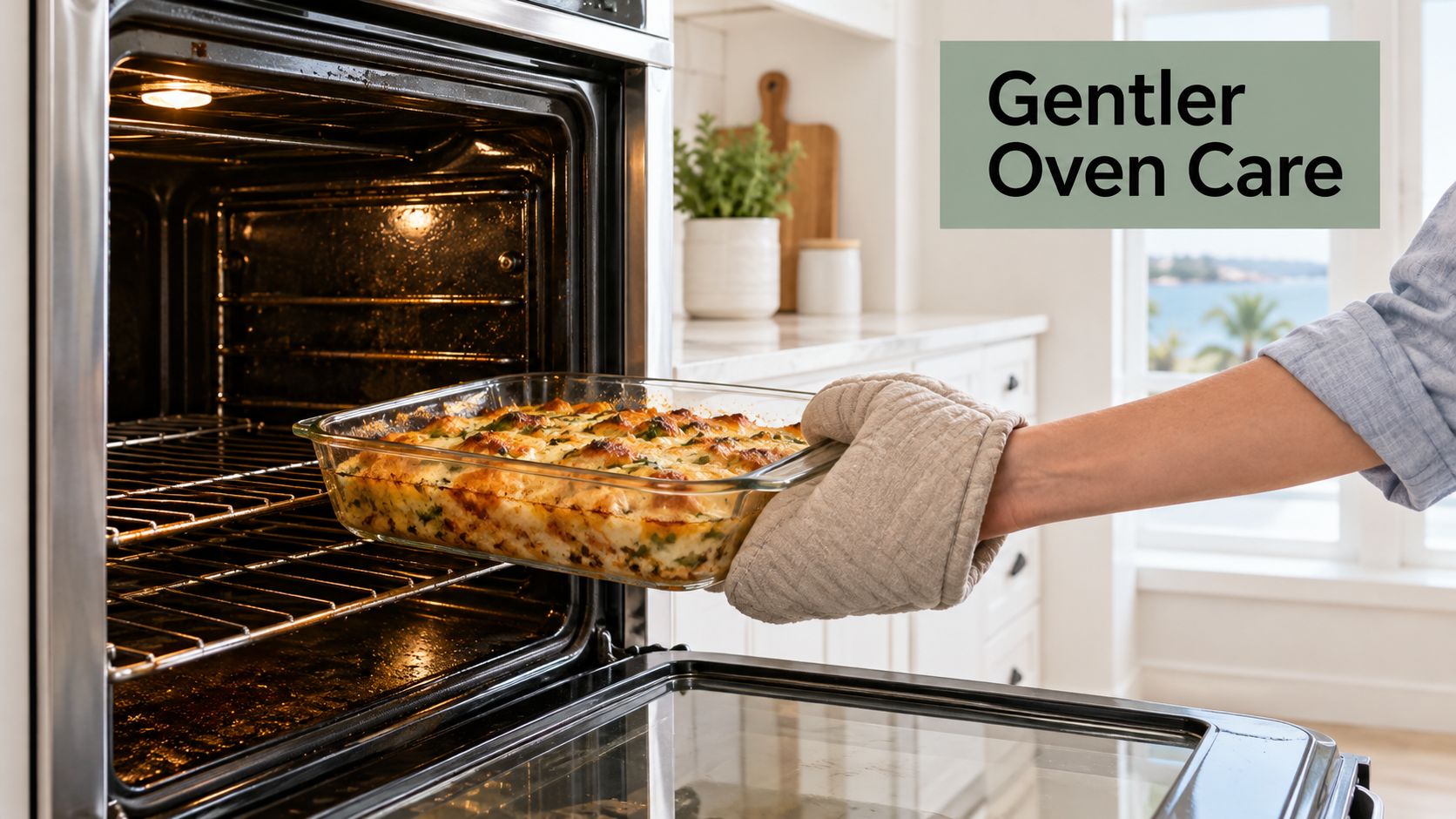
Harsh commercial cleaners can cut grime, but they also bring the kind of fumes you notice immediately in a tight kitchen. For households with kids on the floor, pets underfoot, or a bird in the home, that trade-off matters more than whether the label promises a quick job. A gentler method is often a better fit because it gives you control over the process, the smell, and the surfaces you're touching.
For a broader kitchen repair mindset, a homeowner can also pair oven care with guidance like kitchen appliance fixes when a stubborn appliance problem is bigger than a wipe-down. The point isn't to baby the oven. It's to choose the least aggressive method that still matches the soil in front of you.
Practical rule: if the residue is old, baked on, and spread across enamel or glass, patience usually beats stronger spray.
Prep the Oven Before Anything Touches It
A safe oven cleaning starts before any paste or steam shows up. Turn the oven off, let it cool completely, and keep cold water away from warm glass or enamel. That matters because thermal shock can crack surfaces, and the safer approach in every kitchen is to work on a cool appliance only.
Clear the cavity and identify the surface
Pull out the racks, trays, probes, and anything else the manual says to remove. Then clear loose crumbs with a dry cloth or a plastic scraper, not a metal tool. The U.S. Geological Survey based temperature and safety guidance isn't the issue here, the issue is simple appliance protection, and the University of Illinois Extension advises following the manufacturer's instructions and avoiding oven cleaner on self-cleaning models because it can damage the surface (University of Illinois Extension cleaning and sanitizing guidance).
A quick surface check helps too. Porcelain enamel, self-cleaning liners, catalytic panels, and continuous-cleaning finishes don't all behave the same way, so the product that's fine for one oven may be wrong for another. Keep liquid away from fans, vents, light covers, heating elements, door seals, and electronic controls.
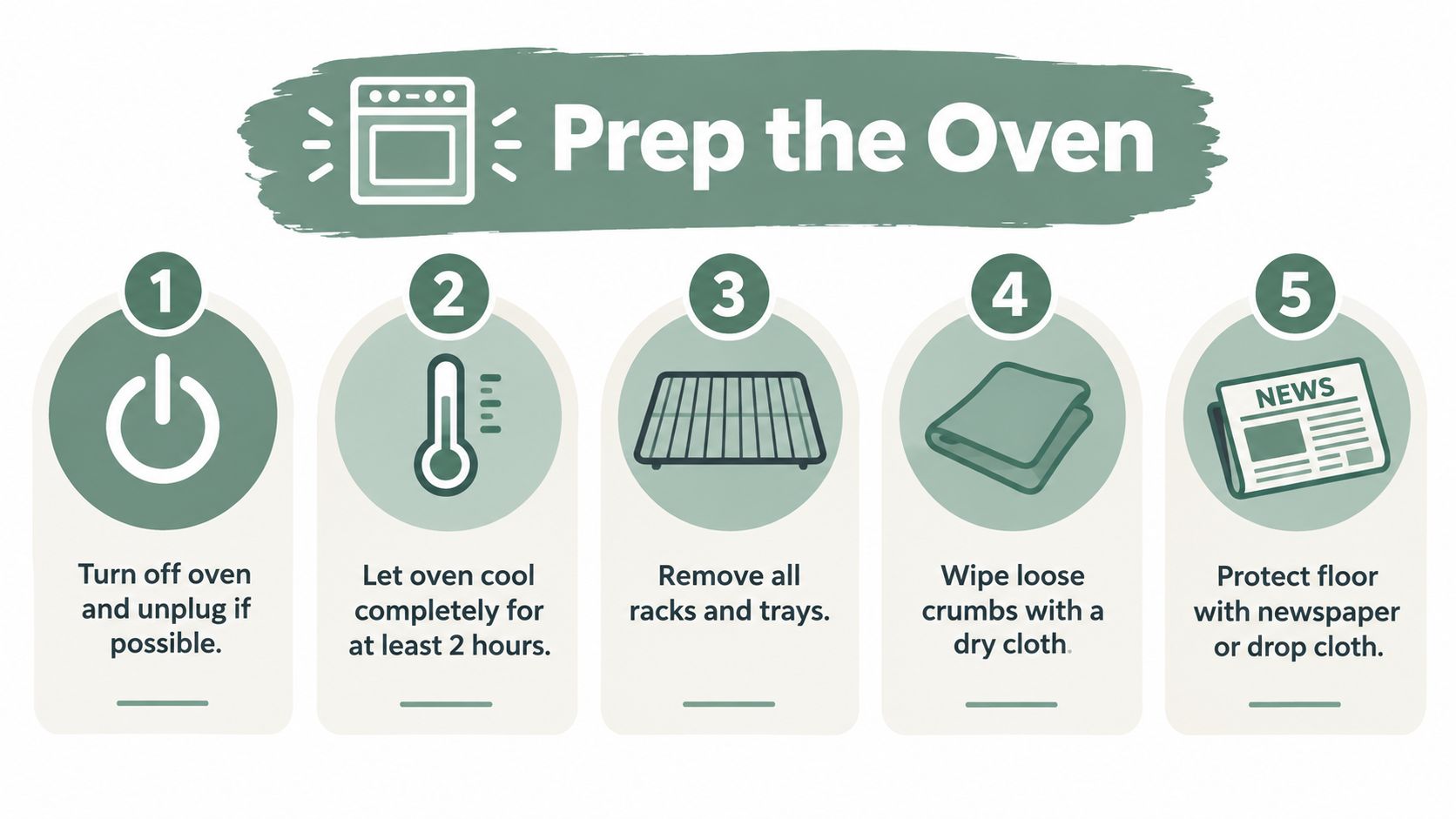
Remove loose debris first, because every leftover crumb becomes harder to lift once moisture or paste reaches it.
Bird owners need one more layer of caution. Manufacturer guidance treats fumes from self-cleaning cycles as a serious concern for birds, so the safest cleaning routine is the one that keeps the air as calm as possible. That means a cool oven, open ventilation, and no aggressive shortcuts near sensitive components.
The Overnight Baking Soda Paste Method
This is the workhorse method when you want the least drama and the most control. In a humid kitchen, baked-on grease often holds onto moisture, and beach-sand residue can turn a quick wipe into a gritty mess. Baking soda is mildly alkaline, and the EPA-backed low-fume approach is straightforward, remove loose debris, cover the dirty surfaces with baking soda, mist with water until damp, and give it enough contact time to soften the grime (EPA green cleaning brochure). What softens the grime is time, not pressure.
Mix, spread, wait
Stir baking soda with a small splash of water until it becomes a thick paste, not a runny slurry. Spread it across the cool floor and interior walls of the oven, avoiding heating elements, gas ports, fans, light fixtures, seals, and control panels. Mist the layer lightly so it stays damp, then leave it overnight.
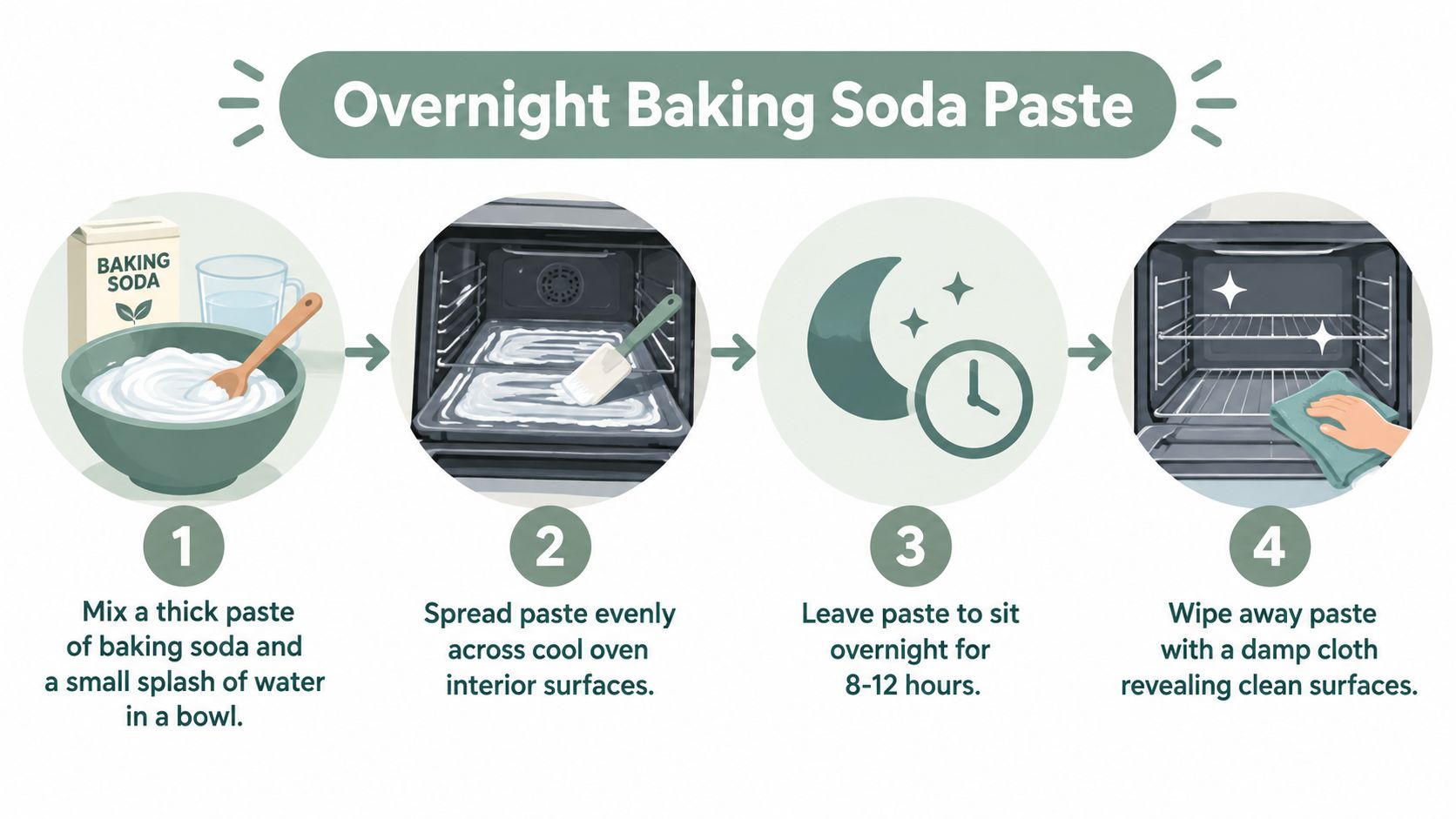
Re-mist it if the paste dries out. That is the part many recipes skip, and it is the part that keeps the residue soft instead of turning it back into a dusty crust. Once the paste has sat long enough, scoop off the loosened material and wipe with a damp microfiber cloth or other nonabrasive cloth.
Rinse more than once
Expect several passes with fresh damp cloths until no powdery residue remains. If a clean white cloth comes back gray or chalky, keep wiping. That transfer check is more reliable than guessing by touch.
For stubborn carbonized areas, repeat the dwell instead of scrubbing harder. A soft approach protects the finish, especially on coated interiors and glass. New Mexico State University's guidance also treats baking soda as a mild household alkali that can safely clean surfaces such as porcelain enamel, which is why this paste method fits many ovens well (EPA document with New Mexico State University reference).
Let the paste do the work; the clock is your scrub brush.
Vinegar, Lemon, and Steam as Smart Finishing Moves
The useful way to think about vinegar, lemon, and steam is not as interchangeable miracle cleaners. They each do one job well when used at the right moment. Vinegar helps with leftover alkaline film, lemon can freshen light residue, and steam softens grime without adding more chemicals.
Compare the finishing options
| Finishing Method Compared | Best For | How To Use | Watch Out For |
|---|---|---|---|
| Vinegar | Leftover alkaline film after paste removal | Wipe lightly with diluted vinegar on a cloth, then rinse | Don't treat it like a disinfectant, and don't mix it in the same bottle with baking soda |
| Lemon | Light residue and a fresher smell | Use diluted lemon juice on a cloth after the main wipe | It's gentler and less acidic than white vinegar, so don't expect it to replace scrubbing |
| Steam | Softening grease and dried food before wiping | Place about 1 cup of water in an oven-safe dish, heat around 450°F (232°C) for roughly 20 to 60 minutes, then let the oven cool completely before wiping | Steam can burn, and hot glass or enamel can crack if you rush it |
Steam has its place, especially for a quick softening pass before a cloth or non-scratch pad takes over. The practical rhythm is heat, cool, then wipe. Abt's steam-cleaning guidance makes that sequence clear, and it also warns against pouring cold liquid onto a hot cavity because thermal shock can damage the oven (Abt steam cleaning guide).
Do not use vinegar, lemon, or steam as a shortcut inside the oven's self-clean or steam-clean program. Manufacturer manuals prohibit bleach, ammonia, and oven cleaner in those cycles, and they also warn against wetting parts that aren't meant to be soaked (NFM use and care guide). The safest move is still to keep the method separate from any active cleaning cycle.
Stain-Specific Tactics for Stubborn Spots
Some oven messes need a different touch. A sugary spill behaves differently from baked-on grease, and racks don't clean the same way as glass. Matching the method to the mess saves time and keeps you from making a small stain harder to remove.
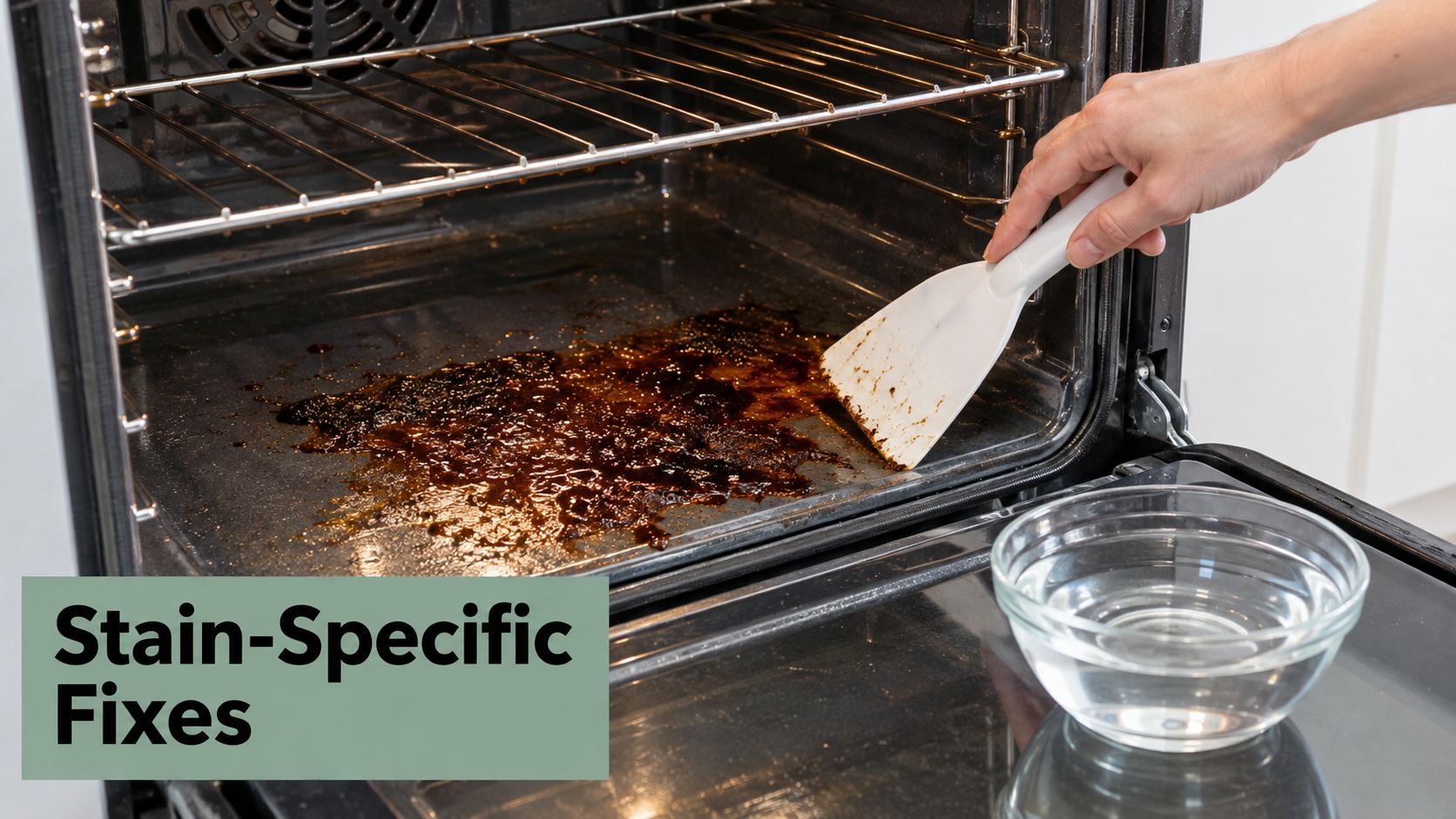
Use the right tool for each mess
- Sugary spills: Warm water and a plastic scraper work before the spill turns fully carbonized. The mistake is waiting until the sugar has baked into a hard shell.
- Baked-on grease: A longer baking-soda dwell and a damp nonabrasive pad usually outperform hard scrubbing. Steel wool can damage enamel and glass.
- Glass door haze: A baking-soda paste on a soft cloth lifts film, but it needs thorough rinsing or the door will streak.
- Racks: Remove them and soak them separately in hot soapy water or a baking-soda bath in the bathtub, then scrub with a nylon brush.
- Drip pans and broiler drawers: Treat them as separate pieces. They catch the worst residue and often need the paste to sit longer than the main cavity.
A useful overview for the rest of the kitchen is a deep cleaning kitchen checklist, especially when the oven is only one stop in a bigger reset. That's how pros keep a job efficient, one surface at a time, with the right tool for each.
If you use a plastic scraper, keep it gentle and angled low. If you soak racks, let the water do the work first. The common mistake across all five messes is reaching for more pressure when the better answer is more time.
Safety Trade-Offs Most Natural Cleaning Guides Miss
A lot of natural-cleaning advice acts like “non-toxic” automatically means low-risk. It doesn't. The safer choice depends on the oven, the room, and the people and pets living there.
Three cleaning paths, three different risks
Caustic commercial oven cleaners are hard on hands, eyes, and lungs. Poison Control notes that these products can cause irritation or severe burns, and inhalation may lead to coughing, chest pain, or shortness of breath (Poison Control oven cleaner safety). That's one reason many homeowners in Gulf Shores and Orange Beach prefer a manual routine instead.
Self-clean cycles carry their own downside. Burning grease and food residue creates smoke and fumes, so the oven is still part of the air-quality problem even when no bottle is used. Birds are especially vulnerable, and people with asthma or other respiratory conditions may be more at risk, so this isn't a casual trade-off.
If you have birds in the house, or the kitchen ventilation is weak, keep the cleaning method simple and cool.
Households with birds, young kids, poor ventilation, or respiratory sensitivity usually do better with a manual baking-soda routine. Self-cleaning should only happen after you check the manual, remove loose debris, and ventilate the room. Don't use commercial oven cleaner before a self-clean cycle, because heated residue can release fumes and damage interior coatings. GE Appliances also warns that repeated chemical cleaner use on a self-cleaning liner can etch and discolor it over time, which can reduce how well the cycle works (GE Appliances oven care guidance).
For a quick reference on materials that leave streaks or damage surfaces, clean stainless steel appliances without streaks is a useful companion read because the same wipe-down discipline keeps nearby finishes from looking neglected while the oven is off-line.
A Realistic Maintenance Rhythm and When to Call Sweet Home Cleaning Service
Most busy Eastern Shore households don't need a marathon oven clean every week. A quick wipe after sticky spills helps a lot, a light pass works well for families who cook often, and a deeper treatment can wait until residue starts to build again. The practical rhythm is simple, stay ahead of the sugar, don't let grease sit, and give the paste method time when it's needed.
When DIY stops making sense
If the door glass is coated in thick carbon, the oven smokes during preheat, the enamel is damaged, or a persistent odor keeps coming back, the job has usually moved beyond routine home care. That's when a professional deep cleaning is the better call, especially for rental turnovers in Gulf Shores and Orange Beach, where the next guest notices every detail.
For Fairhope, Daphne, and Spanish Fort families, a recurring maid service can keep the kitchen from getting to that point in the first place. A simple house cleaning schedule helps distribute the work, and it fits the same maintenance logic you'd use for floors, counters, and the oven door.
If you're comparing service providers for a broader home reset, it helps to check HomeProBadge's cleaner ratings with a critical eye and focus on the services that match your home's needs, not the loudest marketing. For many households, the smart move is to stop trying to muscle through a damaged or overly soiled oven and let a deep-clean team take it from there. Sweet Home Cleaning Service handles that kind of detail work for homeowners who'd rather spend their weekend at the beach, not scrubbing baked-on grease.
If your oven needs more than a quick wipe and you want a cleaner that fits the way homes really live in Fairhope, Daphne, Spanish Fort, Gulf Shores, and Orange Beach, reach out to Sweet Home Cleaning Service. They offer deep cleaning and recurring maid service that can support the kitchen care you're already trying to keep up with, and you can visit Sweet Home Cleaning Service to request a free quote and get the help scheduled.

Let us handle the cleaning. Enjoy your home.


Sweet Home Cleaning Service
19940 State HWY 181, Suite E Fairhope, AL 36532
Phone: (251) 586-4081
sales@sweethomecleaningservice.com