What Is Move Out Cleaning: Scope, Order, and Timeline

What separates a move out clean from weekly cleaning? Move out cleaning is a one-time, top-to-bottom clean performed when a resident leaves, so the home is ready for a landlord, buyer, property manager, or next occupant. It often lands between leases, when a unit must pass inspection before the next tenant.
An empty house can look halfway done. The boxes are gone, so the hard part must be over, right? Furniture hid the baseboards, closet floors, and range hood grease. Gulf Coast humidity and beach sand add a layer a quick wipe misses. A handover clean needs a record: rooms checked, trouble spots photographed, repairs separated from cleaning. That record matters under Alabama deposit rules and a landlord's walkthrough.
Sweet Home Cleaning Service is a house cleaning and maid service based in Fairhope. It handles turnovers for homeowners and renters across Fairhope, Daphne, Spanish Fort, Gulf Shores, and Orange Beach. The work is a documented handover rather than a prettier weekly tidy.
Table of Contents
- What Move Out Cleaning Means and How It Differs From Routine Cleaning
- Bedrooms, living areas, and the spots people miss
What Move Out Cleaning Means and How It Differs From Routine Cleaning
What separates a move out clean from a routine visit? The empty rooms. Move out cleaning prepares a home for a landlord, buyer, property manager, or next occupant once the furniture is gone and every edge is visible. The standard is a documented handover, because deposit decisions depend on what a landlord can see and what you can show.
A routine clean is upkeep. A move out clean is a handover with a paper trail: room-by-room scope, before-and-after photos, and a clear list of what cleaning can fix and what needs a repair. That difference changes the hours and the checklist. A weekly service dusts shelves and mops floors. A turnover pulls the fridge, cleans cabinet interiors, washes baseboards and doors, and takes down the exhaust fan cover. It also reaches the grit in window tracks and the film on glass, spots that are easy to skip when a sofa hides them. On the Gulf Coast, sand works into door tracks and humid air leaves a stale smell in closets, so those areas get checked, not just wiped.
Confusion starts at the line between cleaning and repair. Cleaning removes soil, grease, soap film, and dust. It does not repair a cracked tile, a burned countertop, or soft caulk pulling away from the wall. A good move out clean gets the home to a fair starting point for the walkthrough. It does not hide damage, and it should not try.
That handover standard is why the job is scoped around the lease and the next occupant. Property size, appliance count, pet hair, and the condition of the kitchen change the hours. A small apartment with a clean oven is a shorter job than a family home with a greasy range hood and sand in every slider track. If you are unsure whether you need a deeper clean before the turnover, this comparison of deep cleaning versus regular cleaning explains where the two jobs overlap.
| Area | Routine cleaning | Move out cleaning |
|---|---|---|
| Frequency | Weekly, biweekly, or monthly | One time, when a resident leaves |
| Scope | Visible surfaces and floors | Accumulated residue and hard-to-maintain areas |
| Appliances and cabinets | Outside surfaces wiped | Inside appliances and cabinet interiors included |
| Baseboards, doors, and switches | Quick wipe | Detailed cleaning of edges and high-contact points |
| Bathrooms | Routine clean | Full clean, grout, exhaust fan cover, sanitizing on high-touch points |
| Closets and corners | Tidied | Emptied, cleaned, and checked |
| Purpose | Comfort and upkeep | Handover-ready for a landlord, buyer, or next occupant |
Lease language, property size, and whether you are returning a rental, selling, or prepping for a new resident all change how far that list goes. A move out clean is judged empty, under a landlord's flashlight, and against a written scope. That is the standard to plan for.
What a Move Out Clean Covers in Every Room
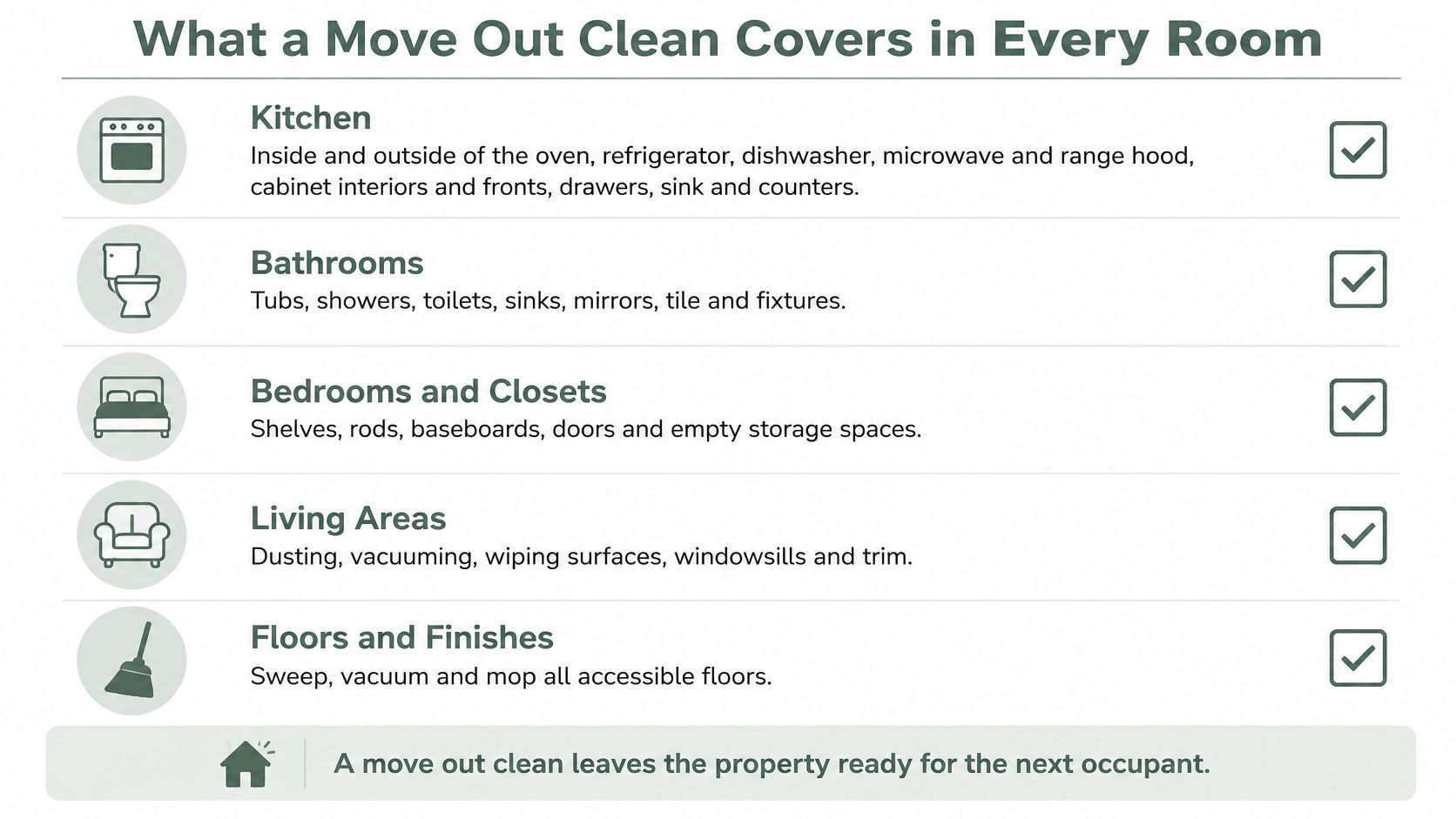
Start in the kitchen, because that is where inspectors linger. Clean the inside and outside of the oven, refrigerator, dishwasher, microwave, and range hood. Empty cabinet interiors and wipe the fronts, including the eye-level doors people touch every day. Pull drawers, scrub the sink, and clear the backsplash of grease film. A fridge that still smells like last month's leftovers will undo a spotless counter.
Bathrooms come next, and humidity makes them stricter here than in a dry climate. Scrub the tub, shower walls, and doors. Clean the toilet, the vanity, and the cabinet under the sink, where bottles leave rings. Work the grout lines, polish the mirror, and take down the exhaust fan cover so dust does not sit in the grille. Soap film on glass is a cleaning job. Soft, spreading growth behind the caulk is a report, not a cover-up.
Bedrooms, living areas, and the spots people miss
In bedrooms and living rooms, empty closet shelves and rods, then wipe them. Doors and frames, baseboards, switch plates, ceiling fan blades, windowsills, and tracks all collect a gray line you only see once the bed is gone. Dust and wipe vents and registers so they do not puff settled dust back into the room when the system runs. Vacuum edges and the accessible floor under furniture, then mop last so you are not grinding grit into a wet floor.
Entry areas need a closer pass on the coast. Beach sand from Gulf Shores and Orange Beach weekends collects along thresholds, inside entry mats, and in corners. Wipe door handles and glass doors, and check the track where the slider meets the floor.
Missed at inspection: cabinet fronts at eye level, light fixtures, the tops of door frames, and the inside of windows. Those four fail walkthroughs more often than the middle of a floor.
Turn the list into a room-by-room sheet. Write the room, the items above, and a blank for "still needed" before keys go back. Landlords and property managers can use that same sheet at the final walkthrough and tick each line, so the handover is judged against a known standard instead of a memory of how the place looked on moving day.
How to Sequence a Move Out Clean From Dust to Disinfection
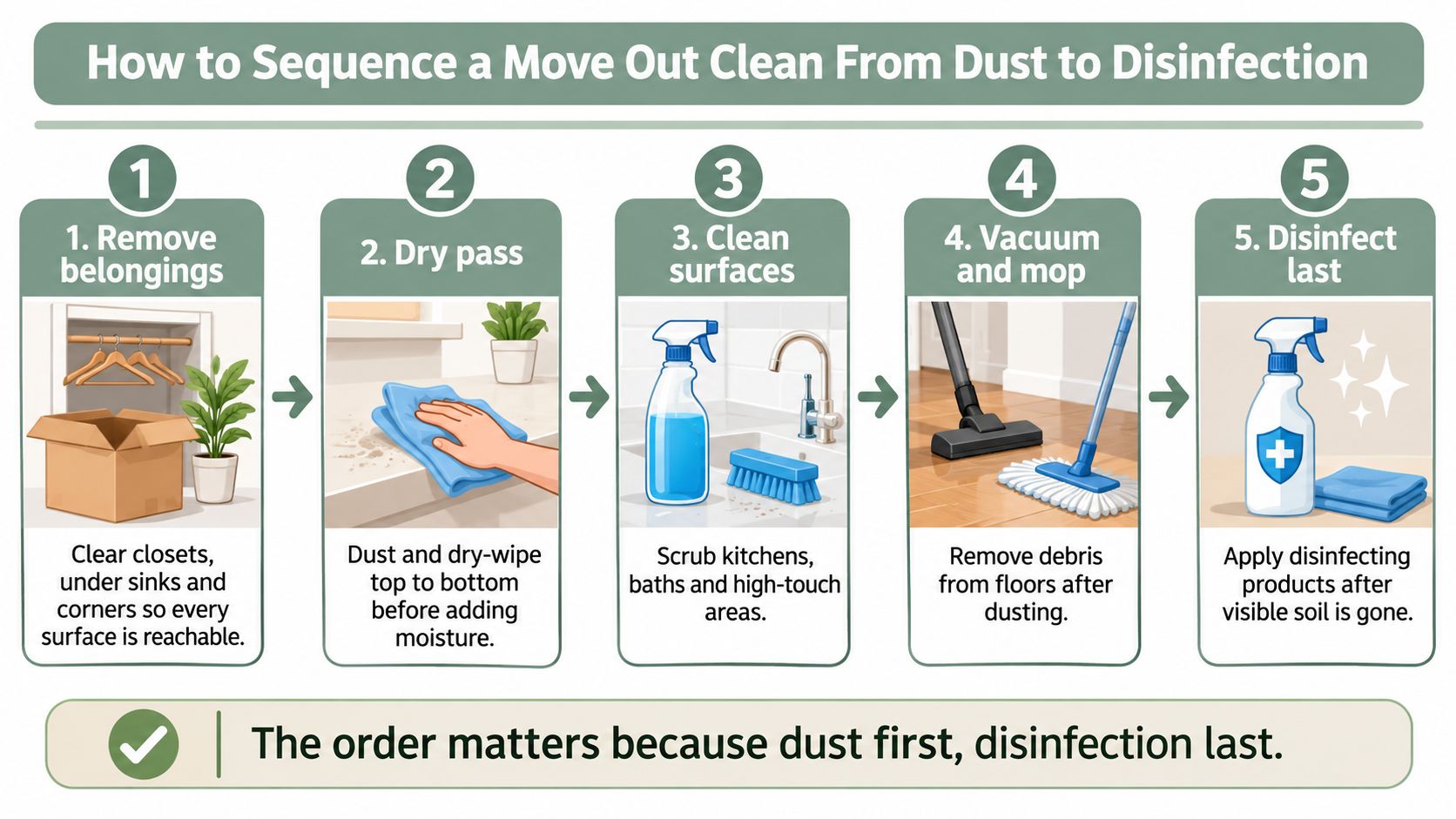
Order is what makes the clean hold up. Washing a dusty baseboard first turns loose soil into a mud smear you then have to remove twice. The CDC's cleaning, sanitizing, and disinfecting guidance is clear that cleaning physically removes dirt, organic matter, and most germs, and that this step has to come before sanitizing or disinfecting because soil weakens antimicrobial chemicals.
- Remove belongings. Clear closets, the space under sinks, and corners so every surface can be reached. Cleaning around a last box hides the shelf the inspector will open.
- Run a dry pass from top to bottom. Dust or vacuum ceilings, corners, vents, ledges, baseboards, and cabinet tops. Loose dust becomes a paste the moment it gets wet. A separate pass on how to dust is worth reading before you start that dry work.
- Clean appliance and cabinet interiors. Racks, shelves, and drawer boxes come out. Wipe, then put them back only after they are dry.
- Wash surfaces with detergent and water. Match the product to the material: painted walls, natural stone, finished wood, stainless steel, glass, laminate, and resilient flooring. A harsh cleaner on stone or a wood finish can create damage that looks like neglect.
- Disinfect only the high-touch points. Doorknobs, light switches, faucets, toilet controls, and appliance handles. Use an EPA-registered product and follow the label, including the wet contact time. Do not wipe it off the second it looks wet.
- Clean floors last. Hard floors get swept or vacuumed, then mopped. Carpet and upholstery need textile-compatible methods, not a flood of disinfectant.
- Walk the checklist. Note any spot to revisit before you call the job finished.
When bleach is the disinfectant
For ordinary turnover, detergent and water is the control step. CDC guidance indicates disinfection is usually unnecessary unless someone is ill or medically vulnerable. Disinfecting a dirty surface wastes product, can mark finishes, and invites a false claim that the home was sterilized.
If you do use bleach, the CDC bleach guidance specifies ordinary unscented household bleach with about 5% to 9% sodium hypochlorite. If the label gives no contact time, keep the surface visibly wet for at least one minute. Ventilate the room. Never mix bleach with ammonia, acids, or other cleaners, because hazardous vapors can form.
A room-by-room checklist that records soil removal, interiors, floor edges, fixtures, and a final look for odor or residue turns the chore into a handover you can defend.
Dust, Humidity and the Limits of Cleaning on the Gulf Coast
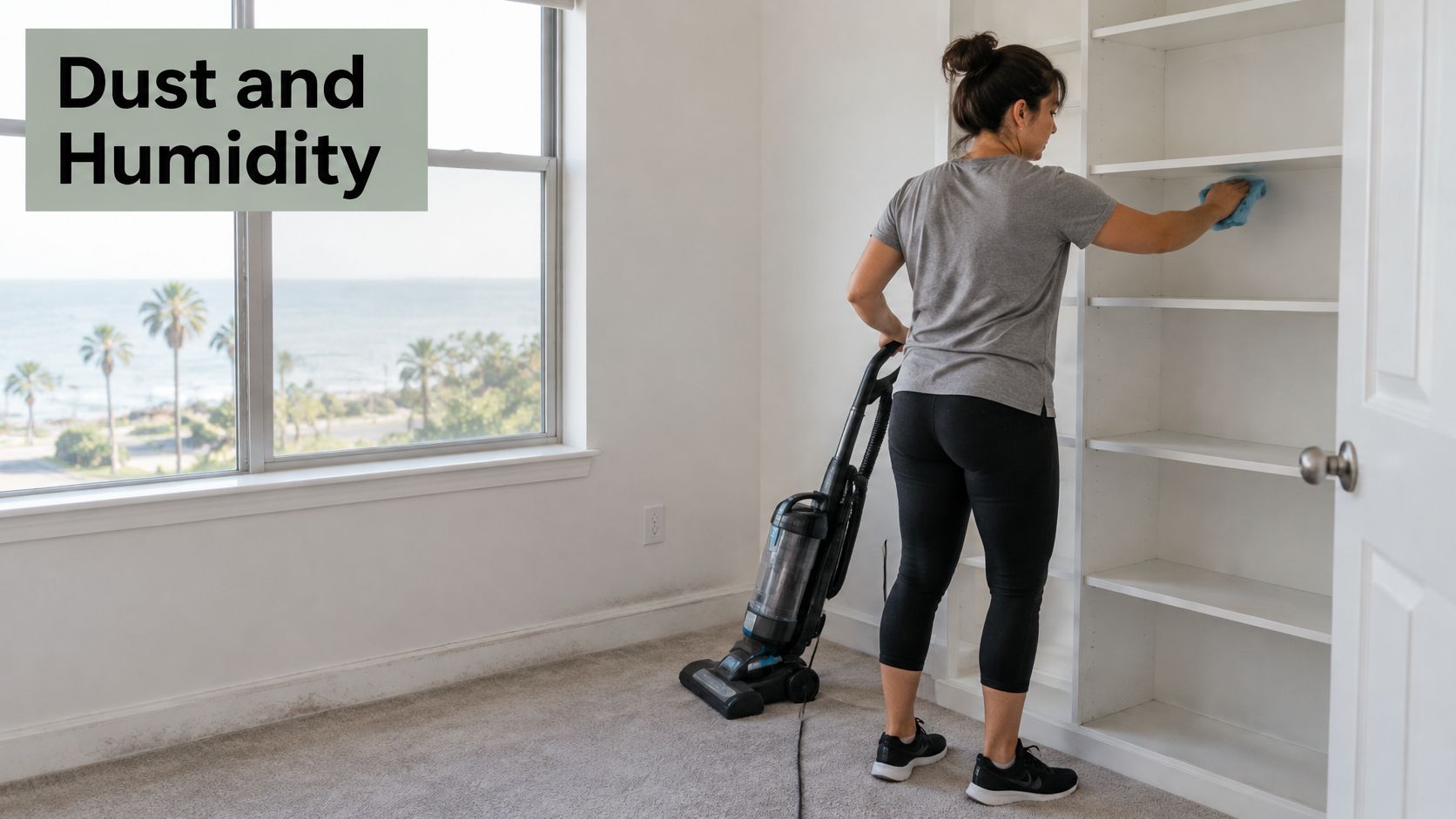
Stronger chemicals are not automatically a better clean. The EPA's guide to indoor air quality treats dust, pollen, pet dander, mold spores, and dust mites as indoor particulate contaminants, and it points to damp dusting, regular vacuuming, ventilation, and, where it fits, HEPA filtration. Source removal and ventilation are the most effective starting points. A heavier bottle does not replace either one.
Vacuuming can temporarily stir fine particles back into the air. If someone in the household is sensitive, they should be out of the home during that work, or the machine should use high-efficiency filtration. Damp cloths keep settled dust from taking off again. That is ordinary turnover care, not a promise that every biological particle is gone.
Humidity as a handover item
The EPA's guidance on biological pollutants recommends keeping indoor relative humidity below 60%, with an ideal target of 30% to 50%, because moisture control helps limit mold growth. Humid months in Fairhope, Daphne, Spanish Fort, Gulf Shores, and Orange Beach make that threshold part of the handover, not a footnote.
Standing water, water-damaged materials, and wet surfaces can support mold, mildew, bacteria, and insects. Check bathroom exhaust fans, the cabinet under each sink, window condensation, and HVAC-related moisture. Report water damage in writing. Do not wipe it and hope the next person misses it. A surface clean improves what you can see. It does not correct a leak or replace remediation when mold is growing in materials.
| Condition | Cleaning handles it | Needs repair or specialist |
|---|---|---|
| Settled dust on surfaces and vents | Yes, damp dusting and vacuuming | No |
| Pet hair and dander | Yes, vacuuming and damp wiping | No |
| Soap film, grease, and buildup | Yes, detergent and water | No |
| Surface mildew on grout or caulk | Yes, cleaning, then fix the moisture source | Yes, if it returns or spreads |
| Mold growing in walls or materials | No | Yes, specialist remediation |
| Standing water, leaks, or water-damaged materials | No | Yes, repair and report in writing |
| Set-in carpet stains | Partly, with textile-compatible cleaning | Replacement may be needed |
| Scuffed or damaged paint | Light scuffs only | Yes, touch-up or repainting |
Spring pollen on windowsills and sand in the entry are cleaning. A soft wall, a musty closet that stays wet, or a stain that has set into the pad under the carpet is not. Sort the house with that table before you spend a day on the wrong job.
A Move Out Cleaning Timeline From Notice to Keys
The cleaning itself often fits in one day. The decisions that make that day work start weeks earlier. Book after the date is real, and schedule the crew only once the rooms are empty.
| When | Task | Who handles it |
|---|---|---|
| 3 to 4 weeks before | Read lease or listing move-out terms, confirm the move-out date, and book the cleaning | Tenant or homeowner |
| 1 to 2 weeks before | Declutter, plan movers, confirm utilities stay on | Tenant or homeowner |
| Day before | Clear closets, drawers, and corners, confirm key and access handoff | Tenant |
| Move-out day, after belongings leave | Cleaning completed, then photos and final walkthrough | Cleaner and tenant |
| Before keys are returned | Written checklist reviewed and forwarding address sent | Tenant |
Two timing mistakes that create rework
Booking while movers are still working. Closets stay blocked, floors get walked on after they are mopped, and the cleaner cannot reach the edges a walkthrough will catch. Wait until the truck is gone.
Scheduling the clean after the final walkthrough. Problems show up when there is no time left to fix them. Put the cleaning after belongings leave and before that walkthrough, then photograph each room in the same pass.
Vacation rentals in Gulf Shores and Orange Beach often have a short window between guests. The same order still applies, just with tighter dates: empty, clean, photos, then the next check-in. Ask the cleaner for a completion checklist so the timeline ends with a written result, not a verbal "we're done."
Utilities need to stay on through the clean. A crew cannot see streaks, run a vacuum, or rinse a sink in a dark house with no water. Confirm the handoff of keys or a lockbox code the day before, so nobody is standing on the porch while the clock runs.
Documenting Your Clean to Protect Your Deposit
Photos and paper do more for a deposit than a second bottle of cleaner. Shoot every room before and after, with the date visible. Open the oven, the fridge, the closets, and the cabinet under the sink in those frames. Review the lease move-out terms before you start, and ask the landlord for itemized expectations in writing. Keep the cleaning receipt. If you find moisture or water damage, report it in writing instead of leaving it for someone else to discover.
A thorough clean does not guarantee a refund. The right scope also changes with the job: a rental return, a sale, a short-term rental reset, or a handover after repairs. Cleaning removes dust, grease, soap film, pet hair, and surface residue. Repainting, carpet replacement, structural damage, mold remediation, pest treatment, and hauling abandoned property are separate responsibilities.
What Alabama law actually times
Under Alabama's security deposit statute, a landlord's security deposit is limited to no more than one month's periodic rent, except for specified additional risks such as pets, alterations, or increased liability. After the tenancy ends and you return possession, the landlord may apply the deposit to unpaid rent or to damages caused by the tenant's noncompliance. Any amount withheld must be listed in a written, itemized notice.
The landlord generally must mail the refund or that itemized accounting within 60 days after termination and delivery of possession. Give a valid forwarding address in writing. If the landlord misses the required deadline, Alabama law provides for payment of double the original deposit.
- Dated photos: one set before cleaning, one set after, room by room, including interiors.
- The lease: read the move-out clause before you assume a standard is "normal."
- Written expectations: ask what the landlord will inspect, and keep that reply.
- Receipts: save proof the work was done before the keys change hands.
- Moisture notes: report leaks and wet materials in writing, with a photo attached.
This is general information, not legal advice. Confirm current requirements with your landlord or an attorney before you rely on a deadline.
How a Professional Turnover Clean Works and How to Book
The booking question is which job the property needs at handover. Sweet Home Cleaning Service, based in Fairhope, handles move-in and move-out cleaning for homeowners, renters, sellers, and property managers in Fairhope, Daphne, Spanish Fort, Gulf Shores, and Orange Beach. The company also offers post-construction cleaning when a remodel has left dust behind. Move-in and move-out work includes scrubbing every corner and sanitizing bathrooms.
A typical turnover runs in four stages.
- Intake. Send the move-out date, property type, approximate size, and any lease or listing terms. That is enough to separate a standard turnover from a deep clean for a home that has not been cleaned in a while, or from a referral when mold or water damage is present.
- Cleaning. The crew works dry to wet, from ceilings and vents down to floors, then through appliance and cabinet interiors, bathrooms, and high-touch points.
- Checklist. Ask for a room-by-room completion list and compare it with your photos before the walkthrough.
- Handover. Review that list before keys change hands, and keep a copy with your move-out records.
The checklist is your handover document. It records what the clean covered and flags what belongs to a repair or specialist instead.
Carpet cleaning, pressure washing, repairs, and the move itself belong with complementary local businesses. Home organization stays in-house and can be added to a turnover when closets, pantries, and cabinets need sorting rather than a wipe-down. If the property is a condo, house rules and association limits shape what "ready" means, and renting out your condo legally can clarify those constraints before you book. For a closer look at how a local crew approaches the work, see these cleaning company tips.
Sweet Home Cleaning Service also offers standard cleaning, recurring maintenance on weekly, biweekly, or every-three-weeks schedules, deep cleaning, post-construction cleaning, and home organization. If you are in Fairhope or elsewhere on the Eastern Shore and Gulf Coast, send the move-out date and property type, then ask for a free quote. The scope should match the walkthrough, not a generic package name.
Sweet Home Cleaning Service provides move-in and move-out cleaning for homes across Fairhope, Daphne, Spanish Fort, Gulf Shores, and Orange Beach, including the cabinet interiors, bathrooms, and floors a handover checks. If you are leaving a house or resetting a rental, tell us the date and the property type so the scope matches the walkthrough. Request a free quote from Sweet Home Cleaning Service.

Let us handle the cleaning. Enjoy your home.
Sweet Home Cleaning Service
19940 State HWY 181, Suite E Fairhope, AL 36532
Phone: (251) 586-4081
sales@sweethomecleaningservice.com