
Home Organization Help: What It Covers and When to Hire It

The kitchen counter was clear on Saturday. By Wednesday, it's holding school papers, unopened mail, a beach bag, and something nobody remembers putting there. You can wipe around the piles again, but what you need is a place for those items to go.
For homeowners and renters in Fairhope and across Baldwin County, home organization help should make everyday upkeep easier, not create a display that falls apart after a busy morning. Sweet Home Cleaning Service is a house cleaning and maid service based in Fairhope, AL. The useful distinction is between designing a workable household system, something you or a separate professional organizer can do, and cleaning the home around that system.
Table of Contents
- Which Rooms Home Organization Help Covers
- How a Home Organization Session Works
- Why Clutter Costs More Time Than It Looks
- Organizing a Gulf Coast Home Against Humidity and Storms
- Organizing Rentals and Vacation Properties
- When to Organize Yourself and When to Hire Help
- Request a Free Quote for Your Home Reset
Which Rooms Home Organization Help Covers
Organization handles belongings. Cleaning handles soil. Sorting a pantry won't remove sticky residue from its shelves, and wiping those shelves won't tell anyone where the baking supplies belong. Both jobs matter, but they require different decisions.
Home organization help means reviewing what you own, deciding what stays, and assigning practical storage locations. A professional organizer can guide those decisions and design categories and return spots. A cleaning team can then maintain accessible surfaces without guessing whether an important paper belongs in a drawer or the recycling.
Choose the room that interrupts your day
Start with the space that repeatedly slows you down. That might be a closet in an older Fairhope home, a crowded family kitchen in Daphne, or the entry where a Spanish Fort household drops everything after work and school.
Common spaces and what gets organized
| Space | What Gets Organized | Typical Outcome |
|---|---|---|
| Closets | Clothes, shoes, and accessories; seasonal rotation | Faster getting dressed and fewer duplicate items |
| Kitchen and pantry | Cooking zones, snacks, and meal prep supplies | Items grouped by task and less rebuying |
| Bathrooms and linen closets | Toiletries, towels, and backstock | Daily items within reach and backstock sorted |
| Living room and common areas | Remotes, mail, throws, and media items | A clear return spot for everyday items |
| Kids' rooms and playrooms | Toys by category, books, and art supplies | Bins that children can realistically put away |
| Home offices | Paper, cables, and supplies | A simple filing system and a clear work surface |
A room doesn't have to look minimalist to work. A kitchen can hold plenty of equipment if frequently used tools are accessible and occasional-use pieces aren't blocking them. Likewise, a child's broad toy categories may work better than a detailed sorting system that requires an adult to supervise every cleanup.
Match storage to the available space
Measure shelves, drawer interiors, and door clearance before buying containers. A basket that fits a shelf but won't slide out past the door frame isn't useful storage. In compact rooms, home organization ideas for small spaces can help you consider existing cabinets and vertical space before adding furniture.
Be cautious about relocating clutter into another room just to finish the first one. Keep a temporary transfer basket, then deliver its contents to their actual destinations before stopping.
Practical rule: Choose the first room by the inconvenience it causes, not by how impressive the finished photograph might look.
How a Home Organization Session Works
A useful session ends with decisions the household can repeat. The UCLA Center on Everyday Lives of Families overview provides context for treating household possessions and their arrangement as an everyday maintenance issue rather than decoration.
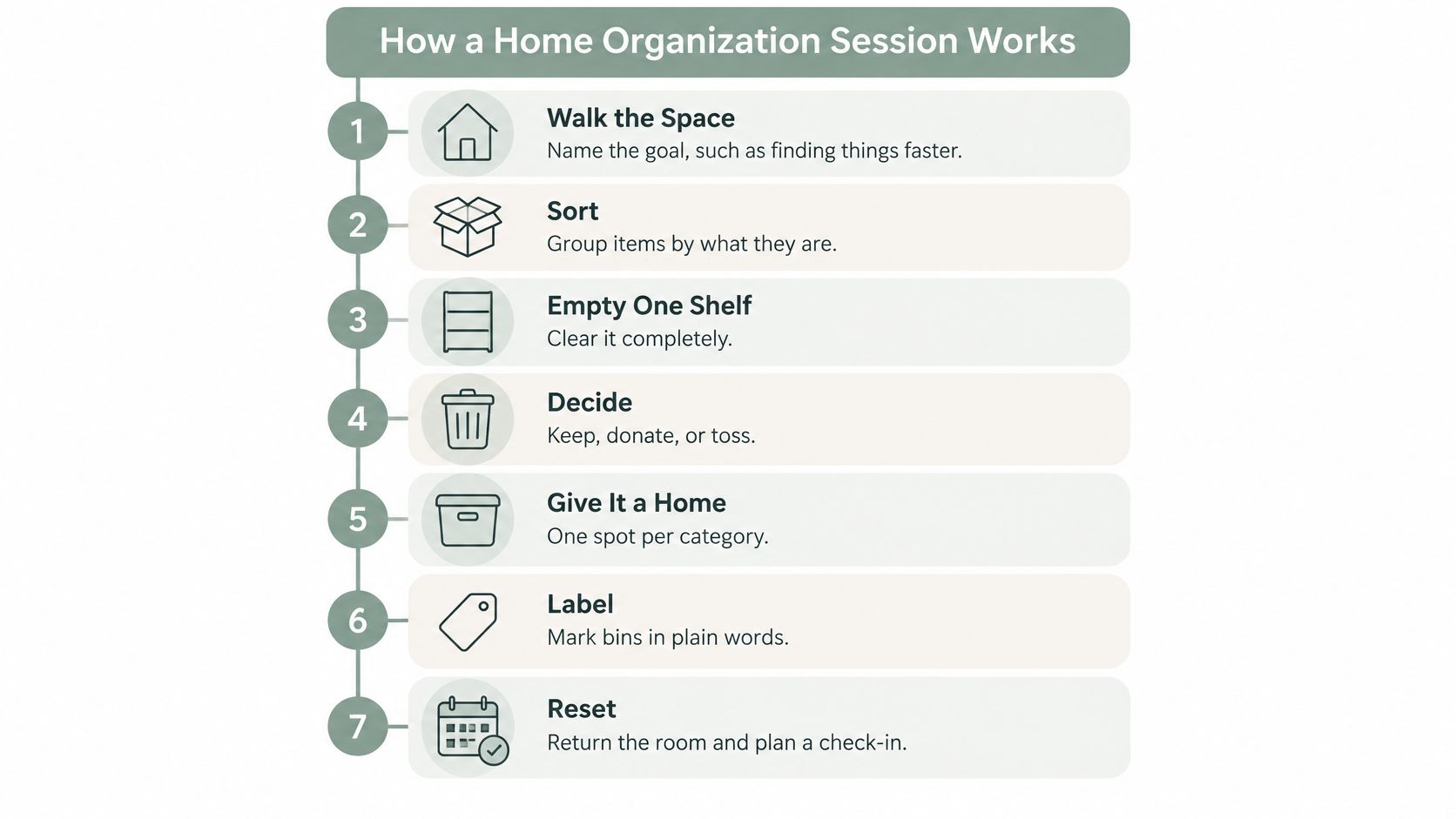
Use the following sequence whether you're working independently or with a professional organizer. Empty only the zone you can finish, not every cabinet in the room.
Follow a decision-first sequence
Walk the space and name the goal. Choose a concrete result, such as finding school supplies without opening unrelated drawers or making room for a new baby's belongings. Starting with sorting before agreeing on the purpose makes every keep-or-remove decision harder.
Sort one zone into keep, donate, and trash. Remove obvious rubbish, unusable duplicates, and expired items first, following appropriate disposal instructions for medicines or hazardous products. The common mistake is creating piles across the floor without leaving enough time to remove them.
Group the keepers by function. Put baking equipment together, gather school supplies, and separate first-aid materials from everyday toiletries. Don't divide categories so finely that putting something away requires a lengthy decision.
Set a container limit and choose its location. Keep daily-use items between waist and eye level where practical, with infrequently used belongings in less accessible zones. Don't buy a larger container automatically when a category overflows; first decide whether everything in it belongs there.
Label after you know the category's volume. Use broad, plain wording such as baking, school supplies, or first aid. Labeling too early leaves you with containers whose names no longer match their contents.
Write the room's reset routine. Specify returning items to assigned zones, clearing work surfaces, and removing belongings that belong elsewhere. Avoid vague directions such as tidy up, which leave each household member interpreting the job differently.
Check the system after a week of ordinary use. Move a container closer to where its contents are used if people consistently leave those items out. Don't treat an unused storage location as a motivation problem before checking whether it's awkward to reach or open.
Finish the zone before expanding
For a room-based checklist to keep beside you, Endless Storage's guide can help you declutter your apartment room by room. Use it to keep the project bounded, rather than adding every unfinished area to today's workload.
A professional session follows the same decision order. An organizer or organizing team can handle much of the physical sorting, but the household still needs to approve what leaves and explain how the space gets used.
A finished drawer has distinct category locations, enough clearance to open and close comfortably, and no mystery pile underneath the dividers. A finished counter has a visible landing spot for incoming items and a clear work area. The result should be understandable without the organizer standing beside it.
Why Clutter Costs More Time Than It Looks
A filing drawer full of loose papers illustrates the problem. The document may be there, but every search requires moving unrelated material and deciding what to inspect next. A household without reliable return locations creates the same repeated work.
The scale of ordinary household labor matters: the U.S. Bureau of Labor Statistics' 2025 American Time Use Survey figures show that people age 15 and older averaged 1.99 hours daily on household activities, including 0.17 hours on household management and 0.33 hours on interior cleaning, with 18.6% performing household management and 23.4% performing interior cleaning on an average day.
Those are population averages, not estimates of time wasted on clutter. They establish that managing and cleaning a home are recurring responsibilities, not occasional projects.

Separate volume from friction
Volume means you have more belongings than the intended storage can reasonably hold. You can improve the arrangement, but you can't make a crowded shelf convenient indefinitely without reducing its contents or changing the storage.
Friction means the process is unnecessarily difficult. A mail tray upstairs won't help someone who opens envelopes at the kitchen counter. A heavy lid may discourage returning a frequently used item even when the container is large enough.
These problems need different fixes. Removing belongings addresses excess volume; moving a return point or simplifying access addresses friction. Buying bins without identifying which problem you have can leave you with the same difficulty in matching containers.
Keep the evidence in perspective
A Motherly summary of UCLA household observations describes a study of 32 middle-class, dual-income Los Angeles households with two or three children, linking women's clutter-related descriptions with stress-related cortisol patterns and declining mood across the day. The evidence is observational, not proof of causation or a promise that organizing produces a medical benefit.
A storage system earns its place when ordinary household members can use it on an ordinary busy day.
The practical target is fewer daily decisions. You shouldn't need to reconsider where the scissors belong every time someone uses them.
Organizing a Gulf Coast Home Against Humidity and Storms
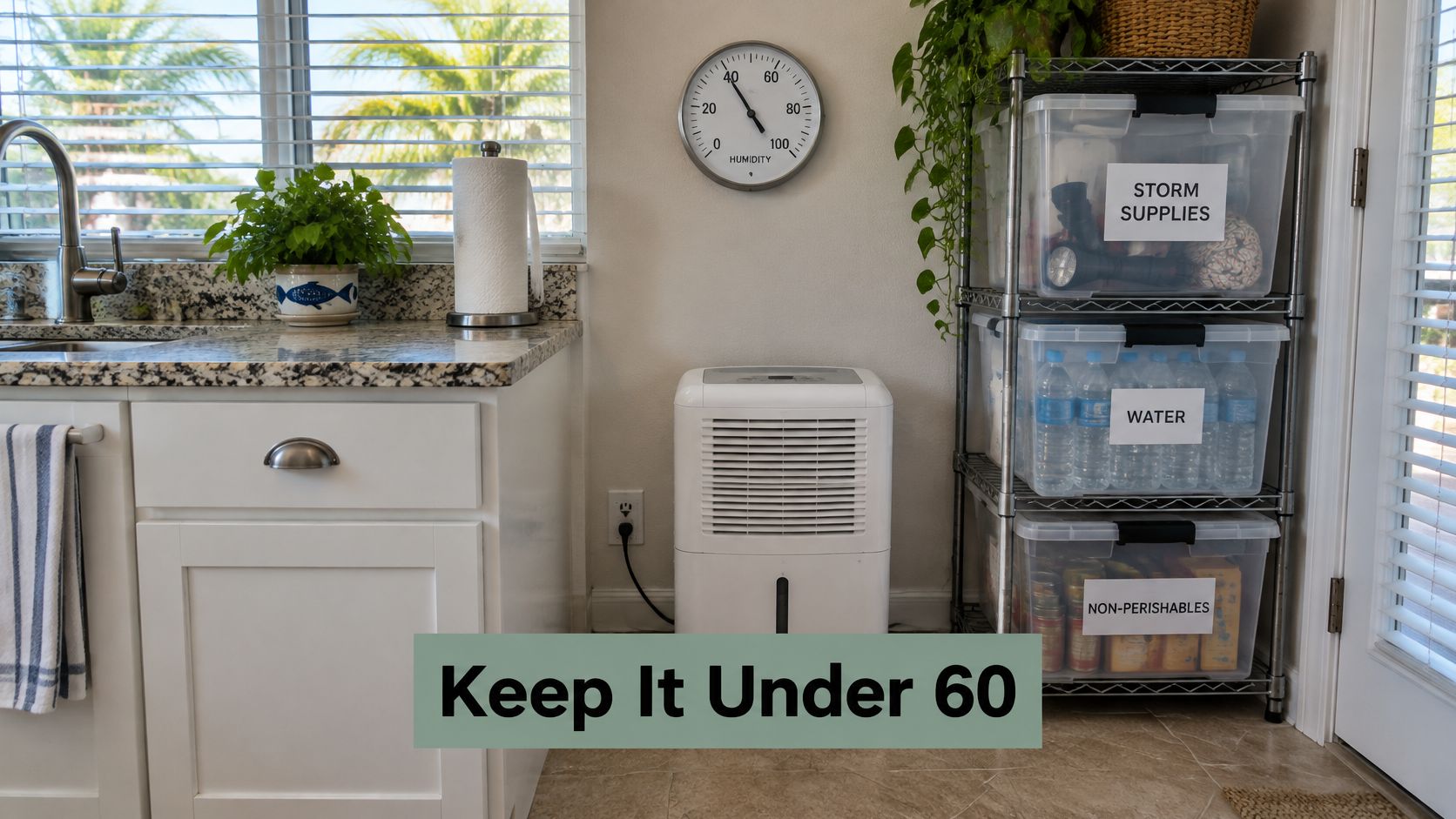
The U.S. Environmental Protection Agency recommends indoor relative humidity below 60%, ideally 30% to 50%. A small humidity meter, typically $10 to $50 according to the EPA's mold and moisture guide](https://www.epa.gov/mold/brief-guide-mold-moisture-and-your-home), lets you check conditions instead of relying on whether a room feels damp.
In Fairhope, Daphne, and Spanish Fort, think about airflow before filling a closet tightly. In Gulf Shores and Orange Beach, give damp beach equipment a drying location before it enters long-term storage. Older Eastern Shore homes and busy family households can face moisture, crowded storage, and tracked-in debris at the same time.
Give stored belongings breathing room
Local organizing risks by area and response
| Area | Common Problem | Organizing Response |
|---|---|---|
| Hall closets and linen storage | Musty smell and mildew on towels and fabrics | Store items on shelves away from exterior walls, use breathable bins for dry fabrics, and check humidity readings |
| Pantry and kitchen cabinets | Stale or damp packaging and pests in dry goods | Move dry goods into sealed containers and rotate stock |
| Garage and entry | Sand, damp shoes, and yard gear | Set a mat, a shoe bin for dry footwear, and a labeled spot for beach and yard gear |
| Storm supply closet | Water damage and loose items in high winds | Keep supplies in labeled bins off the floor and check them before the season starts on June 1 |
Don't close damp towels or shoes inside a storage bin. Dry them first, and investigate persistent dampness rather than trying to hide the smell with a scented product. Cleaning removes surface soil; it doesn't repair a leak or correct excessive indoor moisture.
Choose containers for their purpose, not just their appearance. These home organization product considerations can help you compare accessible bins, labels, and storage options without buying a matching set for every room.
Put storm preparation on the calendar
Atlantic hurricane season runs June 1 through November 30. Use that preparation window to identify where porch belongings will go, label emergency supplies, and keep essential items accessible rather than buried behind seasonal decorations.
Spring pollen and beach sand also deserve an entry routine. Use washable mats and a dedicated gear location, then clean underneath them rather than letting the storage station become another neglected corner.
After a storm, separate ordinary cleaning from water intrusion, structural damage, and hazardous materials. Qualified professionals should handle those conditions before routine household cleanup resumes. Organize with air and moisture in mind, and schedule storm preparation alongside ordinary household resets.
Organizing Rentals and Vacation Properties
Renters need systems they can remove without rebuilding the room. Freestanding bins, suitable over-door racks, and removable visual labels can help, but check door clearance and lease restrictions before installing anything. Photograph and document existing conditions at move-in, especially damaged cabinets, damp walls, and fixtures that don't work properly.
Make access the priority
The 2025 National Renter Survey estimates that 10.2 million U.S. adult renters need accessibility features or live with someone who does; 65.0% of renters needing mobility features and 77.1% needing sensory features lack them, while 43.7% say landlords are typically unwilling to add requested improvements.
Storage capacity isn't always the right goal. A resident may benefit more from less bending, lighter containers, clearer labels, and unobstructed walking paths than from fitting additional belongings into a cabinet.
- Keep daily items reachable: Move frequently used supplies out of deep cabinets and avoid stacking heavy containers.
- Reduce handling: Open baskets or easy-grip containers may be more useful than tightly lidded boxes.
- Report defects in writing: A leaking shower or damp wall needs a maintenance response, not another shelf liner.
Organization can improve access to belongings. It cannot substitute for necessary accessibility features or building repairs.
Build a repeatable guest turnover
Vacation properties in Gulf Shores and Orange Beach need a different approach from an occupied family home. The owner or property manager should establish inventory locations and restocking expectations so the cleaning team isn't making ownership decisions between guests.
Use this turnover order:
- Start laundry and arrange replacement linens and towels. Let machines run while other rooms are restored; dress beds once clean linens are ready.
- Remove trash and dishes, then reset the kitchen. Restore the agreed kitchen layout rather than inventing new cabinet categories.
- Disinfect bathrooms appropriately. Clean visible soil first and follow the product's required contact time.
- Check supplies and designated storage. Restock agreed items and return contents to the owner's documented drawer and closet layout.
- Inspect before guest arrival. Check presentation, missing supplies, and anything that needs the property manager's attention.
A one-bedroom turnover may require approximately 1.5 to 2.5 hours, while larger properties can take four hours or more. Treat those as planning estimates, not promised completion times: laundry capacity, property condition, and the agreed checklist affect the work.
The EPA's guidance on biological pollutants indoors also reinforces why moisture conditions deserve attention in occupied and stored spaces. Flag damp linens, persistent odors, and suspected leaks instead of concealing them during presentation checks.
When to Organize Yourself and When to Hire Help
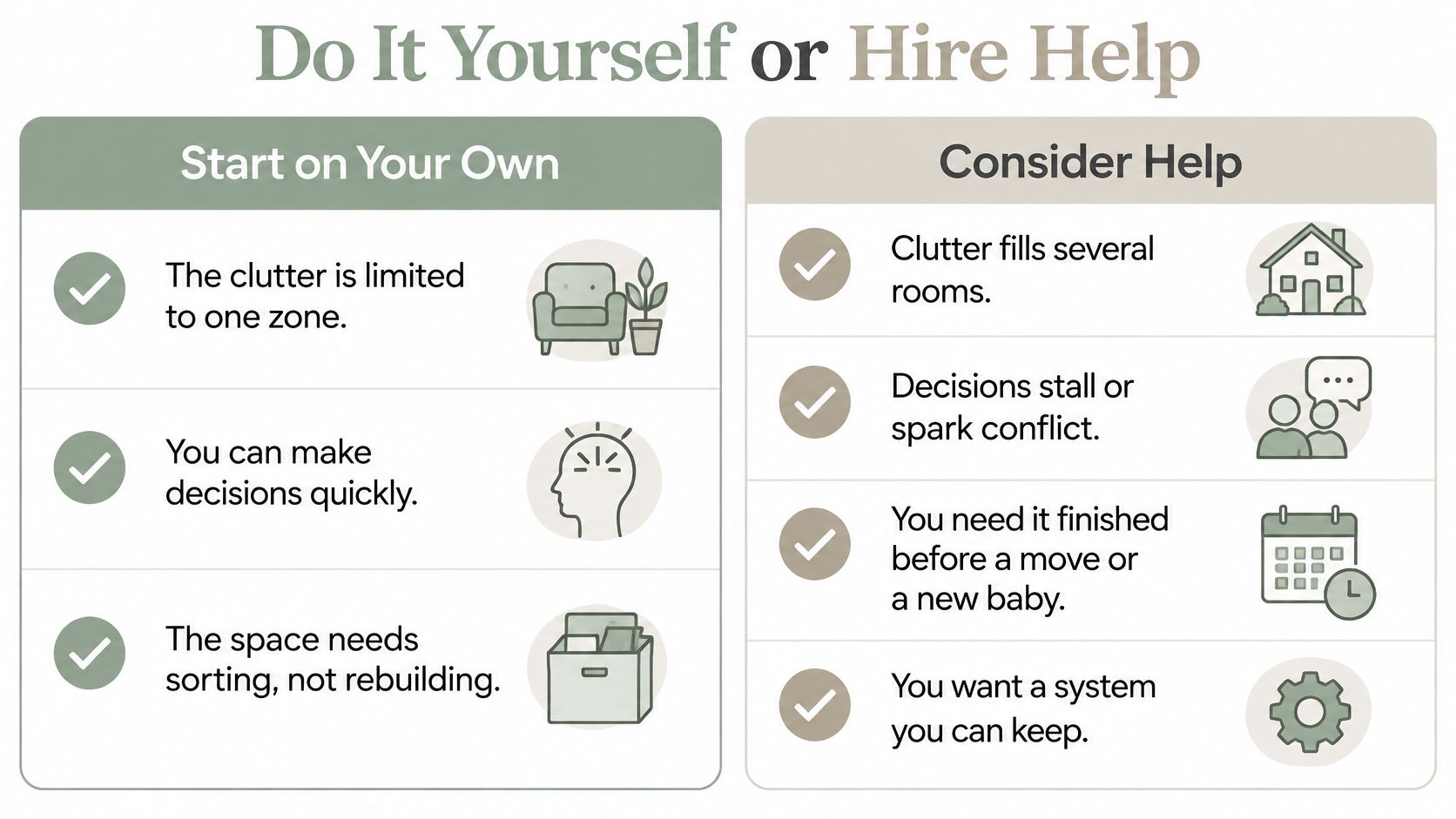
A single drawer or closet is often manageable on your own, especially when you can make decisions and have time to finish the task. Outside help can be useful when clutter has spread across rooms, choices keep stalling, or the household cannot maintain the arrangement. The trade-off is straightforward: DIY lets you work at your own pace, while professional help can provide structure and keep the sorting process moving.
In the 2025 YouGov survey, people identified insufficient storage (46%), too many belongings (41%), difficulty letting go (37%), and lack of motivation (37%) as leading organization challenges. 72% of people with children under 18 said children make organization somewhat or much more difficult.
Choose help for the actual obstacle
Who should start where and when to call a pro
| Situation | Start With | Consider a Professional When |
|---|---|---|
| One closet or drawer needs clearing | Sort, donate, and label it in one afternoon | Decisions keep stalling or the same spot fills up again |
| Whole house overwhelmed after a move or life change | Start with one zone to test the method | You need a room-by-room plan and a schedule to finish |
| Household members do not follow the system | Agree on a few shared return spots | You need a system designed around everyone's routines |
| Disorder returns after each decluttering push | Track which reset habits you keep for two weeks | Organizing needs to be paired with recurring cleaning |
| Limited reach, mobility, or sensory needs | Clear walking paths and move daily items within reach | You want an assessment of which zones need changes |
| Renter who cannot change the space | Use reversible bins, racks, and visual labels | You want a plan that works within lease limits |
For a contained DIY attempt, these ways to declutter your home efficiently can help you keep the task focused. Start with one zone rather than setting a whole-house deadline.
Design for imperfect participation
Agree on a practical reset threshold, such as clearing the dining table before meals, instead of expecting constant tidiness. Assign tasks so everyone knows who handles incoming mail or returns shared supplies. Keep sentimental belongings separate from shared-space decisions, and get permission before discarding another person's possessions.
The easiest system to maintain may be less detailed than the system you'd prefer to look at.
A professional organizer can address the layout and decision process. Sweet Home Cleaning Service offers home organization help that sorts and declutters belongings into keep, donate, and trash piles, then sets up systems designed to last. Organization can also be combined with cleaning for a complete reset.
Consider help when:
- Locations are unclear: Nobody can say where everyday items belong.
- Purchases haven't helped: You've bought bins repeatedly without improving access.
- A transition is approaching: A move or new baby makes completion more urgent.
- Access is difficult: Limited reach or mobility makes ordinary retrieval awkward.
Request a Free Quote for Your Home Reset
A home reset works best when the arrangement fits the household's routines and is practical to maintain. Sweet Home Cleaning Service offers home organization alongside cleaning, so you can ask about sorting and decluttering, setting up systems, and cleaning the space as part of one reset.
Based in Fairhope, Sweet Home Cleaning Service serves Fairhope, Daphne, Spanish Fort, Gulf Shores, Orange Beach, and neighboring communities. Call to discuss whether Home Organization fits your needs and what cleaning could support the next step. During organization, items can be sorted into keep, donate, and trash piles, then arranged so everyday belongings have a home. The team can also recommend basic bins, baskets, and labels.
Match the cleaning to the condition
After a system is in place, standard house cleaning and recurring cleaning help maintain the home. Deep cleaning targets buildup and neglected areas, while move-in/move-out cleaning prepares a home for occupancy or handover. Sweet Home Cleaning Service also offers one-time service and customized cleaning plans, and organization can be combined with cleaning for a complete reset.
The company brings the necessary cleaning supplies and equipment. When requesting a quote, describe the rooms you want organized or cleaned, any areas that need particular attention, and whether you're looking for a one-time visit or recurring upkeep.
- Ask about organization: Explain what feels hardest to manage and call to discuss whether Home Organization is a good fit.
- Confirm coverage: Sweet Home Cleaning Service serves homes and offices within its service area. Contact the company if you're unsure whether your location is covered.
- Set priorities: Identify the spaces that matter most so the proposed work reflects your household's needs.
For a home reset that pairs organizing with cleaning, visit Sweet Home Cleaning Service to request a free quote. Share which spaces need attention and whether you want organization, cleaning, or both.

Let us handle the cleaning. Enjoy your home.


Sweet Home Cleaning Service
19940 State HWY 181, Suite E Fairhope, AL 36532
Phone: (251) 586-4081
sales@sweethomecleaningservice.com