Deep Cleaning vs Regular Cleaning: A Practical Guide

You've wiped the kitchen counters, vacuumed the living room, and picked up the shoes by the door. Then the afternoon light catches the dusty baseboards, and you notice the shower corners still need attention. For a homeowner in Fairhope, that's the deep cleaning vs regular cleaning question: does the house need maintenance, or does it need work that maintenance hasn't reached?
At Sweet Home Cleaning Service, a house cleaning and maid service based in Fairhope, AL, that distinction matters more than a seasonal reminder. Your home's condition, the areas you've been skipping, and Gulf Coast moisture should drive the decision, not a rule that everyone needs the same cleaning calendar.
Table of Contents
Why the Regular vs Deep Cleaning Question Confuses Most Homeowners
Consider a familiar Eastern Shore household: working adults, kids dropping backpacks in the kitchen, and a dog coming home from a beach walk. The floors need attention again, but so do the cabinet edges nobody touched last weekend. Both problems look like “the house needs cleaning,” yet they call for different work.
The confusion starts when homeowners book by the name of the service instead of the condition of the surfaces. A standard visit can keep counters, bathrooms, and floors manageable. It shouldn't turn into cabinet-interior cleaning, detailed trim washing, and heavy shower scrubbing without an agreed scope.
| What you notice | Better starting point |
|---|---|
| Fresh crumbs, footprints, and ordinary bathroom soil | Regular cleaning |
| Sticky trim, layered dust, and stubborn buildup | Deep cleaning |
| Empty rooms before or after a move | Move-in/move-out cleaning |
| Guest departure with an otherwise maintained property | Vacation rental cleaning |
Look past the calendar
A well-maintained Daphne home may need recurring upkeep rather than another whole-house reset. A lightly used Spanish Fort home may still need detailed work if nobody has cleaned the fan blades or window tracks.
The same distinction matters in Gulf Shores and Orange Beach. A vacation rental turnover and a neglected bathroom aren't interchangeable jobs just because both need to be finished before guests arrive.
Practical rule: Book for the dirt you actually have, not the service name that sounds most thorough.
My recommendation is straightforward: assess household use, neglected zones, moisture, and upcoming events before choosing. Regular cleaning handles the work that keeps returning. Deep cleaning tackles the work that keeps getting postponed.
That approach also prevents unnecessary spending. You don't need an intensive reset because guests are coming if the house is already maintained, and you shouldn't expect a routine appointment to erase longstanding buildup.
What Regular Cleaning Actually Covers
Regular cleaning is maintenance with priorities. Start with the surfaces people touch and the rooms people use most, then address ordinary dust and floor soil. The aim is a manageable home between visits, not a detailed examination of every crevice.
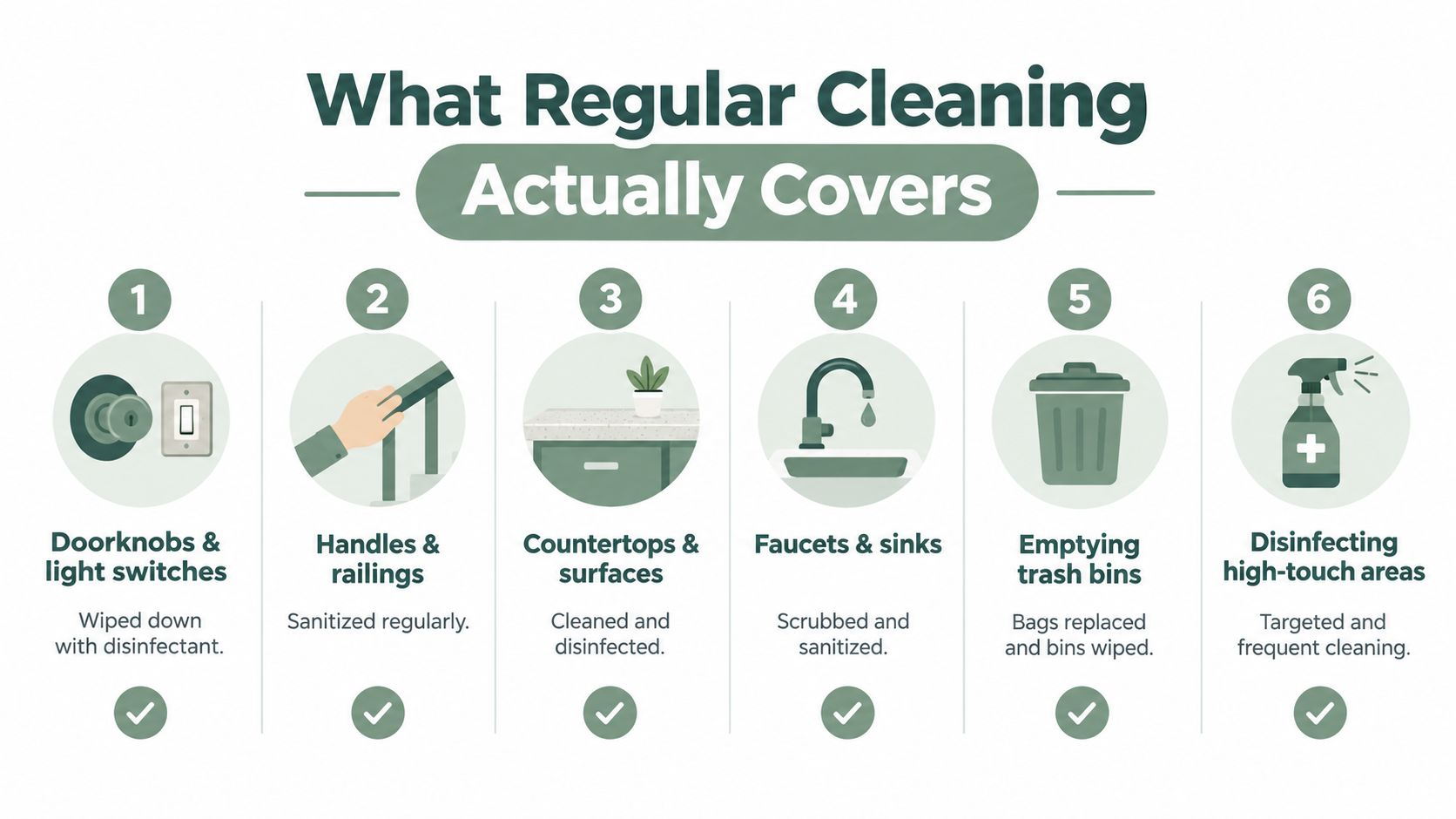
The CDC's household cleaning guidance recommends regularly cleaning high-touch surfaces such as doorknobs, switches, handles, countertops, and faucets, while cleaning other surfaces when they're visibly dirty or need attention. It also distinguishes ordinary cleaning from disinfection, which generally isn't necessary throughout a home unless someone is sick or recently visited while sick.
Agree on the recurring checklist
For a standard house cleaning, ask for a written scope covering:
- Living spaces: Dust accessible surfaces, vacuum, mop suitable floors, and straighten agreed areas.
- Kitchen: Wipe counters, sinks, fixtures, and accessible exterior surfaces.
- Bathrooms: Clean toilets, sinks, mirrors, and agreed shower or tub surfaces.
- Finishing tasks: Empty household trash, make beds if included, and handle light tidying.
Bathroom “sanitizing” shouldn't be a vague promise. Ask what surfaces receive treatment and whether the appointment involves ordinary cleaning or a separate disinfecting step. The infographic's disinfecting labels aren't a reason to apply disinfectant everywhere at every visit.
For weekly, biweekly, monthly, or an agreed every-three-week arrangement, the checklist should remain realistic. Clearing counters before the cleaner arrives gives them access to the surface you're paying to have cleaned.
Routine service also isn't a substitute for small tasks between appointments. Wiping a spill now is better than leaving it for the next visit, and a busy kitchen may need homeowner attention even with reliable recurring maid service.
What Deep Cleaning Actually Covers
A deep clean should change which areas receive attention, not merely how hard someone scrubs the usual counters. It's the appointment for buildup, detailed edges, and accessible places that recurring upkeep hasn't addressed.
Look at the difference between wiping a cabinet front and removing sticky residue around its handle. Likewise, vacuuming an open floor isn't the same job as cleaning an accessible area beneath furniture. Those distinctions should appear in the quote.
| Scope question | Routine approach | Deep-clean discussion |
|---|---|---|
| Trim | Remove ordinary accessible dust | Wash baseboards and door frames |
| Fixtures | Wipe reachable exterior surfaces | Detail fan blades and light fixtures |
| Storage | Clean agreed exterior areas | Discuss empty cabinet and drawer interiors |
| Bathrooms | Remove current surface soil | Address established soap scum and scale |
| Hidden areas | Work around normal furnishings | Identify safely accessible areas underneath or behind |
Define access before the appointment
Ask specifically about window sills, tracks, vent covers, cabinet tops, and behind-appliance work. Don't assume the cleaner will move heavy furniture, disconnect appliances, remove fixtures, or empty storage spaces.
Inside ovens and refrigerators also deserve a separate conversation. A deep-clean label doesn't tell you whether those tasks are included, and emptying an appliance beforehand may be necessary.
Deep cleaning can require more labor than maintenance, but there's no honest universal time multiplier. Surface condition, access, room contents, and the agreed checklist determine the work.
A deep clean should leave less accumulated soil behind. It shouldn't promise to reverse damaged finishes, permanent staining, or unresolved moisture problems.
Cleaning and disinfecting also remain separate operations. The CDC's archived facility guidance explains the sequence of cleaning before disinfection and following product directions, including contact time. It also warns against mixing bleach with other cleaning products and calls for appropriate ventilation and protection.
That's why “stronger chemicals everywhere” isn't a useful definition of deep cleaning. Better-defined detail work is.
Side-by-Side Comparison of Regular and Deep Cleaning
The most useful comparison is what each service lets you cross off your actual household list. Don't choose based on which name sounds more complete. Choose based on whether you're maintaining a satisfactory baseline or correcting areas that aren't at that baseline.
Regular Cleaning vs Deep Cleaning at a Glance
| Criterion | Regular Cleaning | Deep Cleaning |
|---|---|---|
| Scope | Frequently used, accessible surfaces | Agreed detail areas and accumulated grime |
| Frequency | Recurring maintenance schedule | Condition-based reset |
| Time on site | Planned around a repeatable checklist | Estimated from buildup and access |
| Crew size | Assigned to the maintenance workload | Assigned to the agreed scope, not a universal crew count |
| Product use | Products suitable for ordinary surface soil | Products and techniques selected for specific deposits and finishes |
| Ideal triggers | Footprints, crumbs, ordinary dust | Sticky edges, neglected tracks, stubborn residue |
| Typical results | A maintained home ready for everyday use | Detailed areas brought back to a maintainable condition |
Scope matters more than the label. In a Gulf Shores rental, loose beach sand on an entry floor belongs on the turnover checklist. Grit sitting along baseboard edges calls for more deliberate edge work, especially if ordinary floor cleaning keeps missing it.
Frequency doesn't fix an omitted task. If spring pollen cleanup in a Daphne home never includes accessible ceiling-fan blades, booking the same checklist more often won't resolve that omission. Add the task explicitly.
Time and crew size are planning decisions. Don't judge a quote by the number of cleaners alone. Ask which areas they'll finish and what preparation they need from you.
Product choice should follow the surface. A Spanish Fort bathroom with persistent dampness needs a moisture discussion, not an assumption that a stronger product or another pass with a mop will solve everything. Ask how cleaned areas will be left and what drying or ventilation needs attention.
Regular cleaning maintains the agreed surfaces. Deep cleaning expands the work to the details and deposits that need a reset.
For a separate perspective on defining service scope, Cultivate House Detailing's guide for Colorado Springs homeowners is a useful resource to consult when comparing basic window cleaning with detail-focused work. Use it to sharpen your questions, not to assume another provider's checklist applies to your home.
The practical takeaway is simple: compare written tasks, exclusions, and access requirements. A clear standard-cleaning quote is more useful than a vague promise to clean everything thoroughly.
Tasks Included in Each Service
Walk through your home before requesting a quote. Look at the entryway, kitchen edges, bathroom corners, and areas above eye level. You'll get a more accurate scope from describing those conditions than from saying the house is “pretty clean.”
Match the task to the visit
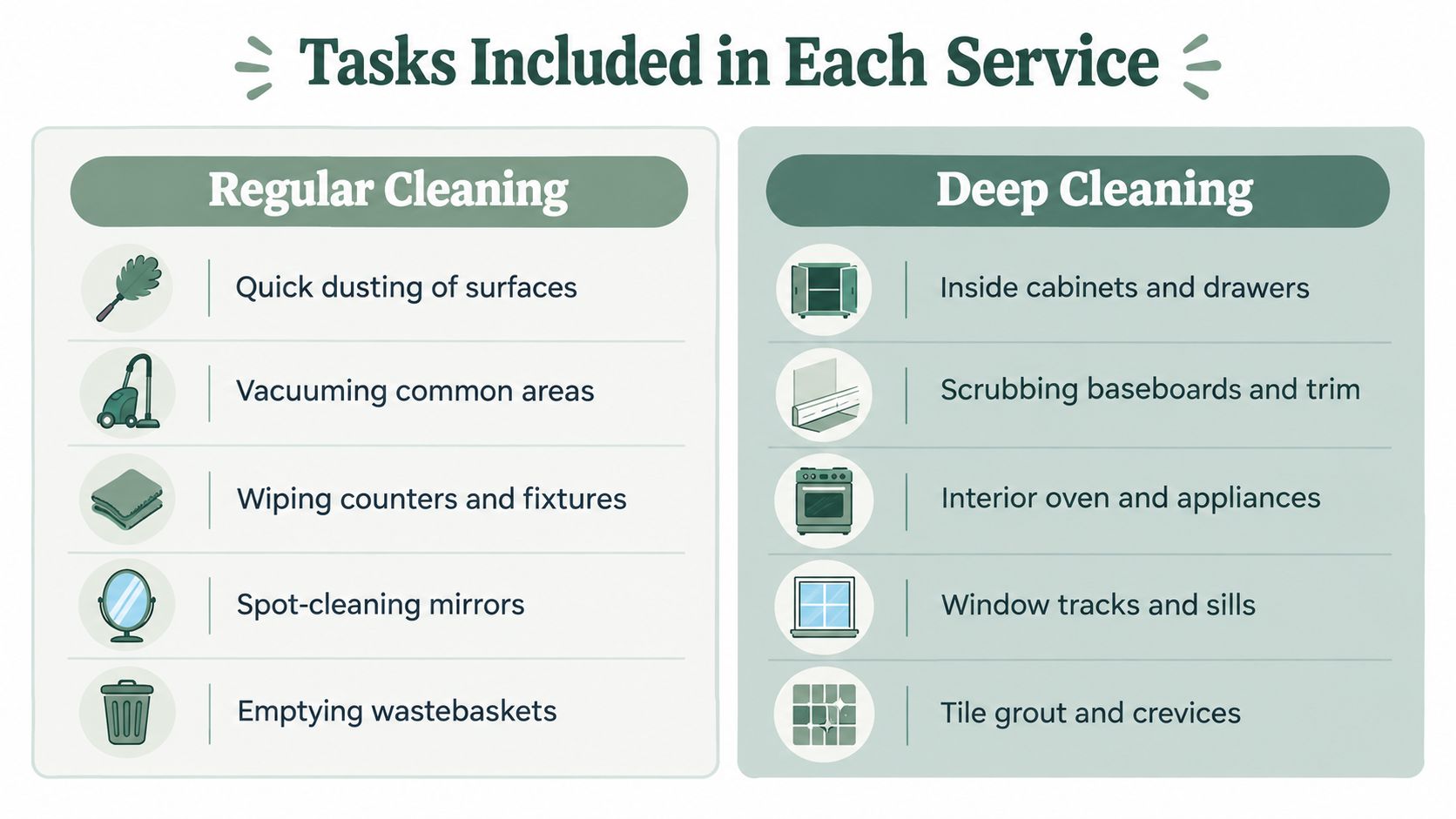
- Keep on the maintenance list: Quick accessible dusting, common-area vacuuming, counter and fixture wiping, mirror spot-cleaning, toilet and sink cleaning, wastebasket emptying, and agreed bed-making.
- Flag for detailed work: Baseboard scrubbing, door-frame washing, ceiling-fan dusting, cabinet-front degreasing, window-sill detailing, and shower scale removal.
- Confirm before booking: Cabinet interiors, appliance interiors, removable vent-cover washing, reachable exterior fan blades, and work behind furniture or appliances.
The image is a planning aid, not a contract. An oven icon doesn't establish that appliance-interior cleaning is included in every deep-clean appointment.
For kitchens, use this deep-cleaning kitchen checklist to identify the areas you want assessed. Note whether the concern is fresh food debris, greasy cabinet edges, an appliance interior, or neglected storage.
Use local conditions as inspection prompts
After beach outings in Gulf Shores or Orange Beach, check entryway edges and grout lines rather than looking only at the center of the floor. For spring cleanup, inspect ledges and fan blades alongside the surfaces you dust regularly.
In Fairhope and Daphne bathrooms, point out recurring mildew or damp corners before the visit. Don't hide the problem under the general request to “scrub the shower.”
For an older Eastern Shore home, also flag loose trim, delicate finishes, and damaged caulk. A cleaner needs to distinguish removable soil from a surface that needs repair.
Photographs help define the job. Send close views of the problem areas and wider views showing access, then ask which tasks fit the proposed service. That prevents a detailed wish list from being squeezed into a maintenance slot.
When a Deep Cleaning Is Worth the Extra Investment
A deep clean is worthwhile when there's identifiable work a standard visit won't cover. Guest preparation alone isn't enough reason. Guest preparation plus sticky kitchen trim, neglected bathroom edges, and dusty overhead fixtures is a different situation.

Choose the response that fits the trigger
| Your situation | Recommended next step |
|---|---|
| Returning from vacation to a maintained home | Standard cleaning unless you find neglected areas |
| Preparing for holiday guests | Add only the detail tasks that actually need work |
| Dust or pollen on overlooked fixtures | Request a targeted deep-clean scope |
| Moving into or out of a property | Book move-in/move-out cleaning with an explicit interior checklist |
| Illness in the household | Discuss appropriate cleaning and any needed disinfection |
| Persistent dampness or condensation | Address the moisture source alongside cleaning |
| Stormwater inside the home | Prioritize safe drying and damage assessment before ordinary housekeeping |
The neglected-zone test has useful context. In a nationally representative survey of 1,000 U.S. adults conducted in February 2025, 80% reported spring cleaning at least annually, but only 19% included hard-to-reach places and 22% included surface dusting, according to the American Cleaning Institute's spring-cleaning survey. My takeaway: don't assume a seasonal cleaning habit means the overlooked areas have been handled.
Treat moisture as a separate problem
The EPA's moisture-control guidance recommends indoor relative humidity below 60%, ideally 30% to 50% when possible. If your hygrometer consistently reads above that upper threshold, investigate ventilation, leaks, and humidity control rather than expecting cleaning alone to resolve the issue.
After storm-related water exposure, the CDC recommends drying the home and contents within 24 to 48 hours when possible, and materials that can't be adequately cleaned and dried may need disposal. For Fairhope, Gulf Shores, and Orange Beach households, that is a drying and damage-response priority, not an ordinary deep-clean booking.
How Often Regular Cleaning Should Happen Between Deep Visits
Choose the recurring interval you can maintain, then adjust it to what the house shows you. Busy families shouldn't have to spend their free time repeatedly catching up, but a lightly used home doesn't need the same appointment pattern as a heavily used one.
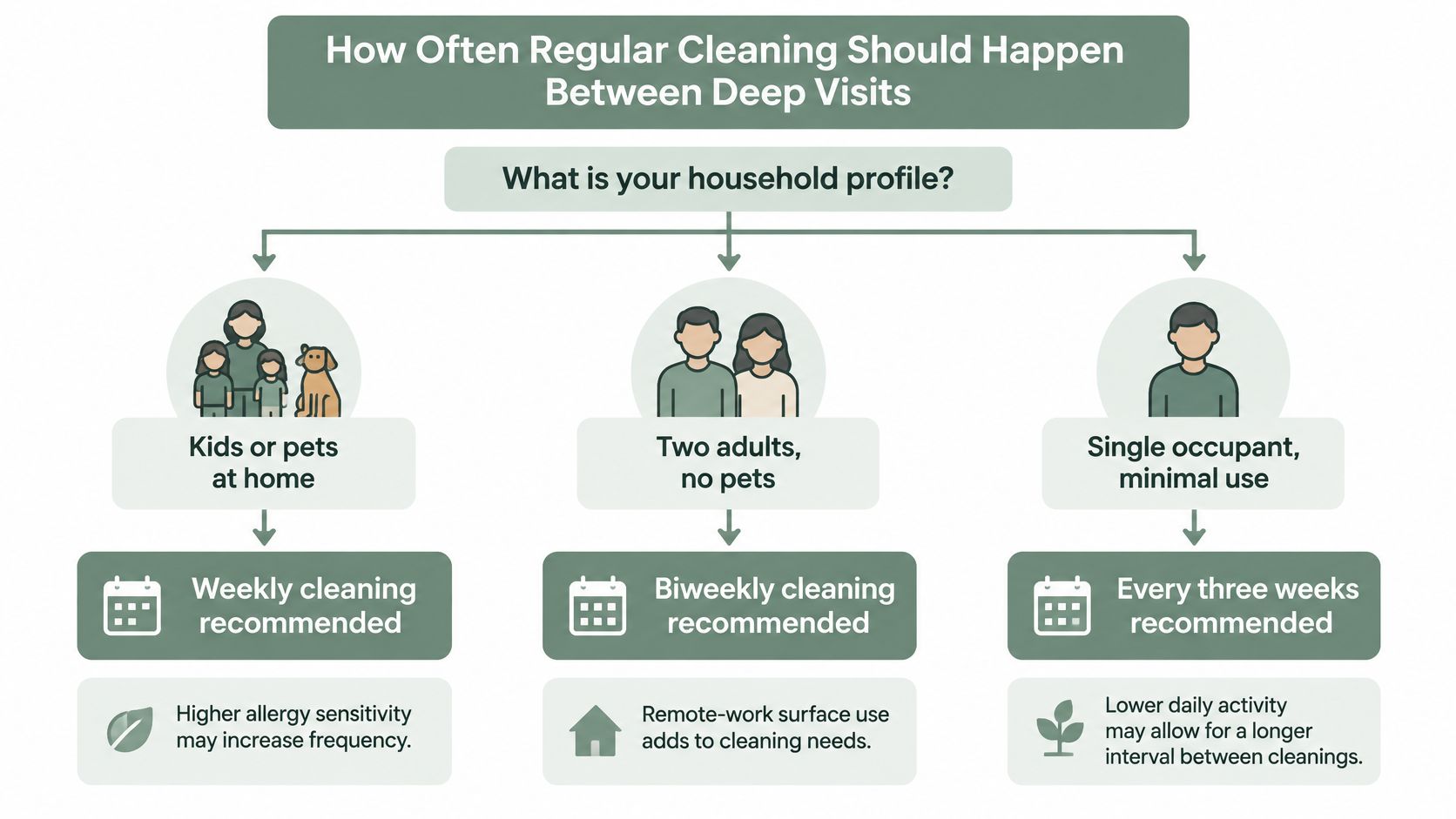
Treat weekly service as a practical starting recommendation for a household with constant floor traffic, children, or pets. Biweekly may suit a home where occupants handle daily kitchen and bathroom upkeep themselves. Monthly service, or an agreed every-three-week arrangement, deserves a candid discussion about what you'll maintain between visits.
Adjust for actual use
The household profiles in the graphic are starting points, not evidence-based rules. Remote-work surfaces, sensitivity to dust, pets, and how much cleaning you handle yourself all belong in the scheduling conversation.
CDC cleaning guidance hosted by OSHA distinguishes frequently touched surfaces from lower-touch areas suited to scheduled attention. That supports a rotating checklist rather than treating every surface identically.
- Busy Spanish Fort family: Prioritize dependable kitchen, bathroom, and floor maintenance, then flag neglected details separately.
- Older Fairhope home: Build a rotation for accessible trim and ledges while noting fragile finishes.
- Gulf Shores vacation rental: Plan vacation rental cleaning around guest departures and inspect detail areas independently of turnovers.
Use a written house-cleaning schedule to separate homeowner tasks, recurring service, and occasional detail work. For exterior planning, Water Works Power Washing's yearly power washing recommendations for homes are a separate resource, not a timetable for indoor deep cleaning.
Scheduling advice: Keep the maintenance reliable and make the reset conditional.
Choosing the Right Service for Your Fairhome Area Home
Start with a short walkthrough. Identify the rooms that need ordinary upkeep, the details with established buildup, and any dampness or access concerns that require a separate conversation.
Then ask for a scope that names those tasks. Confirm cabinet and appliance interiors, furniture-moving limits, delicate surfaces, and what you should clear before arrival.
Ask for the work you need
- Maintained home: Request standard house cleaning or recurring maid service.
- Neglected details: Request a deep-clean assessment with photographs.
- Occupancy change: Discuss move-in/move-out cleaning and empty-storage access.
Homeowners and renters can review Fairhope house cleaning and maid service options before requesting a quote. The right choice isn't the most intensive service every time. It's a dependable maintenance plan with room for specific detail work when your home needs it.
For Fairhope, Daphne, Spanish Fort, Gulf Shores, and Orange Beach, that means accounting for how you live, what gets missed, and what moisture requires you to address beyond cleaning.
Sweet Home Cleaning Service offers standard house cleaning, recurring maid service, deep cleaning, move-in/move-out cleaning, and vacation rental cleaning. Tell us which areas need routine attention and which need a reset so the visit matches your home. If you're in Fairhope or the surrounding Eastern Shore and Gulf Coast area, visit Sweet Home Cleaning Service to book or request a free quote.

Let us handle the cleaning. Enjoy your home.


Sweet Home Cleaning Service
19940 State HWY 181, Suite E Fairhope, AL 36532
Phone: (251) 586-4081
sales@sweethomecleaningservice.com