
What Does a Professional Organizer Do? Services and Process

You've cleared the kitchen counter again, but the mail is back beside the toaster, someone can't find the sunscreen, and the laundry has nowhere to go. In a busy Fairhope home, that doesn't necessarily mean you need to clean harder. You may need a better way to decide where things belong.
So, what does a professional organizer do? The work is about making everyday tasks easier, not creating a picture-perfect house. Sweet Home Cleaning Service, based in Fairhope, AL, approaches organization as a system that needs to work after the team leaves, including during the weeks when nobody has extra time.
Table of Contents
- What a Professional Organizer Does in Your Home
- Why Organizing Is Different From Cleaning
- How an Organizer Works Through a Project
- Life Events and Households That Need Organizing Help
- Privacy, Limits and When an Organizer Should Step Back
- What Professional Organizing Typically Costs
- Choosing the Next Step for Your Home
What a Professional Organizer Does in Your Home
A professional organizer helps people build practical systems for their belongings, spaces, and routines so items have a home and people can return them there. That goes beyond tidying: the organizer considers what you use, where you use it, and what makes putting it away difficult.
The title covers a broad range of work. The U.S. Bureau of Labor Statistics' occupational classification review describes practitioners whose work includes residential closets, storage design, electronic information, business relocations, and personal coaching. For a homeowner or renter, the useful question is which household problems the organizer can help solve.
Professional organizer services by home space
| Space | What the organizer sets up | Expected result |
|---|---|---|
| Closets | Sorting for clothes, shoes and accessories, with zones by use and season | Faster dressing and usable shelf space |
| Kitchen and pantry | Zones for cooking, snacks and meal prep, with labeled containers | Less searching and clear restock points |
| Bathrooms and linen closets | Daily items grouped together, linens sorted and duplicates removed | Clear counters and fewer duplicate purchases |
| Kids' rooms and playrooms | Toy categories in bins at child height | Children can put toys away on their own |
| Home offices | Simple filing system and a paper intake routine | Documents easier to find |
| Living and common areas | Surface plan, entry drop zone and a home for mail and keys | Clutter stops at the entry |
| Moves and downsizing | Keep, donate and trash staging with labeled boxes | Fewer unpacked boxes and a lighter move |
These are intended outcomes, not promises that a household will never get messy. A useful setup makes the next action clear, whether that's finding a towel or returning a school backpack.
Connecting the spaces to everyday life
Say a Fairhope family keeps lunch containers in a crowded cabinet across the kitchen from the lunch-making area. An organizer might move the containers near the preparation surface, match lids, and reserve an accessible shelf for lunch supplies. Buying more containers wouldn't solve that problem.
The same thinking applies in an older Eastern Shore home with limited closets. Before recommending another shelf, the organizer checks whether the existing space holds items you use and whether you can reach them comfortably.
Organizers can also work alongside a cleaning team. The organizer establishes where belongings go, while cleaning addresses the dust and soil on the cleared surfaces.
Start where daily life catches: Choose the space that repeatedly delays you, rather than the room that would make the most impressive photograph.
A functional entryway may give your household more relief than reorganizing an entire guest room.
Why Organizing Is Different From Cleaning
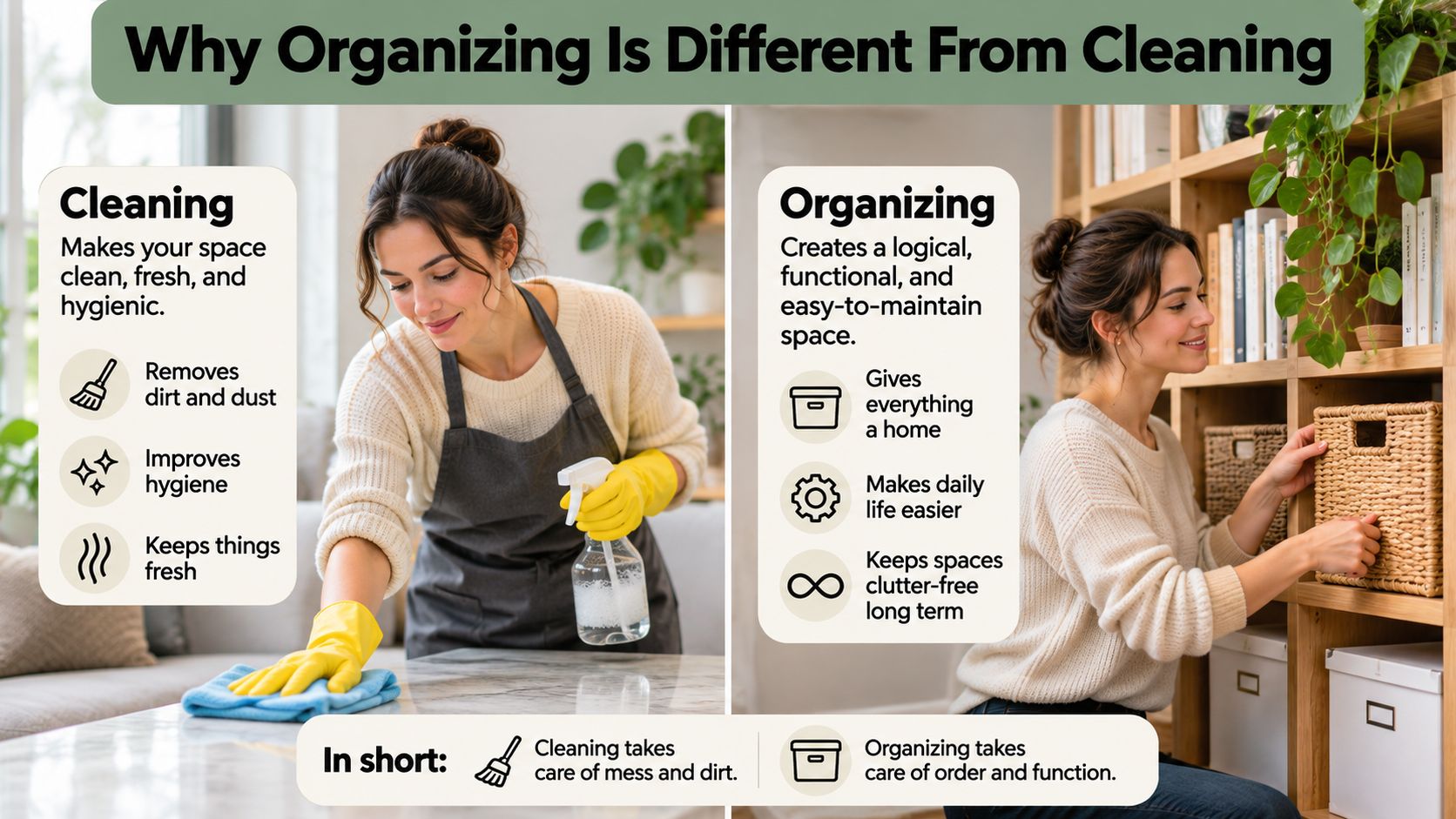
Cleaning is wiping the kitchen counter. Organizing is deciding where the cutting boards live so nobody has to dig for them. Cleaning addresses soil and appearance; organizing changes how people select, store, retrieve, and return belongings.
A clean room can still be difficult to use. A freshly wiped desk covered in unrelated paperwork remains a poor place to work, while a well-sorted pantry still needs its shelves cleaned.
Two different jobs with a shared purpose
| Household problem | The appropriate work |
|---|---|
| Crumbs and sticky residue on a pantry shelf | Cleaning |
| Groceries hidden behind unrelated supplies | Organizing |
| Dust beneath a pile of papers | Sorting first, followed by cleaning |
The distinction matters beyond appearance. A survey reported by HuffPost found that 84% of recently stressed Americans worried their home wasn't clean or organized enough; among those respondents, 55% identified that concern as a source of recent stress. Those findings describe respondents' concerns, not a promise that organizing will resolve stress.
For busy families, renters, and homeowners in Daphne and Fairhope, the practical aim is fewer household obstacles. You shouldn't have to move a pile every time you need a work surface.
The sensible sequence is to sort and clear, clean newly exposed shelves and surfaces, then place the retained belongings. This guide to home organization and cleaning services explains how the jobs fit together.
Judge the result by retrieval time, misplaced items, and usable surfaces after a week, rather than by how the room looks immediately after an appointment.
How an Organizer Works Through a Project
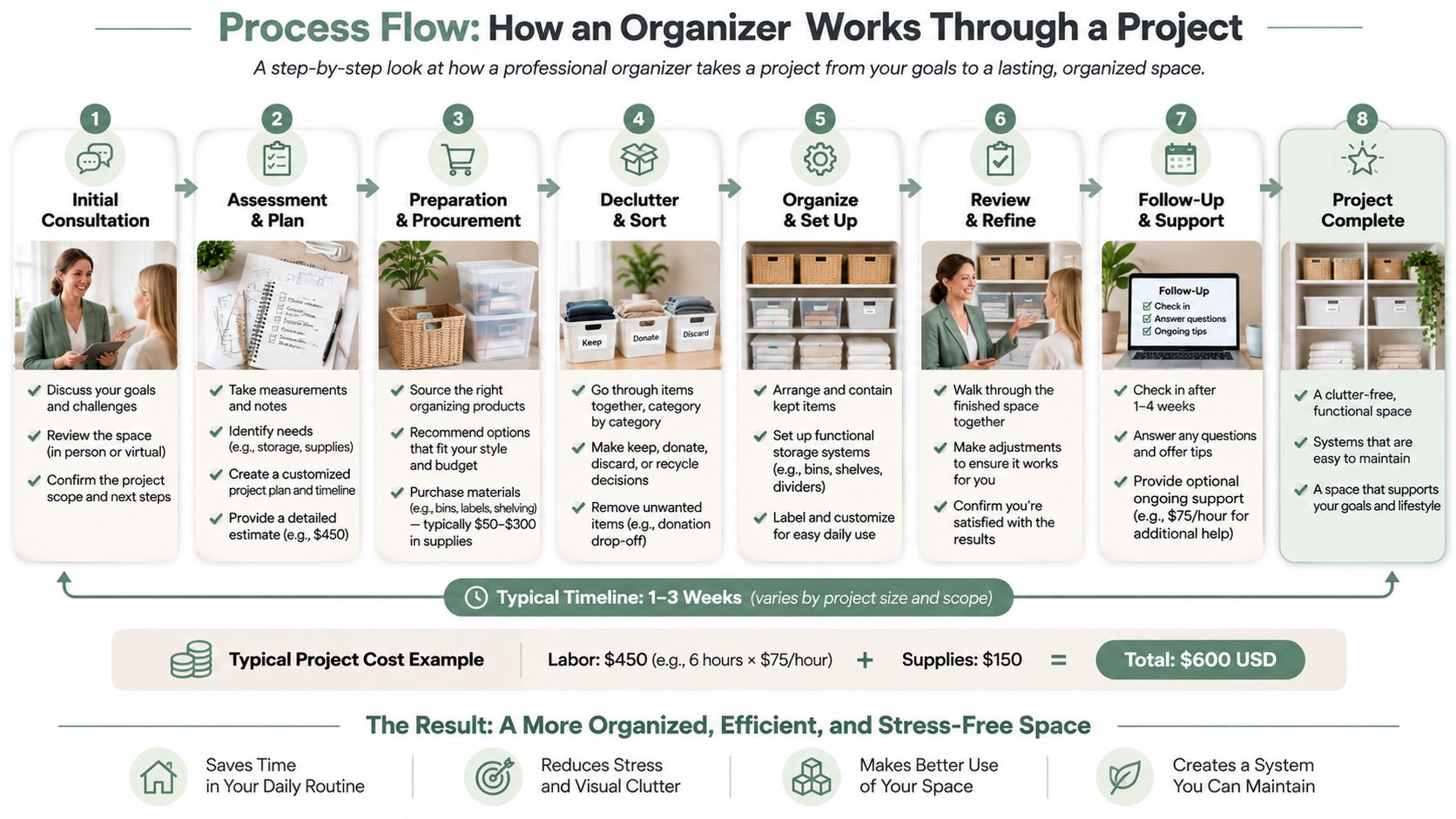
A useful project starts with questions before anyone buys matching baskets. The organizer needs the household's goals, schedule, and trouble spots, because a setup only lasts if the people using it can reset it during a busy week.
From the first conversation to a workable reset
Learn how the household operates. The intake conversation establishes your goals, schedule, who uses the space, and which belongings need private storage. A Fairhope home with packed weekday mornings needs different drop zones than a spare room used twice a month; skipping this conversation produces a setup built around somebody else's habits.
Walk through and define zones. The organizer follows everyday activities, checks traffic paths, and identifies what needs to remain accessible. This is also where the job gets classified: too much stuff calls for sorting, poor placement calls for zoning, and dirt calls for cleaning before organizing can hold.
Sort before making storage decisions. Belongings are grouped by category, then sorted into keep, donate, and trash piles with you making the decisions at a comfortable pace. Manageable sections matter because emptying every cabinet at once can leave a household with more unfinished work than it can manage.
Fit storage to the retained inventory. After sorting, the organizer measures shelves, checks container sizes, and suggests bins, baskets, and labels only after the keep pile is known. Buying containers beforehand risks paying for storage that fits neither the cabinet nor its contents.
Create a reset routine. Connect an action to an ordinary cue, such as recycling junk mail when it enters the house and placing actionable mail in its tray. Lunchboxes, backpacks, and work papers need the same kind of trigger, since a clear cue is easier to follow than a vague intention to keep a counter clear.
Check the system against actual use. After the household has tried the arrangement, review overflow, awkward labels, and categories nobody puts away. Moving a basket or renaming a zone usually works better than relying on repeated reminders.
Why the routine deserves attention
A 2024 workplace diary intervention published in the Journal of Occupational and Organizational Psychology found that implementation intentions predicted more frequent performance of a new behavior, which increased behavioral automaticity. That is workplace evidence rather than a household-organizing trial, and the practical lesson is narrower: link a specific action to a recognizable cue.
Sweet Home Cleaning Service's home organization focuses on systems so the home stays organized after the team leaves. A label is part of the system, while the routine carries it through late practices, guests, and weeks when nobody has extra energy.
For practical starting points, use these home organization approaches to choose one area you can maintain. Judge success by whether items return to their places with little prompting; when a category keeps overflowing, adjust the system.
Life Events and Households That Need Organizing Help
Moving changes the job of every storage space. Before unpacking a Fairhope home, decide where daily activities belong instead of copying the previous layout. When downsizing, choose what fits the next home before committing to storage. Storage-size guides, such as the option to compare Nottingham storage unit sizes, address capacity; deciding what belongs in your next home comes first.
A new baby calls for supplies near the changing area and an obvious place for refills. Working from home calls for boundaries around papers and equipment so the dining table remains usable. In either case, the arrangement needs to work during a busy week.
When household abilities or schedules change
For older adults or people with mobility limits, prioritize reach, visibility, and ease of return. Where comfortable and appropriate, keep frequently used belongings between waist and shoulder height. Readable labels and containers that avoid awkward lifting make putting things away easier.
Busy families in Daphne, Spanish Fort, and Fairhope need systems children can use independently. Low toy bins and reachable backpack hooks give belongings a clear landing place. These home organization ideas for small spaces offer options when floor space is limited.
Gulf Coast readiness is a separate planning task
Before hurricane season, organizing can make important papers, medications, pet supplies, and go-bags accessible in Gulf Shores and Orange Beach homes.
Ready.gov's hurricane guidance calls for an emergency plan, evacuation routes, multiple ways to receive alerts, insurance and document review, clearing drains and gutters, bringing outdoor furniture inside, and assembling supplies.
Those decisions remain the household's responsibility. A labeled bin supports emergency preparation, but organizing alone cannot provide the plan.
Arrange the space before a transition begins, while there is still room to make thoughtful decisions.
Privacy, Limits and When an Organizer Should Step Back
Good organizing is client-directed. A drawer can be sorted, a closet can be simplified, and a pantry can gain zones, but the choices still belong to the household. Sweet Home Cleaning Service's Home Organization work focuses on systems that help the home stay organized after the team leaves. Sorting items into keep, donate, and trash piles works like a decision filter, not a verdict on what a family should own.
That matters when a project involves personal papers, family routines, or private rooms. Professional organizers should keep client information confidential and should not share photographs of a client's home or belongings without the client's written consent. Confirm that policy in advance. The Association of Professional Organizers' code of ethics can be reviewed as one professional reference, but don't assume every provider follows an identical rule.
Establish boundaries before opening drawers
Agree on the limits before work begins. Name off-limits rooms, documents, valuables, and containers. Decide who may handle them, and clarify whether photos are part of the project at all.
Sentimental belongings deserve a slower pace than expired packaging. A family may keep recipe cards because cooking connects them to someone important, while releasing kitchen tools that never get used. The deciding factor is personal value, not a target for owning less.
You don't have to become a minimalist to have a home that works.
Research involving clutter and decision-making, published through PubMed Central, discusses hesitation, decisional procrastination, and negative experiences associated with clutter. The practical takeaway is to allow a process that respects the person making the decisions. Rushing can leave people with a tidy shelf and a pile of regrets.
When organizing isn't the right fix on its own
An organizer should not diagnose or treat hoarding, grief, or depression. When those issues shape the work, a mental-health professional, social worker, occupational therapist, or hoarding-disorder specialist may need to participate alongside, or instead of, an organizer. Bins can support a plan. They cannot replace care.
Likewise, bins won't fix an active leak, persistent dampness, or damaged storage. In a Gulf Coast home, don't cover a moisture problem with neatly stacked belongings. Address the underlying condition before filling that space again. Organizing works best when the structure is sound and the household is ready to maintain it.
Before hiring, ask:
- Sentimental items: How will you handle belongings I'm not ready to decide about?
- Private documents: Who will see or handle my paperwork?
- Project photographs: Are pictures taken or shared, and how is my written consent obtained?
Clear answers matter more than dramatic before-and-after photographs. A good system should survive busy weeks, not just look settled on the day the work ends.
What Professional Organizing Typically Costs
What hourly rate should a household expect? Published figures offer a starting point, but they aren't Fairhope quotes or interchangeable measures.
Published hourly rates for professional organizers
| Source | Hourly rate | What it measures |
|---|---|---|
| KonMari survey of certified consultants, 2025 | $82 per hour, median | More than 30 certified KonMari Consultants worldwide |
| ProMatcher, data through October 2025, reported by Axiobench | $64.82 per hour, average | Average U.S. price for professional home organizers |
A median is the middle reported rate when rates are ordered. An average is calculated by adding the rates and dividing by the number of observations. Because these sources describe different groups and measures, the gap between them doesn't establish what a Baldwin County household should pay.
What changes the project total
The hourly rate is only part of the calculation. A closet containing mostly ready-to-hang clothing is a different assignment from a home office where every paper needs a decision.
The scope should account for:
- Rooms and inventory: Identify the actual closets, cabinets, or work areas included, not just a whole-home label.
- Decision-making work: Allow for the time you need to review documents, duplicates, and sentimental possessions.
- Storage purchases: Clarify whether containers and labels are included or approved separately.
- Follow-up work: Establish whether a return visit is included and what that visit covers.
Your availability matters, too. If the organizer needs your approval before anything leaves the house, make sure the schedule allows you to participate rather than leaving a growing undecided pile.
Compare a defined scope, not just an hourly figure
Request a walkthrough estimate that lists the rooms, expected hours, and intended finish point. Compare that scope with the published benchmarks, while keeping their different geographic and professional coverage in mind.
Coordinate organizing and cleaning where appropriate. Scheduling the work in sequence can reduce separate visits, but only if the sorting is far enough along for the cleaning team to access the surfaces.
Put the end point in writing. For example, a pantry project might finish when retained food is grouped, shelves are cleaned, categories are labeled, and the household understands restocking. Adding the garage midway should be a new scope decision, not an unnoticed extension of the original job.
Choosing the Next Step for Your Home
You don't need to overhaul the whole house to decide whether organizing would help. Start with the problem you want to stop dealing with.
- Daily friction: You repeatedly search for the same belongings or move piles to use a surface.
- An approaching change: A move, new baby, downsizing, or work-from-home arrangement will change what you need from the space.
- A reset that won't last: You straighten the room, but the same clutter returns within days.
If these fit, an organizer can help establish the missing system. Home Organization is particularly useful for busy families without time to declutter, people overwhelmed by belongings, and households preparing for a new stage of life.
Match the help to the problem
If belongings already have sensible homes and the issue is dusty shelves, dirty floors, or bathroom buildup, standard house cleaning is the better starting point. There's no reason to buy an organizing project to solve a cleaning problem.
Sweet Home Cleaning Service can combine home organization with cleaning for a complete reset. Once spaces are sorted, deep cleaning or move-in/move-out cleaning prepares them for use, while recurring maid service on a weekly, biweekly, or monthly schedule supports ongoing upkeep.
The team serves homeowners and renters in Fairhope, Daphne, Spanish Fort, Gulf Shores, Orange Beach, and nearby communities across the Eastern Shore and Gulf Coast. Customers can call Sweet Home Cleaning Service for help deciding whether Home Organization is right for them.
Sweet Home Cleaning Service offers home organization and cleaning to help your rooms function through busy weeks, not just look tidy on appointment day. If you're in Fairhope or the surrounding Eastern Shore and Gulf Coast area, visit Sweet Home Cleaning Service to book or request a free quote today, and tell the team which room matters most.

Let us handle the cleaning. Enjoy your home.


Sweet Home Cleaning Service
19940 State HWY 181, Suite E Fairhope, AL 36532
Phone: (251) 586-4081
sales@sweethomecleaningservice.com