Best Home Organization Methods for Alabama Families

You're trying to get everyone out the door in Fairhope. Sand has followed the kids in from the beach, pollen is collecting near the entry, and a closet that seemed fine yesterday feels damp and crowded today. By evening, the kitchen counter has become a drop zone for bags, mail, and things nobody remembers putting there.
That's not a character flaw, and another row of matching bins won't fix it. The best home organization gives everyday items an obvious place, makes the system easy for everyone to use, and accounts for the way Gulf Coast homes are lived in. Sweet Home Cleaning Service serves Fairhope and surrounding communities, and the practical advice is simple: build a routine that fits your household, not a picture-perfect room that's hard to maintain.
Table of Contents
Why Home Organization in Fairhope Is Different from the National Advice
A Fairhope morning can bring its own small mess before breakfast. Shoes and beach bags collect near the door, pollen rides in on clothing, and a closed-up closet may feel musty during a humid stretch. Add work, school, and family responsibilities, and a weekend-long organization project can be hard to start, let alone finish.
Generic advice often treats clutter as a visual problem. On the Eastern Shore, the environment affects where things should go and how often you need to reset them. A beautiful basket won't help if damp towels stay crammed inside it, and a closet system won't last if it takes too much effort to put laundry away. Older homes and busy families in Fairhope, Daphne, and Spanish Fort may also have different storage layouts and daily traffic patterns, so one universal method isn't likely to fit every home.
Treat organization as maintenance
A 2024 white paper from the Institute for Challenging Disorganization reported that 50% of Americans feel overwhelmed by the amount of stuff in their homes. It also cited an average of 42 unused items per household, representing about $723 in unused value. The same summary found that the perceived effect of clutter on quality of life was significantly related to dwelling characteristics, including square footage and the number of bedrooms and bathrooms. The ICD white paper underlines why a home's size and layout matter: organizing a small rental and a larger family home won't call for identical systems.
Start with the rooms your household uses hardest, then decide what belongs in each space. Create a practical entry drop zone for shoes and bags, keep cleaning tools where you use them, and avoid storing boxes or clothing against damp walls. When the weather shifts or family routines change, adjust the system instead of blaming yourself for a messy week.
Practical rule: If putting something away takes several steps, the system is asking too much of a busy household.
The Most Popular Organization Philosophies Compared
There isn't one organizing philosophy that works for every family. The right choice depends on how much time you can give the project, how much decision-making you can tolerate, and whether your household is ready to let go of possessions.
| Philosophy | Core Principle | Best Fit For | Maintenance Load |
|---|---|---|---|
| KonMari | Keep items that feel meaningful and group related categories together | People ready to make broad, reflective decisions about possessions | Moderate to high during the initial sorting |
| Minimalism | Reduce possessions to what you use or value | Households comfortable owning fewer things and resisting extra purchases | Lower once the household agrees on limits |
| Room-by-room decluttering | Finish one space before moving to the next | Families who need visible progress and clear project boundaries | Moderate, with recurring upkeep by room |
| One-touch rule | Put an item away as soon as you finish using it | Homes with clear, accessible storage and shared habits | Low in theory, but everyone must participate |
Match the method to your household
KonMari can help when decisions about belongings feel tangled, but the process may stall if people aren't ready to sort a large number of items. Minimalism can make storage simpler, but it's not a requirement for an orderly home. A room-by-room approach is often easier for busy households because you can begin with a pantry shelf or entryway rather than emptying an entire home.
The one-touch rule works best when an item already has a clear home. If the scissors might belong in a kitchen drawer, office bin, or junk drawer, someone will eventually leave them on the counter. Make the storage decision first, then ask everyone to return the item after use.
For more reading on different approaches, Sweet Home Cleaning Service's guide to home organization books can help you compare ideas before choosing a method. My recommendation for most busy families is room-by-room sorting with simple household rules. You can borrow useful ideas from other philosophies without treating any one method as a test you have to pass.
Building a System That Actually Stays Organized
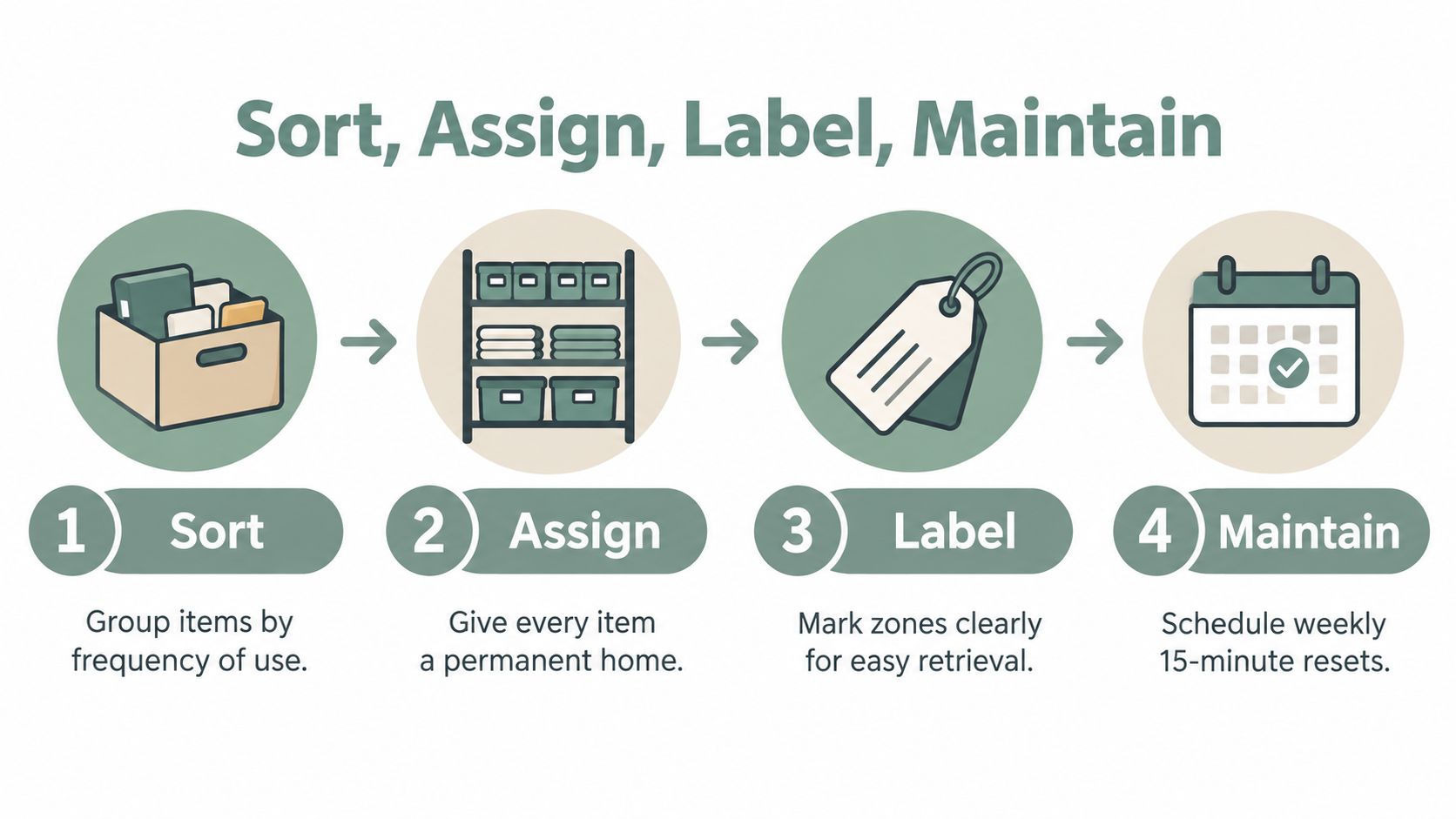
A lasting system needs four parts: sort, assign, label, and maintain. Skipping the first step leaves unnecessary items in circulation; skipping the second gives possessions no permanent home. Labels can help, but they won't rescue a storage area that's overfilled or inconvenient to use.
Sort with decision rules, then assign a home
Before you open a closet or pantry, decide how you'll judge what stays. Consider frequency of use, condition, seasonality, replacement cost, and whether an item has a place. Those rules reduce the chance of handling the same belongings again and again without reaching a decision.
A 2023 survey study of 172 adults who had recently completed home-decluttering projects found that participants who lacked time or felt less control experienced more stress and lower success. The study on decluttering projects supports a practical approach: work on a bounded zone, such as one pantry shelf or one category of children's clothes, instead of turning the whole weekend into an open-ended project.
Then give each kept category a home near where it's used. Put cooking tools by the preparation area, keep frequently used linens within easy reach, and create a low, accessible bin for children's everyday toys. For ideas on making children's spaces easier to use, this guide to organizing a playroom offers additional inspiration.
Label only where it helps
A label should answer a real question, such as where spare batteries go or which bin holds seasonal linens. If everyone can identify a category at a glance, labels may add clutter rather than clarity. Use containers that let household members see what's inside, and don't fill them past the point where items can be returned easily.
Finally, set a small maintenance routine that your family can follow. Put the reset on a calendar, choose who handles shared zones, and return items to their homes before clutter spreads across counters and floors. A workable system should be easy to retrieve from and just as easy to put back.
DIY Organization Versus Hiring a Professional Team
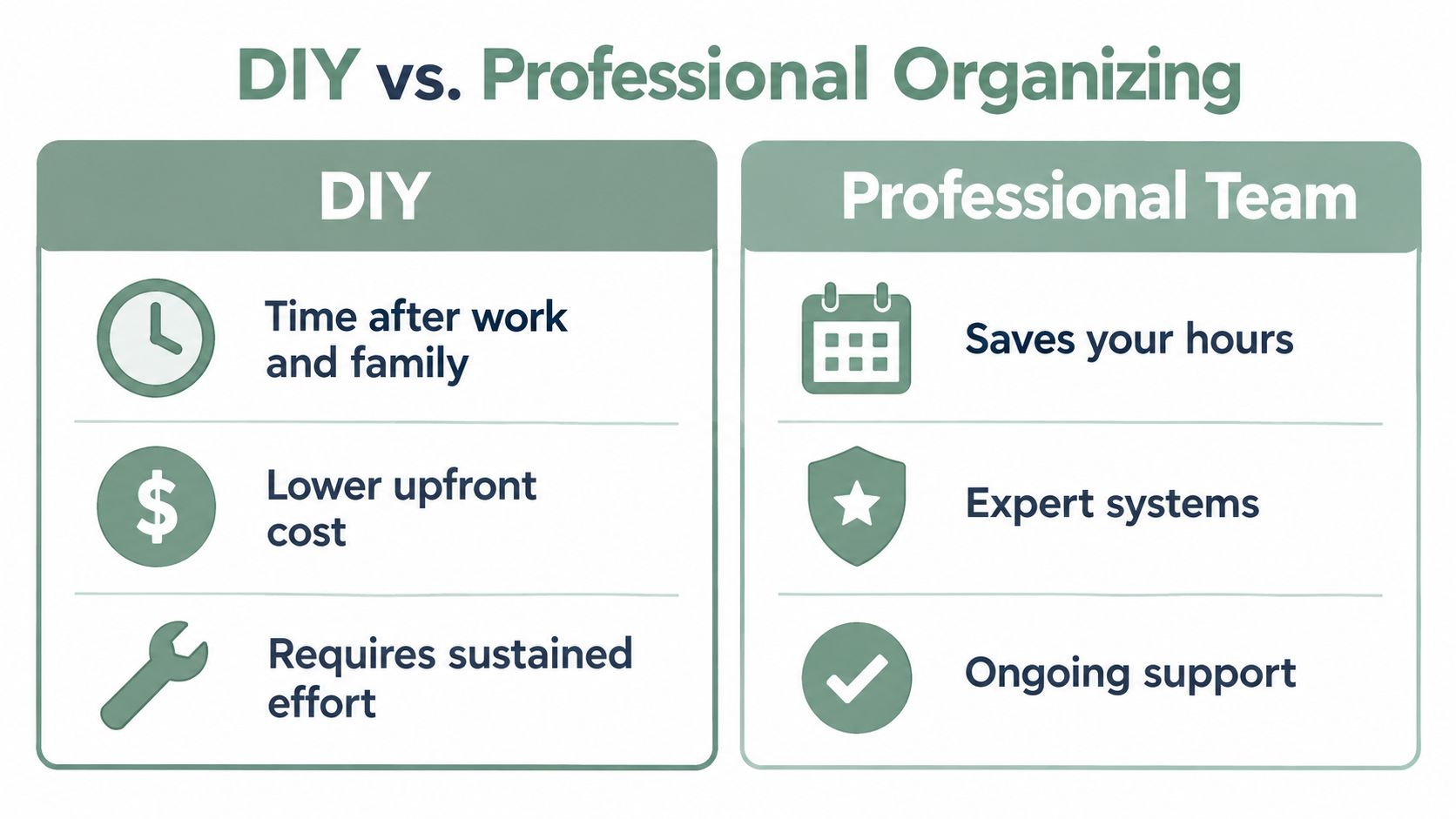
DIY organizing costs less in professional fees, but it still takes time and attention. Hiring help can save household hours and provide hands-on support, though the service won't make decisions about your belongings for you. The better choice depends on the project, your available time, and whether you can complete the work without letting it take over the household.
Use three honest checks
Time: If you can give a small area focused attention and return to it over several sessions, DIY is a reasonable choice. If a closet or pantry has been postponed repeatedly because work and family duties take priority, outside help may make the project more manageable.
Physical access: Moving items, reaching shelves, and sorting bulky belongings can be tiring. If those tasks are difficult for you, don't turn a practical home project into a strain. Ask someone you trust for help or consider professional support.
Scope: One crowded drawer is a straightforward DIY job. Several rooms, storage areas, and decisions about what to keep may call for a more coordinated reset.
Know what a professional reset can do
A useful professional visit should be about more than making shelves look tidy. It can combine cleaning with sorting and setting up straightforward storage zones. Sweet Home Cleaning Service offers home organization alongside cleaning, with support for spaces such as closets, kitchens and pantries, bathrooms, children's areas, and home offices. You can review the home organization service details to see whether the service fits your project.
Keep expectations grounded. You'll still need to make personal decisions about what stays, and a system will need household participation afterward. Choose DIY when the project is contained and you have time; seek help when the work keeps slipping, the scope feels overwhelming, or physical tasks make it hard to begin. Neither choice is a judgment on how well you manage your home.
The Mental Load Problem Most Organization Advice Misses
A storage system can look orderly and still fail because one person has to remember every rule, locate every item, and remind everyone else to put things back. More containers may even create more work if household members need to decide which bin to use or ask where an item belongs.
A 2024 study on cognitive household labor linked organizing and related mental work with women's depression, stress, burnout, mental health, and relationship functioning. A 2025 U.S. YouGov survey found that 46% of households organize only when things become unmanageable, while 37% report lack of motivation and 26% identify other household members as a challenge. The discussion of household mental load points to a better question than “Do we have enough storage?” Ask whether everyone can use and maintain the system without one person acting as its full-time manager.
Make ownership visible
Keep shared drop zones where people naturally enter and leave. Give each person a clear place for daily items, and choose household rules that are easy to remember. Children can be responsible for returning their own shoes or toys to a designated spot, while adults can agree on who resets shared surfaces.
Try a brief evening reset that fits the family's routine. The important part isn't making every room perfect. It's returning everyday items to clear, accessible homes so the next morning doesn't begin with searching.
For vacation rental hosts in Gulf Shores and Orange Beach, the same principle applies between guest stays. Keep guest-facing supplies grouped and easy to check, and assign responsibility for restocking rather than assuming someone else will notice what's missing. A small, clearly defined system is often easier for a household or turnover team to maintain than a highly customized one.
A system should distribute the work, not just the belongings.
Coastal-Specific Organization for Gulf Coast Homes
Gulf Coast homes need storage choices that account for moisture, seasonal pollen, beach sand, and storm preparation. Don't rely on visual tidiness alone. A closet can look neat while damp items stay crowded together, and an entryway can spread sand through the home if there's nowhere to leave beach gear.
Manage moisture and pollen
The U.S. Environmental Protection Agency recommends keeping indoor relative humidity below 60%, with 30% to 50% as the ideal range when possible. The EPA's mold guidance makes a small hygrometer a useful tool for bathrooms, laundry rooms, closets, and other areas where moisture builds up. Store clothing, paper goods, and boxes away from damp walls or floors, and leave room for air to move around stored items.
During pollen season, keep windows closed and use air conditioning, as advised by the American Academy of Allergy, Asthma & Immunology. Its cleaning guidance also recommends maintaining indoor relative humidity between 30% and 50%. Put washable entry mats near doors, contain frequently used outerwear, and include window sills and frames in routine cleaning.
Keep storm supplies together
Ready.gov recommends at least a three-day supply of nonperishable food and water and says medications should cover at least one week. It also recommends including items such as pet supplies, contact information, chargers, flashlights, and sanitation supplies, and replacing perishable supplies regularly. Ready.gov's hurricane preparation guide offers the fuller checklist. Keep emergency items together in a known, labeled, portable location, and leave pathways clear.
Homes in Daphne and Spanish Fort benefit from the same straightforward seasonal habits as those in Fairhope, Gulf Shores, and Orange Beach: contain sand at the entry, store storm supplies in one place, and rotate items as household needs change. Vacation rental hosts can keep turnover supplies grouped and make sure outdoor items have a planned place before a storm. For a look at useful storage options, see Sweet Home Cleaning Service's home organization product guide.
Your Next Steps and How Sweet Home Cleaning Service Can Help
You don't need to reorganize your entire house this week. Pick one high-friction area and make a system that every person who uses it can follow.
Start with a short checklist:
- Choose a zone: Pick a pantry shelf, bathroom drawer, closet category, or entry drop zone.
- Set your rules: Decide what stays based on use, condition, and whether it has a sensible place.
- Make items accessible: Keep frequent-use belongings near the task they support.
- Share the upkeep: Decide who returns items and resets the area.
- Plan the next reset: Put a manageable maintenance session on the household calendar.
If you need help with the physical reset, Sweet Home Cleaning Service provides home organization for closets, kitchens and pantries, bathrooms, children's spaces, and home offices. The company also offers standard house cleaning, deep cleaning, move-in/move-out cleaning, vacation rental cleaning, and recurring maid service on weekly, biweekly, or monthly schedules. A cleaning visit can address routine upkeep, while organization work helps create places for the items your household needs to keep.
Whether you live in Fairhope, Gulf Shores, Orange Beach, or another Eastern Shore community, choose a small starting point and make the routine realistic. A home doesn't need to look staged to work well. It needs storage that fits the people who live there and a maintenance plan that doesn't fall to one person alone.
Sweet Home Cleaning Service can pair practical home organization with standard house cleaning, deep cleaning, or recurring maid service to help keep your spaces manageable. If you're in Fairhope or the surrounding Eastern Shore and Gulf Coast area, visit Sweet Home Cleaning Service to book or request a free quote.

Let us handle the cleaning. Enjoy your home.
Sweet Home Cleaning Service
19940 State HWY 181, Suite E Fairhope, AL 36532
Phone: (251) 586-4081
sales@sweethomecleaningservice.com