Professional Home Organization Services: What to Expect


You open the pantry to find three half-used bags of rice and two spice blends that do the same job. Meanwhile, the school uniform you need is somewhere behind the winter coats. Nothing is especially dirty, but getting out the door still takes more searching and rearranging than it should.
For homeowners and renters in Fairhope, Daphne, Spanish Fort, Gulf Shores, and Orange Beach, professional home organization services should make those ordinary routines easier. Sweet Home Cleaning Service, based in Fairhope, combines cleaning and home organization with a practical starting point: understand how the household lives before deciding where anything belongs.
Table of Contents
What Professional Home Organization Services Include
Professional home organization is an assessment-led service. An organizer reviews how you use a space, helps you decide what stays, and creates storage locations, labels, and routines that your household can maintain. The work isn't just moving clutter into matching containers.
A useful distinction is that cleaning removes what's dirty, while organizing removes the decisions that make a space hard to keep up. A clean counter still becomes a landing zone if mail, school papers, and keys don't have somewhere else to go.
Organizing Scope by Space
The scope should describe both the physical work and the daily change you want. Use the following as a starting point, then confirm which tasks your provider includes.
| Space | What the organizer does | What changes day to day |
|---|---|---|
| Kitchen and pantry | Sorts food, cookware, and small appliances; sets zones by use; labels shelves | Everyday cookware and breakfast items are reachable without moving other items |
| Closets | Edits clothing by season and fit; plans shelves, rods, and bins, with installation agreed separately; stores off-season items | Getting dressed takes less searching, and out-of-season items are labeled |
| Bathrooms | Consolidates toiletries and linens; assigns cabinet zones; checks storage placement for airflow | Restocking is straightforward, and duplicate bottles are easier to spot |
| Kids' spaces | Sets low, reachable bins by category; builds simple put-away routines | Children can see where things belong |
| Home offices | Separates active paperwork from archives; sets a supply zone | Files and supplies have predictable locations during the workday |
What Should Be Agreed Before Work Begins
A useful scope names the rooms, the problem in each room, and the stopping point. “Make the closet work for weekday mornings” is more actionable than “organize everything.” It also helps prevent a targeted visit from becoming an unfinished whole-house project.
Clarify who approves donations, who handles discarded items, and whether shopping or hardware installation is included. Decluttering support isn't permission to dispose of someone's belongings. Private papers, medications, valuables, and sentimental items need explicit handling instructions before sorting starts.
An organizer should also distinguish between what can be rearranged and what requires another trade. Moving a shelf is different from altering cabinetry, and recommending a closet rod doesn't automatically include installing it.
The finished result should match your routines rather than a photograph. What you pay depends on how much decision-making, physical work, and follow-up that result requires.
What Professional Organizing Costs and How It Is Billed
Pricing depends on scope, not just room size. A small office with mixed paperwork may involve more decisions than a larger closet with clearly separated clothing. Before comparing totals, identify the billing model and what work the estimate covers.
Professional Organizing Pricing Models
These are useful models to discuss with a prospective provider. Don't assume that every provider offers each option.
| Pricing model | How it is billed | Best fit | Confirm in writing |
|---|---|---|---|
| Hourly | Per hour of on-site work, potentially with a minimum visit | A single closet, an assessment, or a targeted fix | Minimum hours and whether shopping or supply runs count toward time |
| Flat project fee | One price for a defined scope, such as a kitchen and pantry | Bounded projects with a set room list | Exclusions such as products, hauling, or installation |
| Day or half-day block | Fixed fee for an agreed block of on-site time | Multi-room resets or organizing around a move | Start and end times and what happens if work exceeds the block |
| Recurring maintenance visit | Scheduled follow-up at an agreed interval | Households needing upkeep after the initial reset | Visit length, interval, and whether it can accompany recurring cleaning |
Hourly work offers flexibility, but the final total depends on how the visit progresses. A project fee offers clearer boundaries, provided those boundaries are written down. A time block buys working time, not necessarily completion of every room on a wish list.
What Changes the Final Estimate
The main variables to discuss are the rooms involved, expected working time, sorting volume, and any hauling arrangements. Storage products, hardware installation, and travel across Baldwin County also need an explicit answer rather than an assumption.
Household decisions matter, too. If someone must review every document or approve each donation, the schedule should allow for that involvement. Rushing those decisions isn't a sensible way to control costs.
For context, Angi's home-office organizing cost guide reports an average project cost of $527, with most homeowners spending $251 to $835. That's a published benchmark for a particular room type, not a quote for your home or for Sweet Home Cleaning Service.
Before accepting an estimate, ask:
- What's included? Request the room list, labor arrangement, and expected deliverables.
- What's excluded? Check product purchases, shopping, donation transport, and installation.
- What triggers an additional fee? Ask how extra rooms, longer sorting sessions, or return visits are approved.
Compare two quotes using the same written room list. Otherwise, a lower total may only describe less work.
Storage Design Rules That Keep Systems Working
Storage should suit the person reaching for an item, not merely fill the available cabinet. A container that fits perfectly can still be impractical if someone must kneel, unload it, or move another bin every time they need something.
Storage Zones by Height From the Floor
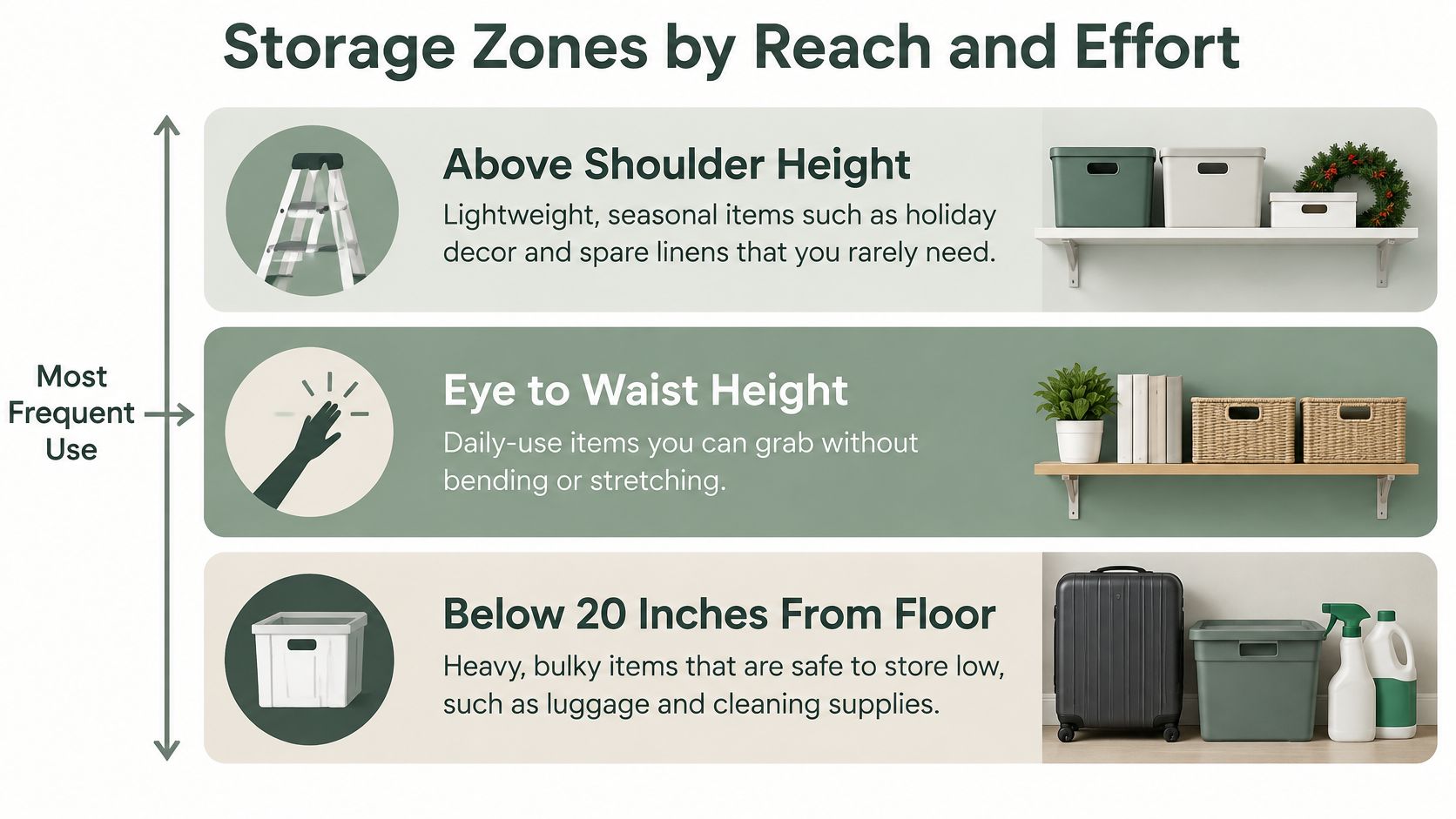
The approximate bands below adapt storage-design guidance on reach, visibility, and container depth: below about 20 inches for suitable heavy or bulky items, about 20 to 60 inches for everyday access, and above about 60 inches for lightweight, infrequently used belongings.
| Height from floor | Best for | Example items |
|---|---|---|
| Below about 20 inches | Heavy or bulky items that are safe to lift | Pet food, laundry detergent, large pots |
| About 20 to 60 inches | Daily-use items within easy reach | Everyday dishes, toiletries, school supplies |
| Above about 60 inches | Lightweight, seasonal, or rarely used items | Holiday decor, spare linens, off-season clothing |
These are starting points, not universal accessibility measurements. Adjust placement for the actual user, and keep cleaning products and other potentially hazardous items secured rather than prioritizing convenience alone.
Design for Retrieval and Return
Use these rules when choosing shelves and containers:
- Visibility: Favor single-layer arrangements where practical. If an item disappears behind another category, you'll need to search before deciding whether to replace it.
- Container depth: Make sure the back is accessible without unloading the front. Deep bins suit some bulky categories, but they're awkward for frequently used small supplies.
- Compatible sizes: Choose footprints that fit the cabinet and sit together predictably. Matching appearances matter less than usable dimensions.
- Spare capacity: Leave room for ordinary purchases and items returning from use. A tightly packed category requires rearranging whenever anything changes.
For example, in an older Eastern Shore home with a shallow closet, narrower shelving and a single accessible rod may work better than deep bins. That's a design example, not a reason to replace existing storage automatically. Measure the opening, check door clearance, and try the arrangement before buying.
The home organization product guide can help you consider options after you know what each container must hold.
Practical rule: A storage system isn't finished until the person using it can put things back comfortably.
Keep the working formula simple: one category, one home, one container, one label. Adapt it when an item needs special handling rather than forcing everything into identical boxes.
How an Organizing Project Unfolds, Step by Step
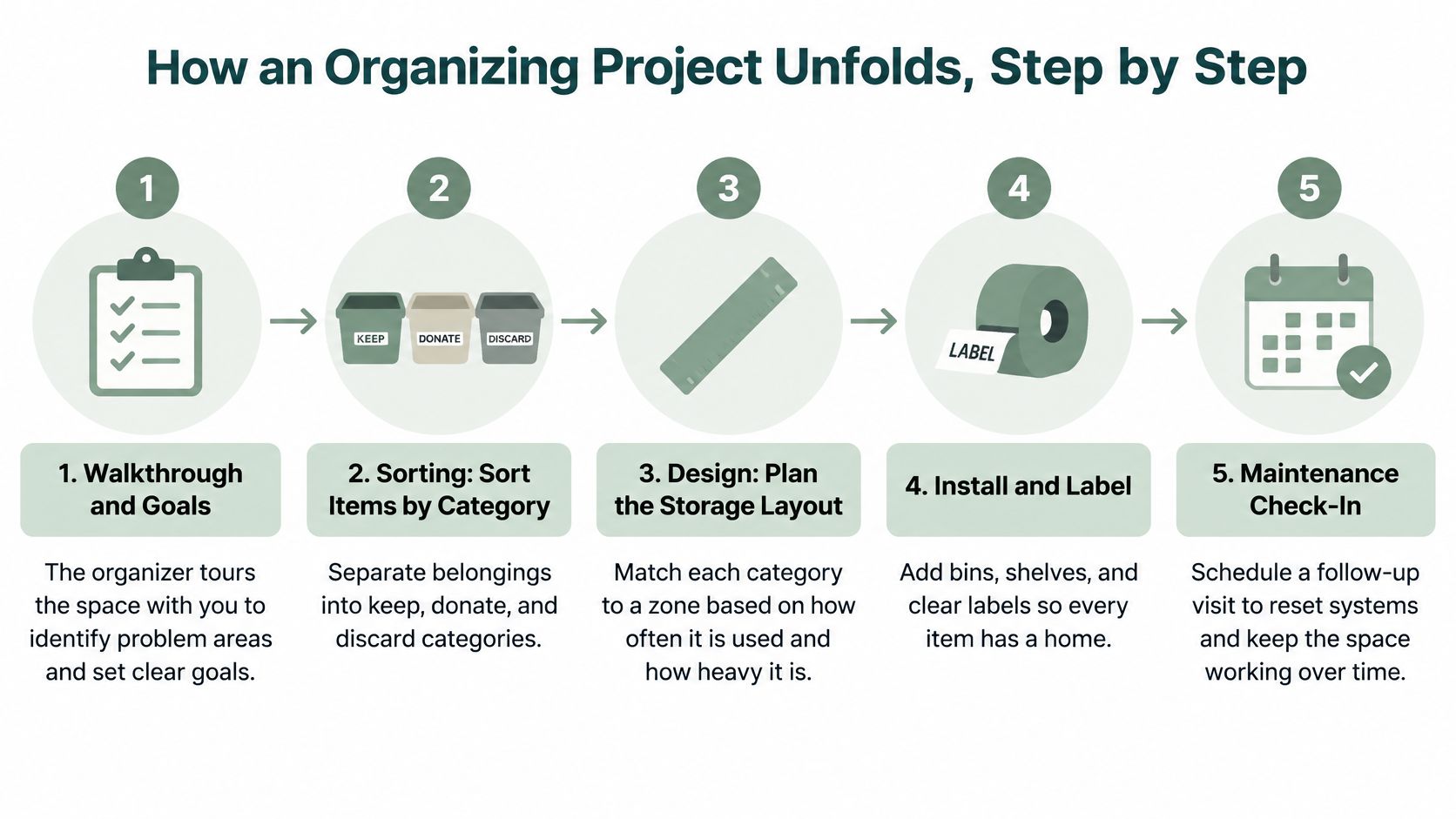
A well-run project follows an agreed sequence, so you know what will happen before anyone empties a drawer. The organizer should explain where your participation is needed and what can continue without you standing nearby.
The overview below shows the broad phases. The detailed sequence includes the decisions and testing that make those phases useful.
From Walkthrough to a Working System
Walkthrough and goals. Tour the agreed spaces together and choose a few concrete outcomes, such as finding school supplies easily or reclaiming the office desk. The common slip is treating appearance as the goal without discussing the routine that's difficult.
Zone mapping. Identify daily-use areas, overflow storage, and unused space, then establish room boundaries before moving belongings. Without boundaries, an organizer can accidentally shift the problem into another room.
Decision session. You decide what to keep, donate, store, or discard, with an agreed holding place for uncertain items. Skipping this conversation leads to buying bins before anyone knows what they need to hold.
Category sorting. Group similar belongings and identify duplicates or misplaced items for your review. Removing duplicates without checking their purpose is a mistake, particularly when household members maintain separate supplies.
System build. Fit the approved belongings into shelves, bins, and labels using the reach principles already described. Packing containers to the top leaves no tolerance for normal household changes.
Retrieval test. Retrieve and return familiar items yourself, including anything used by children or someone with limited reach. Watching the organizer demonstrate isn't enough, because their movement and habits may differ from yours.
Maintenance plan. Agree on a manageable reset routine and a check-in after the first month. The common slip is leaving with instructions that require more attention than the household can realistically give.
What Completion Should Look Like
At handover, you should know where everyday belongings go and how to handle incoming items. Approved donations and discarded materials should have an agreed destination, not remain as unexplained bags beside the door.
A finished room doesn't have to look untouched. It has to work when people are living in it.
Keep labels understandable to the people who use them. If a household member can't find or return something during the test, adjust the arrangement before calling the project complete.
How Organizing and Cleaning Work Best Together
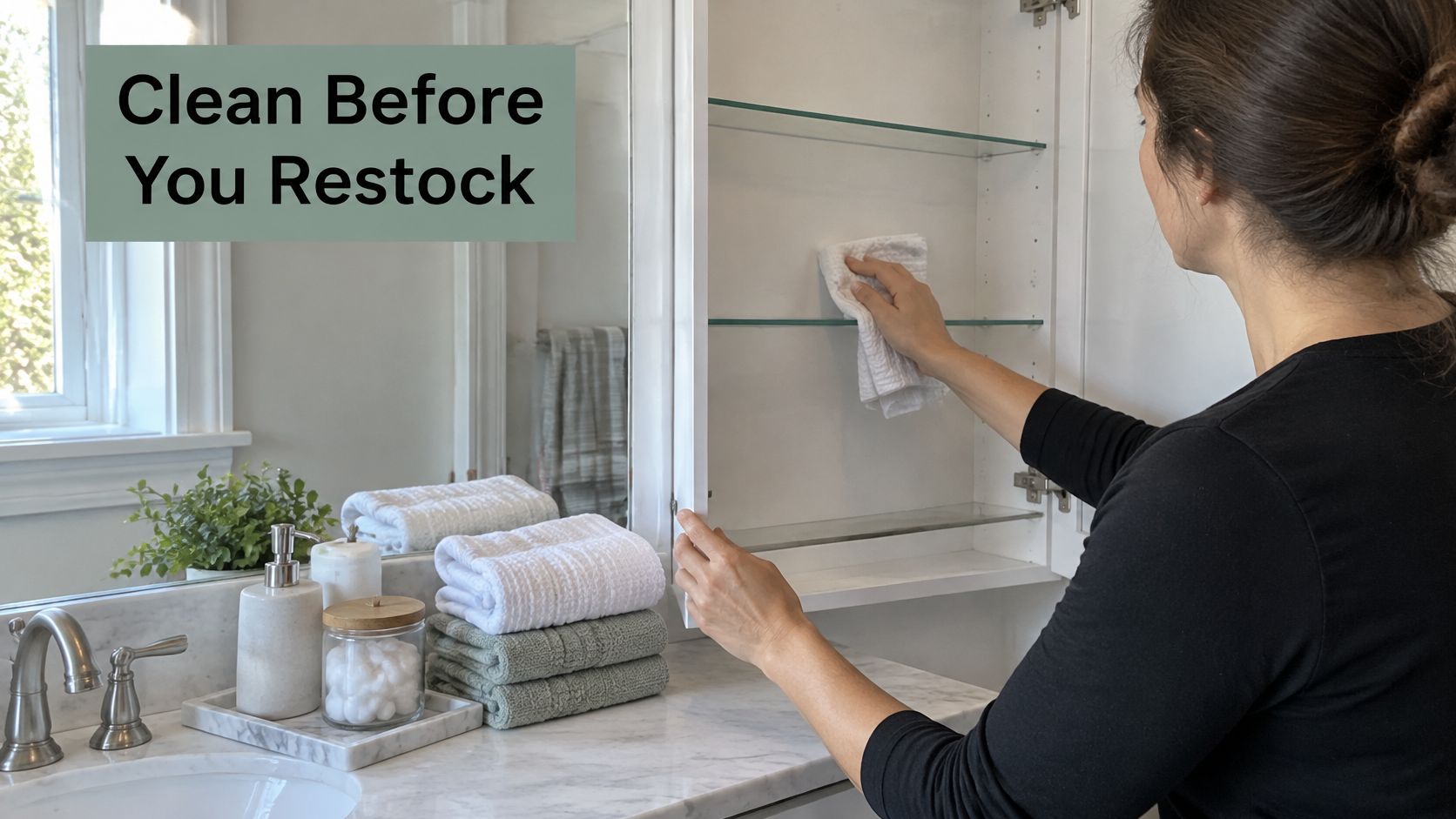
Clear and sort first, clean the emptied surfaces, then install and label. Finish with a maintenance clean of the work area rather than placing organized belongings back onto dusty or damp shelves.
For a bathroom cabinet, that means reviewing products before wiping the interior and letting it dry. Return the approved items to labeled zones afterward, keeping medication disposal separate from ordinary household discards.
Plan Around Moisture and Tracked-In Material
For Gulf Coast homes, storage decisions should account for damp conditions. The EPA's indoor-air guidance recommends indoor relative humidity below 60%, ideally 30% to 50%, and identifies poorly ventilated bathrooms and other moist areas as places that can encourage mold and biological contaminants.
Don't pack a closet tightly or push stored belongings against a damp wall and assume the problem is solved. Leave airflow space, investigate condensation, and avoid returning damp contents to enclosed storage.
A humidity meter makes checking conditions more objective. The EPA's moisture-control guide describes these instruments as commonly available at hardware stores, with an example price range of $10 to $50.
- Beach sand: For Gulf Shores and Orange Beach households, establish a mat and washable-bin zone near the entrance used after beach trips. Keep sandy equipment separate from clean linens.
- Spring pollen: Favor entry storage with wipeable surfaces and doors where appropriate. Don't create an arrangement that requires moving numerous decorative baskets before cleaning.
- Existing buildup: If emptied cabinets or neglected edges need more attention, discuss deep cleaning before the storage system goes back in.
Prepare for Seasonal Resets
The official Atlantic hurricane season runs June 1 through November 30, although activity can occur outside those dates, according to NOAA's tropical cyclone climatology. A pre-season reset should keep floor paths accessible and household supplies grouped so you're not searching through unrelated belongings.
After a storm, address tracked-in water and debris before reorganizing, and keep unsafe or damaged areas outside an ordinary cleaning visit's scope. Organizing isn't a substitute for addressing water intrusion or necessary repairs.
For vacation rental turnovers in Gulf Shores and Orange Beach, clearly separated linen and replenishment zones can simplify the reset without mixing guest-ready stock with used items. Sweet Home Cleaning Service can combine organization and cleaning in a visit when the agreed scope and schedule allow, so ask which tasks can realistically be completed together.
Organizing Shared Homes, Tight Storage and Letting Go
Limited storage isn't the only obstacle. In a July 2025 YouGov survey of 1,155 adults, 46% named insufficient storage, 41% too many belongings, 37% difficulty letting go, and 26% other household members as organizing challenges; 46% said their households organize only when clutter becomes unmanageable.
Those findings support a practical approach: agree on decisions and upkeep before attempting a complete reset. Buying storage won't resolve a disagreement about whose belongings can move.

Make Agreements That Fit the Household
When people disagree, establish who has the final say over shared items and keep personal belongings under their owner's control. Review an agreed “maybe” area weekly rather than allowing uncertain items to spread across cleared surfaces.
When storage can't expand, decide which belongings earn the available space. Fewer, larger containers may work for broad categories, but only if they remain manageable to lift and search. The maintenance focus is controlling incoming items, not repeatedly repacking an already full closet.
Renters should agree on removable hardware and freestanding storage that comply with the lease. For older adults or anyone with limited mobility, prioritize accessible everyday locations and test them with the user rather than assuming a standard layout will suit.
Protect Private and Sentimental Belongings
Important papers should go into a labeled archive with an agreed review date, never into disposal by default. Sentimental items deserve a separate decision process, particularly when someone isn't ready to review them during the visit.
In occupied home offices, agree on who may handle documents, which drawers remain closed, and where active work must stay. Apply the same clarity to medications, valuables, and sensitive family materials. Photos should require separate permission, not be treated as part of routine access.
A 2025 American Home Shield survey of 1,000 U.S. adults found that 30% felt shame when comparing their homes with online content. Easier routines are a better target than social-media presentation.
The practical home organization guide offers further ideas to adapt, not standards your household must meet.
Client control: You can pause, change the pace, or stop work in a room at any time.
Choosing a Provider and Booking a Free Quote
Before booking professional home organization services, check how the provider handles decisions, access, and unfinished work. A useful conversation should leave you knowing what will happen, what you'll need to approve, and what the team won't do.
Provider Checklist Before You Book
Use this screen before signing with an organizer or cleaning service. A red flag is a reason to slow down and request clarification in writing.
| Criterion | What to ask | Red flag |
|---|---|---|
| Process | Do they walk the home and agree on goals before sorting? | Sorting starts before any conversation |
| Privacy | Who sees the home, and are photos taken or shared? | Photos posted without written permission |
| Pricing | Is the quote itemized with inclusions and exclusions? | No written scope or unclear add-on fees |
| Insurance and bonding | Are their staff insured and bonded? | No straight answer |
| Follow-up | What maintenance visit or check-in is included? | A reset with no plan for upkeep |
| Local conditions | How do they plan for humidity, sand, and storm season? | Generic advice with no mention of Gulf Coast conditions |
Process comes first because an organizer needs to understand your priorities before touching belongings. Ask whether everyone involved in household decisions should attend the walkthrough and how unavailable decision-makers will be consulted.
Privacy deserves its own answer. Confirm who enters the home, whether subcontractors are involved, how access is managed, and whether photographs can be declined entirely. Permission to work in a room isn't permission to publish it.
Turn the Conversation Into a Written Scope
The pricing document should name the billing model and identify purchases or tasks requiring additional approval. Ask directly about staff insurance and bonding rather than assuming either from a professional-looking website.
Follow-up should be equally clear. Find out whether a check-in is included, optional, or separately billed, and what happens if a storage arrangement proves awkward during normal use. Local planning should address the conditions relevant to your home without turning a straightforward visit into an unnecessary project.
Sweet Home Cleaning Service is a Fairhope-based, locally operated option offering home organization alongside standard house cleaning, recurring maid service weekly, biweekly, or monthly, deep cleaning, move-in/move-out cleaning, and vacation rental cleaning. The useful starting point is a defined household problem, whether that's a difficult pantry, an inaccessible closet, or storage that needs attention before cleaning.
When requesting a quote, describe the room, the daily frustration, and any privacy or access limits. You don't need to hide the difficult areas or purchase supplies first. An accurate description helps establish a realistic scope and protects your time.
Sweet Home Cleaning Service offers home organization and cleaning to help households create storage that works through ordinary, busy days. If you're in Fairhope, Daphne, Spanish Fort, Gulf Shores, or Orange Beach, visit Sweet Home Cleaning Service to book or request a free quote online, by phone, or by email, and describe the space you'd like to make easier to use.

Let us handle the cleaning. Enjoy your home.


Sweet Home Cleaning Service
19940 State HWY 181, Suite E Fairhope, AL 36532
Phone: (251) 586-4081
sales@sweethomecleaningservice.com