Best Home Organization Products for Coastal Living


You know the feeling. The pantry is crowded, the garage has picked up beach sand again, and the closet feels damp enough that cardboard and woven bins never quite last through a full season in Fairhope. Sweet Home Cleaning Service sees that pattern a lot across Daphne, Spanish Fort, Gulf Shores, and Orange Beach, where humidity, pollen, and storm prep change what works at home.
The best home organization products for coastal living aren't the prettiest ones in a catalog. They're the ones that hold up to moisture, clean quickly after a sandy week, and keep working when hurricane season turns storage into a safety issue.
Table of Contents
Why Coastal Homes Need Specialized Storage Systems
A coastal home can look organized on Saturday and feel undone by Tuesday. Shoes track in sand from the porch, spring pollen settles on open shelves, and anything left in a humid garage starts to feel harder to maintain. In Fairhope, the same mistake shows up room after room, pretty baskets that can't handle moisture, or storage that looks good until real life hits it.
The global home-organization-products market was estimated at $21.6 billion in 2025 and is projected to reach $32.1 billion by 2034, with a 4.5% compound annual growth rate and $10.5 billion in additional annual sales over the period (Dataintelo market report). That growth points to a practical habit. Families keep buying durable systems because temporary fixes lose usefulness fast in homes that face humidity, salt air, and frequent cleanup.
Clutter costs more than square footage
A 2025 survey of 1,000 self-storage customers found that clutter changes how people use their homes. 21% said they dedicate more than 500 square feet to storage, while 54% said they give up between 100 and 500 square feet for things they rarely use (Storable and SpareFoot report). Garages were also heavily affected, with 31% saying theirs were at least half-filled with clutter and 9% saying they couldn't park a car inside.
That same report found that 56% buy storage or organizational solutions at least once a year, and 29% spend as much as $750 annually on shelves and bins. For Gulf Coast homes, the takeaway is straightforward. Choose products that reclaim floor space, resist damp conditions, and make items easy to put back where they belong. Those are the systems that keep earning their place when the house is busy and the season changes.
Practical rule: If a storage product can't handle a damp garage or a sandy entryway, it is not a real solution for coastal living.
For homeowners comparing options, Sweet Home Cleaning Service's Gulf Shores cleaning tips fit naturally into the bigger picture, because a clean house stays organized more easily when the storage itself can withstand the environment.
Evaluating Shelf Strength and Load Capacity
A shelf that looks sturdy in a showroom can sag fast once canned goods, detergent bottles, or folded linens land on it. In Daphne and Spanish Fort homes, buyers trust the finish instead of the structure, and that is where shelves fail. Real capacity depends on span, fastening, and where the weight sits.
Read the shelf like a structure, not a style choice
For closet organizers, Sherwood Shelving guidance puts a practical benchmark at about 50 to 75 lb of evenly distributed static load across a 25 to 36 in span, or roughly 23 to 34 kg across 64 to 91 cm. The same manufacturer guidance also points out that spans of 36 to 48 in may need a center support and should generally stay near 40 to 50 lb of evenly distributed load. Longer unsupported spans increase bending stress and deflection, and a centered heavy object can create a weak point even when the shelf's total rating looks acceptable.
Match the shelf to the room it serves. Pantry shelves, garage racks, and linen storage need different assumptions than a light clothing closet.
Put heavy items near the supports, not in the middle, and do not treat a uniform-load rating like a license to stack one dense object wherever it fits.
A quick way to judge a product is to ask how it mounts. Stud-mounted rails, proper anchors for the wall substrate, and enough fasteners matter more than glossy marketing language. The same basic principle shows up in children's furniture stability testing, where weight, force, and attachment quality decide whether a unit stays dependable.
Choosing Materials That Survive Gulf Coast Humidity
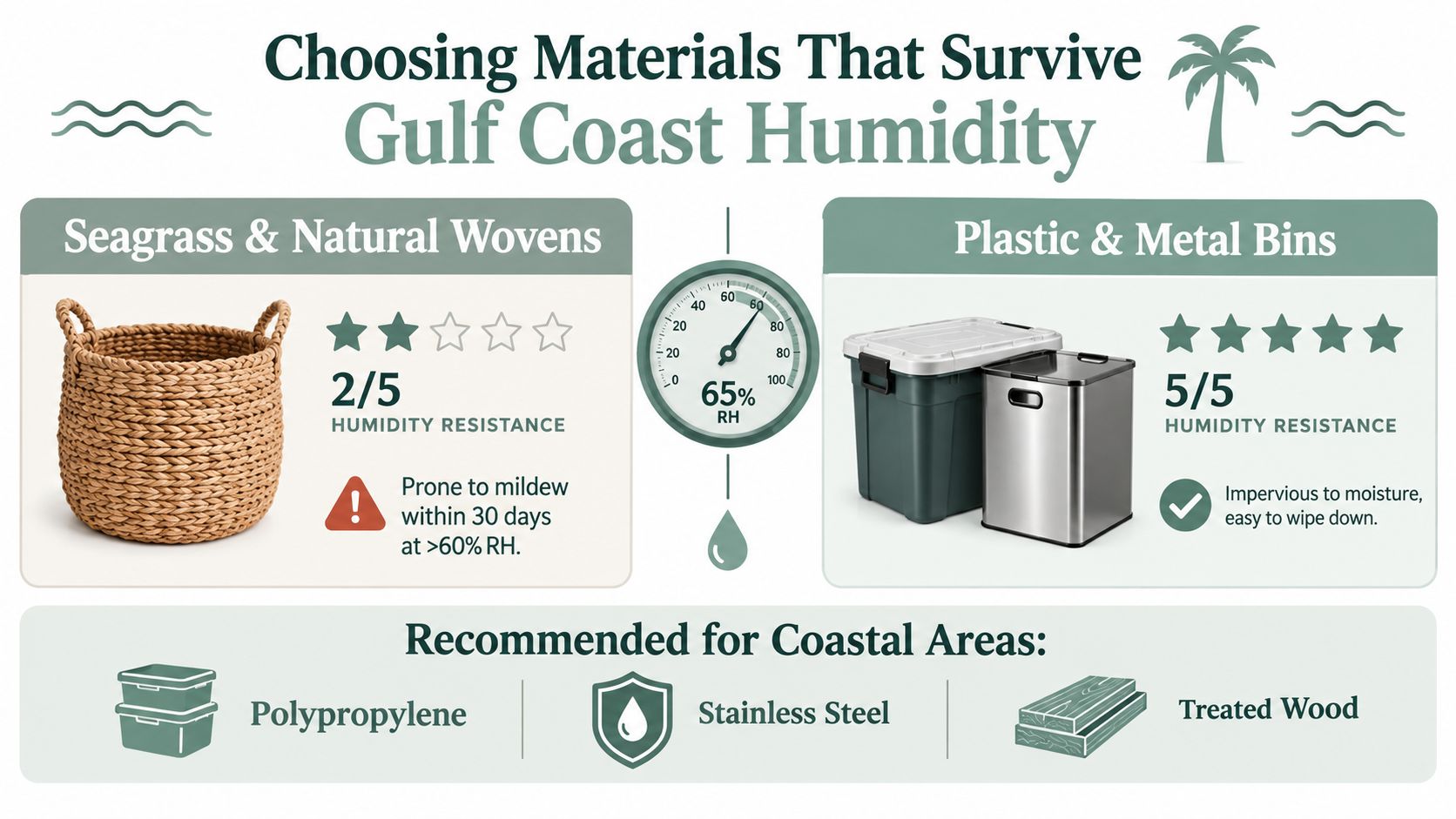
A basket can look perfect in a dry showroom and still fail fast in a coastal laundry room. In Gulf Shores and Orange Beach, the issue isn't taste, it's whether the material can stand up to moisture, sand, and repeated wiping without breaking down.
Compare for lifespan, not just appearance
Clear plastic, polypropylene bins, and metal containers tend to make more sense in humid zones because they're easier to clean and less likely to hold onto moisture. Natural fibers like seagrass and many fabric bins can work in drier rooms, but in a damp garage or beach-entry area they're harder to keep fresh-looking. For homes near the water, that makes wipe-clean surfaces a better daily choice than decorative texture.
Sustainable storage deserves the same practical test. Market coverage has been pushing modular, recyclable, bamboo, and reusable products, but “eco-friendly” doesn't tell you enough on its own. A better framework compares durability, repairability, cleanability, moisture resistance, and end-of-life options before you buy.
- Choose clear containers when visibility matters: They help prevent duplicate purchases and make pantry resets easier.
- Use fabric only where moisture is low: Fabric bins are usually better for dry closets than for garages or laundry areas.
- Reserve bamboo for protected spaces: It can look polished, but it needs a drier environment to stay attractive.
- Prefer metal with a protective finish: It works well when you need structure and frequent cleaning.
For coastal homes, the material question is also a maintenance question. If a bin or basket forces you to baby it, it probably won't survive real household use.
Families who want a simple rule can use this one. Buy the container you can clean quickly after a humid week, not the one that only looks good on day one. That's especially true in homes that also need a storm plan, because storage has to flex from everyday use to emergency mode without becoming a second job.
How to remove water stains from wood is a useful companion topic for anyone using wood shelves or furniture in humid rooms, because surface care matters just as much as the container itself.
Designing Ergonomic Retrieval Zones for Daily Use
Storage only works when your family can reach it without making a mess every time. That's the part people miss when they buy larger bins or more shelving. In Fairhope households with kids, roommates, or busy work schedules, retrieval needs to be easy enough that people put things back.
Match the product to the motion
Use about 12 in of vertical clearance for baking sheets, and keep about 12 in of shelf depth for folded clothing when you want stacks that don't collapse into each other (Organize Home Logic guidance). Frequent-use items belong in the middle zone, not on the floor and not overhead. Pull-out components help because they reduce the number of movements it takes to retrieve and return items.
The cleanest setup usually combines a few simple parts.
- Adjustable shelf pins: Let you change zones as needs change.
- Labeled bins: Keep small, repeat-use items grouped by purpose.
- Pull-out drawers or baskets: Help prevent deep shelves from becoming dead space.
- Shallow containers for frequent items: Easier to scan and easier to return.
- Deeper containers for light or seasonal items: Better for bulky things that don't need daily access.
The easiest system to maintain is the one that makes the right action the fastest action.
Dual hanging levels can help closets use vertical space better, but the heaviest garments still need to sit near structural supports. In pantries, I'd rather see a few well-sized bins and a clear layout than a wall of oversized containers that force people to dig. That's where good organization starts to feel invisible, because the room starts working with your habits instead of against them.
Integrating Hurricane Preparedness Into Everyday Storage
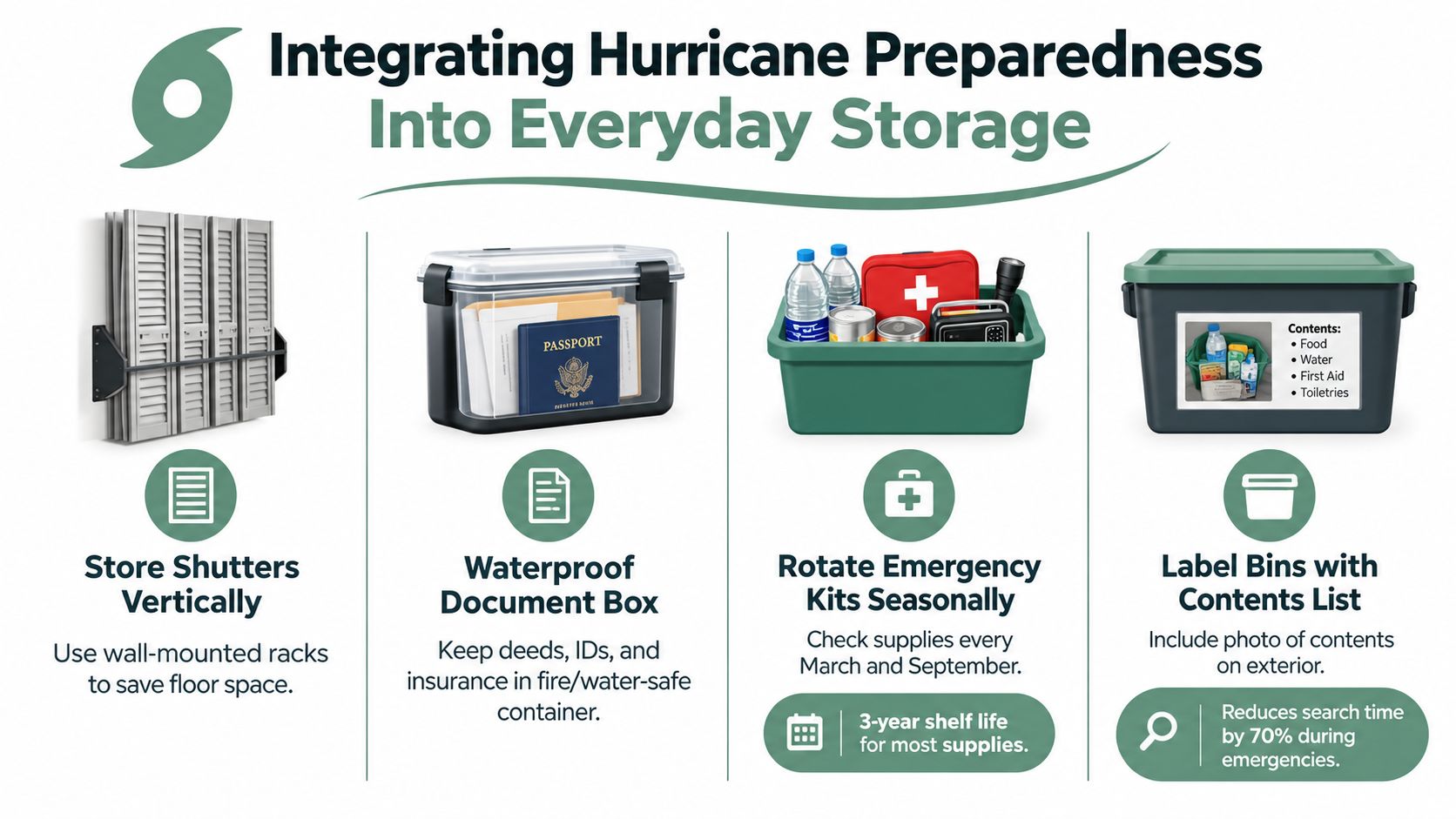
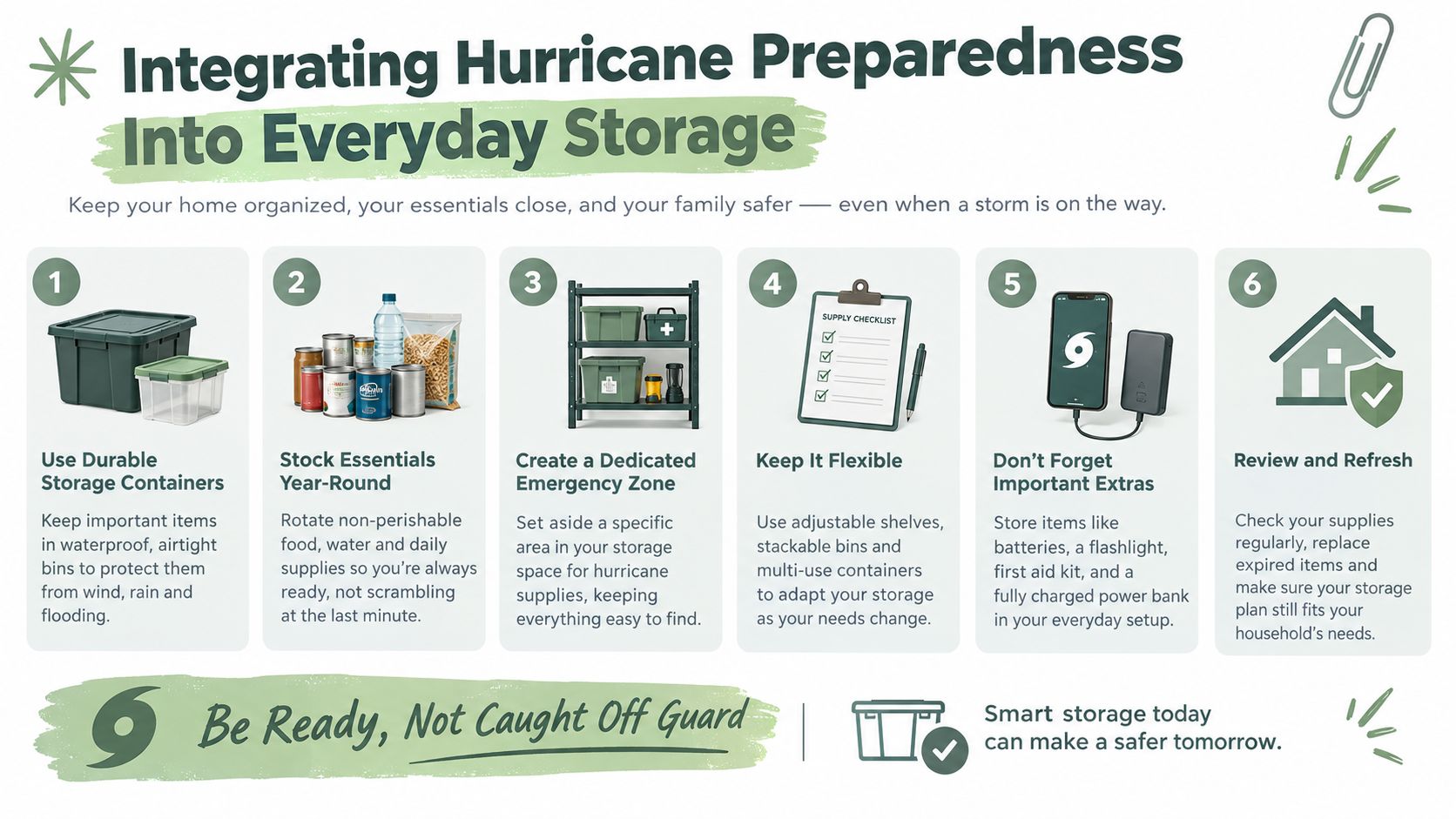
In coastal Alabama, storage has another job, it has to support storm readiness. That's true in Fairhope, Orange Beach, and Gulf Shores especially, where a garage or hall closet can become evacuation prep central in a hurry. The smartest systems don't separate daily life from storm prep, they make both easier.
Build one system that serves both routines
FEMA recommends storing important documents in a waterproof container so they stay dry and accessible during an emergency (FEMA hurricane preparation guide). A practical version is a clearly labeled, portable file box with identification, insurance records, medical information, prescriptions, property documents, and contact lists inside. Keep it somewhere easy to grab, not buried behind holiday décor or summer bins.
A hurricane-preparation manual also recommends keeping a household-goods inventory with photographs stored alongside other important records in a secure waterproof container (Highland Beach hurricane manual). In real homes, that means labeled folders for receipts, serial numbers, and appliance records, organized by room so updates are simple after a move, turnover, or replacement purchase.
Outdoor storage needs the same kind of discipline. The National Weather Service recommends bringing in furniture, birdfeeders, decorations, and trash bins before a storm, and tying down trash and recycling bin lids when items can't come inside (NWS marine debris fact sheet). That's why a garage storm zone works so well, it keeps tie-down supplies, bins, and outdoor items together instead of scattered.
For homeowners also thinking about exterior upgrades, choosing storm rated patio doors is worth reviewing alongside storage planning, because access points and storage flow both matter when a storm is approaching.
Maintaining Your Systems With Professional Support
Even well-chosen storage products need upkeep. Sand settles in drawer tracks, pollen lands on open bins, and humid rooms make neglected corners feel heavier to manage. In Fairhope, Daphne, and Spanish Fort, the homes that stay organized are usually the ones that get regular cleaning, not just a one-time reset.
Keep the system easy to maintain
The first thing I look at is whether the setup can be cleaned without undoing it. Open shelves collect dust faster than closed storage, and bins that need to be emptied every time they're wiped down usually get ignored. That's why recurring maid service and standard house cleaning often help more than buying one more organizer.
Sweet Home Cleaning Service also offers home organization support, which fits naturally with deep cleaning, move-in/move-out cleaning, and recurring service when a room needs a full reset. In practical terms, that can mean sorting, labeling, and setting up storage systems that are easier to maintain between visits.
If a system falls apart the moment the family gets busy, it wasn't finished yet.
For Gulf Coast homes, maintenance matters after storms too. A garage that doubles as storm storage, a pantry that holds backup supplies, or a vacation rental in Orange Beach all need routines that keep things functional without adding friction. That's where a local cleaning team earns its keep, not by making storage look staged, but by helping the household stay ahead of buildup.
Sweet Home Cleaning Service serves homeowners and renters who want a cleaner, more workable home in Fairhope and nearby coastal communities. Book standard cleaning, recurring maid service, deep cleaning, move-in/move-out cleaning, or home organization support when you want your storage systems to stay useful, not just look good for a week. Visit Sweet Home Cleaning Service and request a free quote for your Fairhope, Daphne, Spanish Fort, Gulf Shores, or Orange Beach home.

Let us handle the cleaning. Enjoy your home.
Sweet Home Cleaning Service
19940 State HWY 181, Suite E Fairhope, AL 36532
Phone: (251) 586-4081
sales@sweethomecleaningservice.com