How Do You Clean a Textured Ceiling Safely, Step by Step

Most popular advice for a dirty textured ceiling tells you to grab a spray bottle, a sponge, or a broom and start scrubbing. That advice skips the only question that matters first. Is this ceiling safe to disturb at all? Textured finishes are raised, porous, and fragile, and older ones can raise an asbestos concern that ordinary dusting advice never mentions.
At Sweet Home Cleaning Service, we treat that safety and moisture check as step zero for Fairhope homeowners. If you're asking how do you clean a textured ceiling, the honest answer starts with knowing when not to clean it, then matching a gentle method to the exact texture you have. Done in that order, you can remove dust and light marks without knocking texture loose, soaking drywall, or turning a routine clean into a bigger problem.
Table of Contents
- Check Your Ceiling Before Any Cleaning
- Match the Method to Your Texture Type
- How to Clean a Textured Ceiling Step by Step
- Remove Stains Without Soaking the Texture
- Decide Whether to Clean, Test, or Call a Professional
Check Your Ceiling Before Any Cleaning
A ceiling can be cleaned at home only if it is intact and either confirmed asbestos-free by lab testing or clearly built after the 1945 to 1978 period. The U.S. Consumer Product Safety Commission asbestos guide notes that asbestos was used in some sprayed or troweled ceiling and wall materials in buildings constructed or remodeled between 1945 and 1978, and in textured paints and ceiling joint compounds banned in 1977. Age alone does not rule out asbestos in older ceilings. If the finish fails that test, stop.
Homeowners in Fairhope, Daphne, and Spanish Fort run into this when they buy an older house with popcorn texture. Humidity is the other hard stop. Gulf Coast air keeps stains coming back, and a mark that looks dry can still be soft underneath. Wiping that spot drives water into the peaks and loosens the finish.
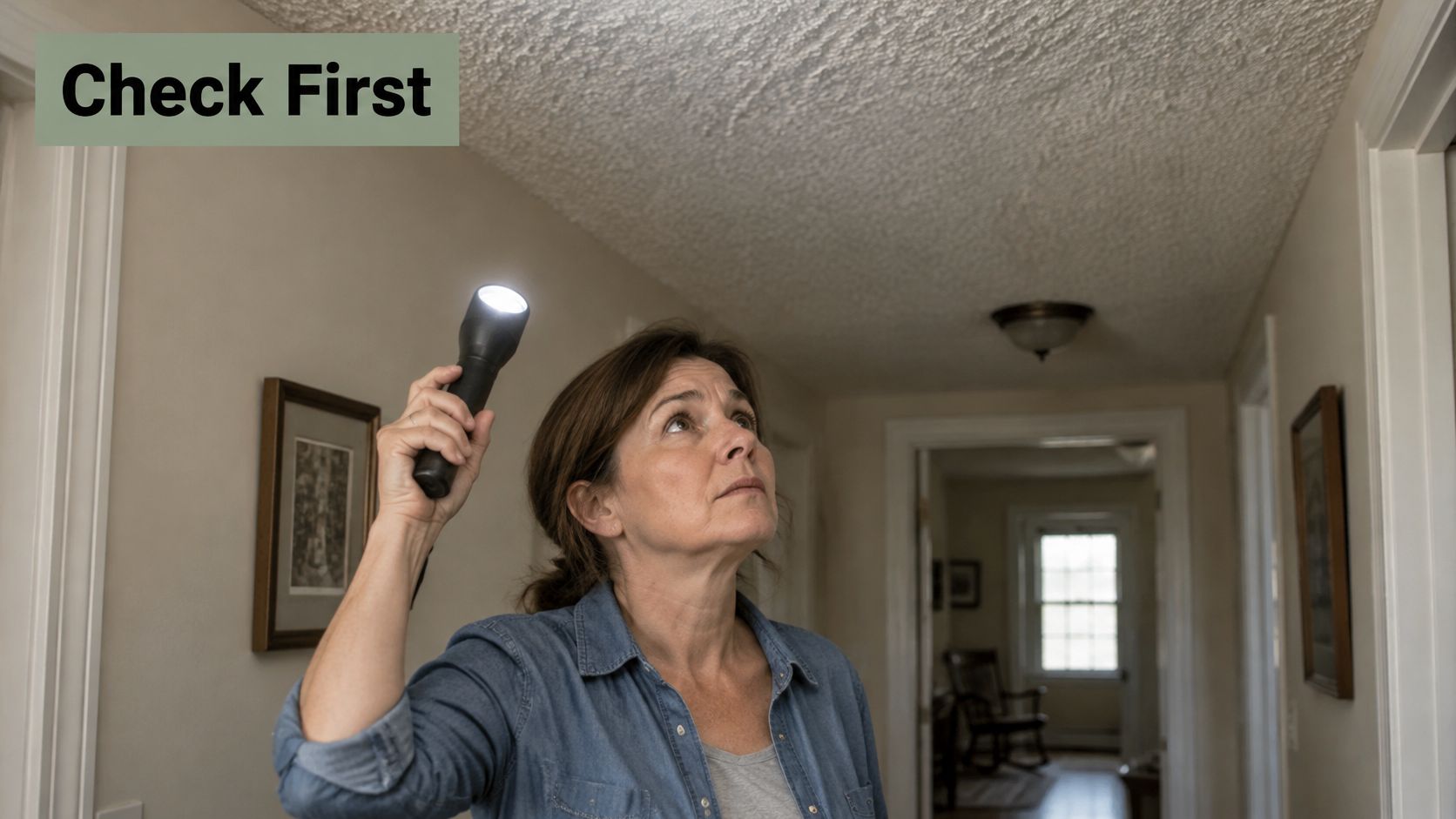
Use This Go or Stop Check
- Find the build year. Check sale records and remodel history. A newer coat over older material does not settle the question.
- Inspect without touching. From the floor or a stable ladder, look for flaking, crumbling, water stains, sagging, or soft spots.
- Don't trust your eyes for asbestos. The EPA guidance on identifying asbestos in the home states that visual inspection cannot confirm asbestos and only testing by a qualified laboratory can do so.
- Stop if it's damaged, damp, or unknown. Restrict access and arrange assessment by a trained asbestos professional. Do not brush or vacuum it.
- Proceed only if it's intact and cleared. Use the gentlest method that lifts loose dust, and keep water off any stain that still feels soft.
For any suspect ceiling, dry sweeping, scraping, sanding, drilling, and ordinary vacuuming are off the table because they can create and spread dust. Even post-renovation cleanup needs that pause, which is why our guide to handling dust from construction separates normal dust from surfaces that shouldn't be disturbed.
Practical rule: If texture comes off when you look at it closely, leaves grit on the floor below, or feels crumbly, cleaning is the wrong job.
I would not put a cloth on a ceiling that fails any of those checks. When you book with Sweet Home Cleaning Service, use the special instructions on the booking form to note the ceiling's age and condition so the crew can plan around it before any work starts.
Match the Method to Your Texture Type
Raised peaks trap dust differently depending on the finish, so one damp-cloth method doesn't fit every ceiling. Identify yours by eye from a low angle, without touching a suspect surface. Popcorn shows clustered, rounded bumps. Knockdown shows flattened peaks in a swirled pattern. Orange peel shows small, even dimples. Skip trowel shows irregular, overlapping ridges with flat gaps.
| Texture | Safe method | Tools | Water allowed | Effort |
|---|---|---|---|---|
| Popcorn (acoustic) | Dry HEPA vacuum with blotting, then spot wipe only | 3-inch natural-bristle wand, HEPA vacuum, barely damp microfiber | Barely damp, spots only | Low to moderate |
| Knockdown | Soft brush along the ridges, then a light damp wipe | Soft brush, microfiber, bucket | Lightly damp, test first | Moderate |
| Orange peel | Vacuum with brush attachment, then light wipe on marks | Soft brush, HEPA vacuum, microfiber | Lightly damp, test first | Low to moderate |
| Skip trowel | Gentle dusting, spot wipe, keep water off the ridges | Soft brush, dry microfiber, sponge | Minimal, spot only | Moderate to high |
What the Effort Ratings Mean
- Low means one vacuum pass. You're lifting loose dust and stopping there.
- Moderate means vacuuming plus spot wiping. You work in small sections and let each one dry.
- High means very small sections. Skip trowel ridges hold water in their edges, so you pause often to check for softening.
Popcorn is the most fragile finish here and gets dry or spot-only cleaning. Knockdown tolerates a lightly damp wipe along its flattened ridges because there's less loose aggregate to knock off. Orange peel looks sturdy, but it still needs a test patch because paint condition varies. Skip trowel needs the least water on its ridges, where moisture sits instead of spreading evenly.
Local conditions decide how often this matters. Spring pollen settles overhead in Fairhope and Daphne homes even with windows closed most of the day. Fine beach sand tracked into Gulf Shores and Orange Beach properties turns into airborne grit that lands on ledges and texture. Between vacation rental guests, a quick dust-only pass is usually smarter than a wet wipe, because there's no drying time to manage during a turnover.
Steam, pressure washing, and sponge scrubbing don't belong on any of these finishes. They either force moisture into the ceiling or tear at the high points you're trying to keep.
How to Clean a Textured Ceiling Step by Step
For a sound ceiling that isn't suspected to contain asbestos, gentle vacuuming comes first. Armstrong's ceiling cleaning guidelines specify a vacuum wand about 3 inches in diameter with natural-hair bristles and recommend a HEPA filter to reduce airborne dust, while warning against excessive pressure and recommending a blotting action to limit loss of texture.
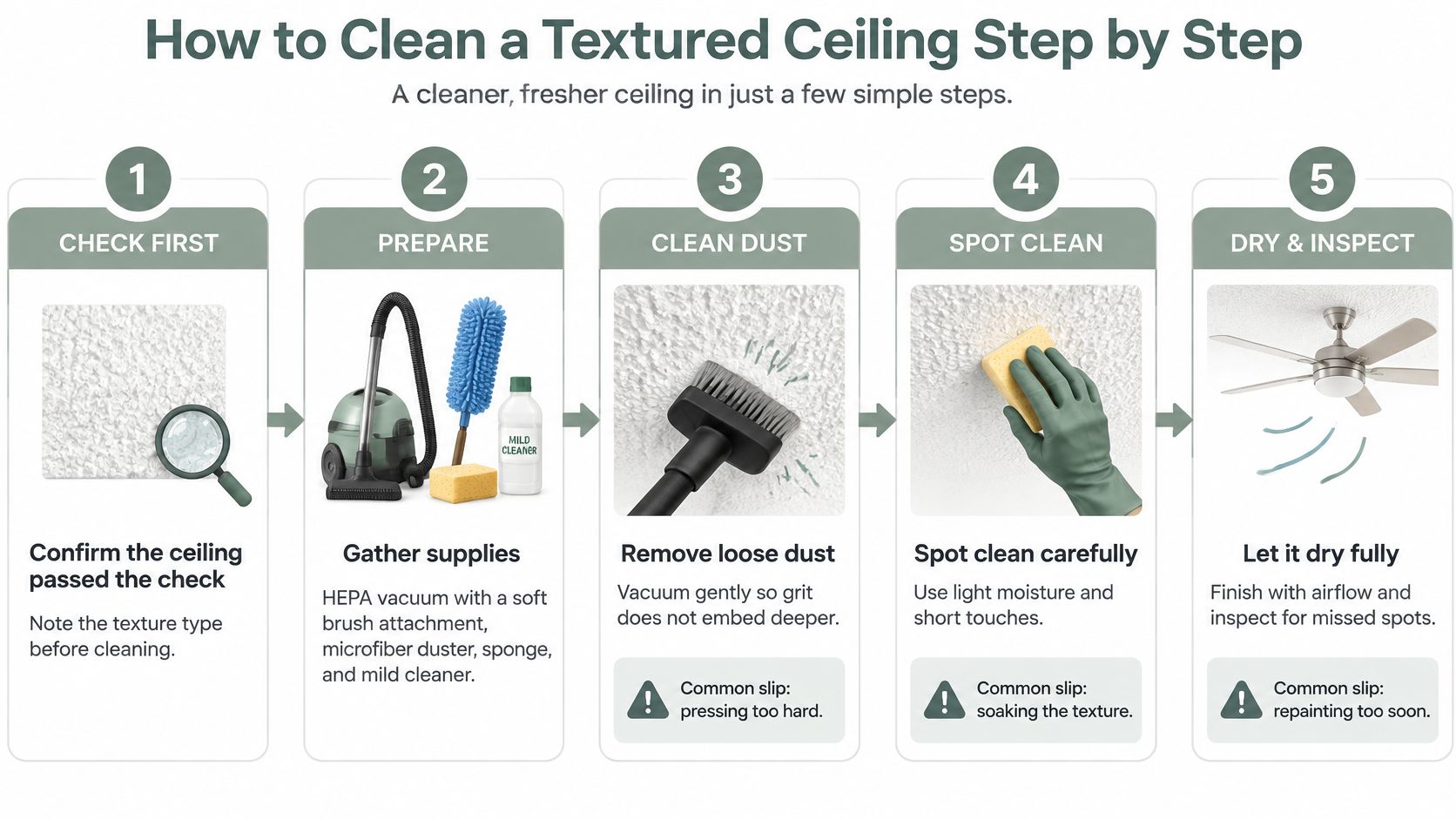
The Low-Disturbance Routine
- Confirm the ceiling passed the check. Note the texture type so you use the right water limit. Skipping this is how a fragile popcorn ceiling gets treated like washable paint.
- Gather supplies. You'll need a HEPA vacuum with a soft brush wand, microfiber cloths, a bucket, mild neutral detergent, drop cloths, a stable stepladder, and eye and respiratory protection.
- Protect the room. Cover furniture and floors, then turn off the HVAC or close room returns so falling dust doesn't travel through the system to other rooms.
- Vacuum loose dust with light blotting. Work in small sections from the perimeter inward, keeping the attachment lightly engaged. The common slip is pressing the wand into the texture, which knocks off peaks and leaves bald spots.
- Test a barely damp cloth on a hidden spot. Wring it until it feels almost dry, touch a small area near a corner, and let it dry fully. If texture transfers or color changes, stop with water entirely.
- Wipe marks with minimal rubbing. Use short, light touches instead of scrubbing back and forth. Soaking an area to speed things up softens the finish and can stain or delaminate it.
- Let each section dry before repeating. A second pass on damp texture pulls more material loose than the first. Stop if grit appears on the cloth.
- Inspect with a flashlight at a low angle. Side light reveals missed dusty patches that overhead light hides. Touch up only those spots, not the whole ceiling again.
The same restraint applies at the wall line, where ceiling texture often meets paint. If you're freshening the whole room, gentle cleaning methods for painted walls from Aqua Painting are a useful companion, since flat wall paint also marks easily under a wet, heavy hand.
For timing, I'd plan about 45 minutes to 1.5 hours for a small bedroom and 2 to 4 hours for a full living area, depending on dust load and how many spot wipes need drying time between passes. Households across Fairhope and Spanish Fort dealing with spring pollen buildup will sit at the longer end. Our general guide on how to dust high and low surfaces in order helps you sequence the rest of the room so ceiling dust doesn't land on already cleaned furniture.
Press, drag, and scrub are the three moves that damage texture. Blot, lift, and wait are the three that work.
A properly cleaned ceiling looks even in side light, with no shiny rubbed patches, no missing peaks, and no damp shadows. If one clean stripe stands out sharply against the rest, you've either removed texture or the surrounding area needs the same light vacuum pass to blend.
Remove Stains Without Soaking the Texture
A stain's cause decides the fix, and repeated scrubbing usually makes the mark bigger while the cause keeps working overhead. Photograph any stain before you touch it so you can tell next week whether it's growing.
| Stain type | Clue | Safe fix | Stop when |
|---|---|---|---|
| Surface dust | Even gray film across the texture | Dry HEPA vacuum with blotting, then barely damp wipe | Texture comes off onto the cloth |
| Cooking or smoke film | Yellow-brown haze, strongest near kitchen or fireplace | Mild neutral detergent on a wrung-out cloth, tested first | Film is sticky or keeps spreading |
| Water stain | Brown ring with a darker edge | Find and fix the source, dry 24 to 48 hours, then test clean | Stain grows, sags or returns |
| Mold-like growth | Fuzzy or dark spots with a musty smell | No bleach scrubbing, fix moisture source and get specialist evaluation | Any spread, softness or recurring growth |
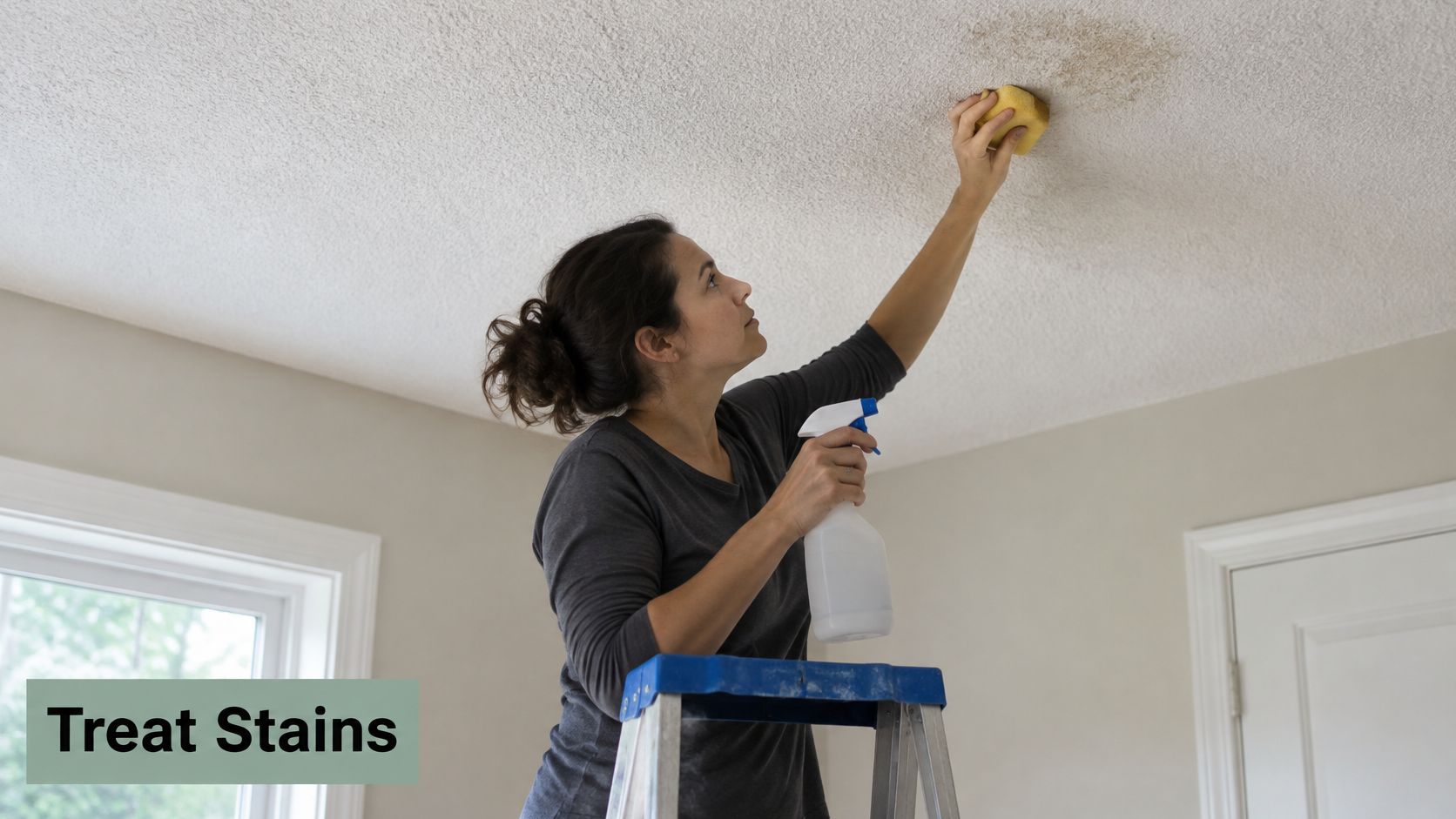
Fix the Source Before the Mark
A water stain is a symptom, not dirt. Find and repair the roof, plumbing, or condensation source first, because cleaner can't stop a leak. Oregon State University environmental health guidance on mold recommends drying water-damaged areas within 24 to 48 hours to help prevent mold growth and notes that porous materials such as ceiling tiles may need removal if they become moldy.
Only after the area is dry should you test clean a small spot with a lightly damp cloth. Painting comes last, if at all, and the advice to fix leaks before painting over stains from Alex Trend Painters explains why coating over an active problem just hides continuing damage.
Humidity control keeps stains from returning. The EPA mold and moisture resource directory emphasizes correcting the leak or humidity problem, drying wet materials within 24 to 48 hours where possible, and keeping indoor relative humidity below 60%, ideally 30 to 50%. It also notes that mold in porous materials can be difficult or impossible to remove completely, and that bleach is not recommended as the default method for mold removal.
That matters on the Gulf Coast. Humid summers and storm season leaks in Fairhope, Spanish Fort, and Orange Beach send moisture back into the same ceiling cavity, so the same ring reappears after a careful clean. Run bathroom fans during and after showers, and use dehumidification where rooms stay damp.
Never use pressure washing, steam, abrasive pads, bleach mixtures, or strong solvents without confirming compatibility. They flatten texture, drive moisture into drywall, or spread growth across porous material.
Stop rule: A stain that spreads, sags, feels soft, or returns after full drying needs a specialist, not another wipe.
Decide Whether to Clean, Test, or Call a Professional
On an older textured ceiling, cleaning is the last decision, not the first. The first is whether the texture is safe to touch at all. In Baldwin County homes, that split falls three ways, and picking the wrong one turns a dust job into a fiber or moisture problem.
Clean it yourself when the ceiling is intact, the build date is clearly after 1978 or the material is known to be safe, and the work is dust and light marks. Test first when the home was built or remodeled between 1945 and 1978, the ceiling history is unknown, or the texture is hard to identify. Call for professional help when texture is flaking, water-damaged, sagging, or growing mold, or when a test confirms asbestos.
A proper assessment starts with sampling and a qualified laboratory, not a cloth. NerdWallet's popcorn ceiling cost guide reported in 2025 that professional asbestos testing for popcorn ceilings costs approximately $480 on average in the United States. Removal pricing varies enough by room and method that a written quote matters more than any average.
If a renovation is on the table rather than a clean, read understanding asbestos risks before ceiling renovations from CS1 Real Interiors before anyone scrapes a sample area. The practical questions to put to any provider are these:
Questions to Ask Any Provider
- Who collects the samples, and how many locations will they sample?
- Which laboratory analyzes them, and will you receive the written report?
- Does the company assess only, or does it also perform removal?
- How is waste handled if material comes down?
- Will clearance air monitoring follow any suspected fiber release?
If the material is not asbestos, the standard low-disturbance method is appropriate. If asbestos is confirmed or cannot reasonably be ruled out, keep the surface wet, avoid creating dust, and leave the job to qualified asbestos professionals. A ceiling in a home being sold or rented may also need that written report before listing or move-in. Test early, not during a rushed turnover. I would not schedule a cleaning visit until that answer is in writing.
Sweet Home Cleaning Service offers standard house cleaning, recurring cleaning weekly, biweekly, or every 3 weeks, deep cleaning, and move-in and move-out cleaning across Fairhope, Daphne, Spanish Fort, Gulf Shores, and Orange Beach. Cleaning covers intact, non-suspect ceilings only. Testing and removal belong to qualified asbestos professionals.
The team is fully trained, background-checked, and insured, and brings all necessary supplies and equipment, so you do not need to provide anything. The booking form asks for contact information, address, and any special instructions, which is the right place to note an older textured ceiling. If you are deciding whether a ceiling dust pass fits a larger reset, the breakdown of what a deep clean includes shows how high dusting fits the rest of the house. Custom cleaning plans are priced individually. Contact the office for custom pricing.
If the ceiling is intact and cleared for cleaning but the ladder work, dust, and drying time do not fit your week, Sweet Home Cleaning Service can fold careful high dusting into a deep cleaning, a recurring visit, or a move-in clean for a Fairhope, Daphne, Spanish Fort, Gulf Shores, or Orange Beach home. Visit Sweet Home Cleaning Service to book, mention the ceiling's age and condition, and contact the office for custom pricing so the safest approach is set before anyone arrives.

Let us handle the cleaning. Enjoy your home.



Sweet Home Cleaning Service
19940 State HWY 181, Suite E Fairhope, AL 36532
Phone: (251) 586-4081
sales@sweethomecleaningservice.com