Office Cleaning Schedule: How Often to Clean Each Area

Your office got cleaned on Monday. By Wednesday, the break room counter's sticky, the entry floor's gritty, and nobody's sure when the shared phones were last wiped. That's not usually a cleaning problem. It's a scheduling problem, because different surfaces fail at different speeds.
At Sweet Home Cleaning Service, we think a good office cleaning schedule works like triage. You give daily attention to what people touch and where they eat, and you save the slower work for weekly or monthly visits. This guide shows you how to set those frequencies, assign owners, and adjust for Gulf Coast humidity, sand, and storm season in Fairhope, Daphne, and Spanish Fort.
Table of Contents
Office Cleaning Frequency for Every Area
A Fairhope office where restrooms get cleaned once a week and shared phones and door handles aren't wiped between visits will show the gap within days. Paper runs low, fixtures look dull, and the front door hardware gets handled by every client who walks in. Offices in Daphne and Spanish Fort run into the same pattern when they treat every room as if it needs the same interval.
The evidence points the same way. A 2018 study published in the Journal of Applied Microbiology found that cleaning physically removed approximately 50% of bacteria, fungi, and human cells from desk surfaces, yet microbial concentrations recovered fully within 2 to 5 days. A single monthly desk clean therefore leaves most of the month uncovered, especially at shared desks or where people eat while they work.
A working frequency table
Use this as your starting point, then tighten an interval when traffic, visitors, or food use makes a surface soil faster. This area by area thinking is the approach Sweet Home Cleaning Service brings to setting up a plan.
| Area or task | Frequency | Responsible | Reason |
|---|---|---|---|
| Restrooms | Daily | Cleaning staff | Fixtures and floors take the most daily use |
| Kitchen and break room | Daily | Cleaning staff | Food contact and frequent handling |
| Door handles, light switches, shared phones | Daily | Cleaning staff | Multiple people touch them every day |
| Desks and shared equipment | Two to three times a week | Cleaning staff, employees wipe personal items | Contamination returns within two to five days |
| Entry floors and high-traffic walkways | Daily, more in beach-sand season | Cleaning staff | Sand and grit track in from outside |
| Detail dusting, partitions, edges | Weekly | Cleaning staff | Low-touch surfaces collect dust gradually |
| Vents, upholstery, hard-to-reach surfaces | Monthly | Cleaning staff or vendor | Dust builds up out of sight |
| Blinds, window washing, carpet extraction | Quarterly or seasonal | Vendor | Deep work that needs equipment |
Visibly soiled areas and spills don't wait for the table. Clean them when they happen, even if that room was just serviced.
If a surface looks dusty or feels sticky before its next scheduled visit, its frequency is too low.
That simple test catches most under-scheduled offices. Raise that one task a band and watch whether complaints stop.
How to Build Your Office Cleaning Schedule
Start with the floor plan, not the calendar. A calendar built from habit will miss the copier panel everyone touches and over-clean a storage room nobody enters.
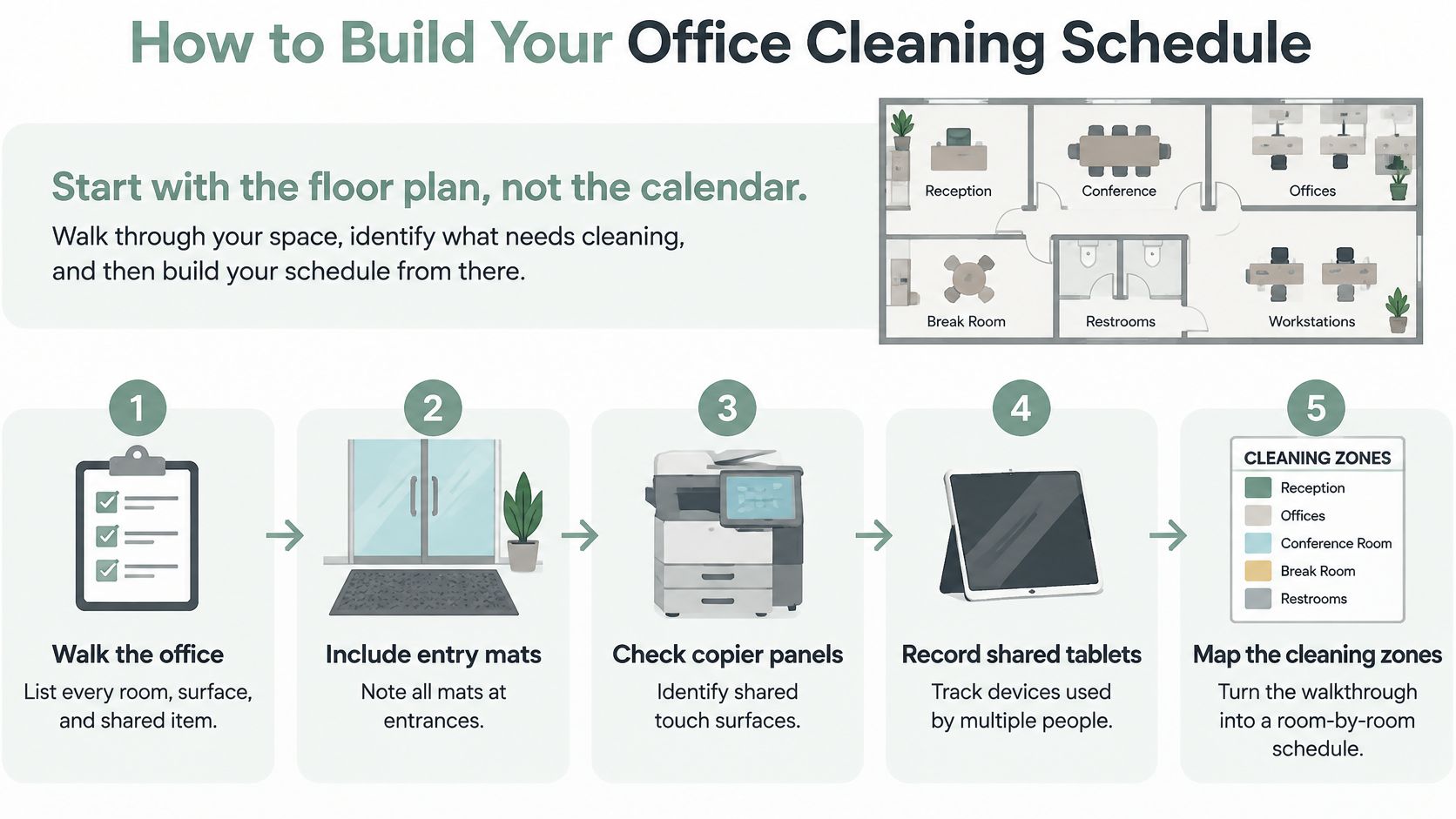
- Walk the office. List every room, surface, and shared item, including entry mats, copier panels, shared tablets, and break-room appliances, so nothing is cleaned only when someone remembers it.
- Rate each item. Judge it by how many people touch it, how much traffic it sees, how visibly it soils, and how exposed it is to illness, because that rating sets the risk.
- Place each item in a frequency band. Put high-risk items on daily service and low-touch detail work on weekly or monthly service.
- Assign an owner. Cleaners take restrooms and common areas, while employees wipe their own keyboards and phones, so personal items don't fall between two teams.
- Choose the method. Clean before disinfecting whenever dirt or organic material is visible, because disinfectant works poorly through grime.
- Turn bands into a calendar. Add days and times, and schedule vacuuming and dusting after hours or before staff arrive so disturbed particles settle.
- Add verification. Use initials, timestamps, and noted exceptions, plus a supervisor spot check each week.
- Review every quarter. Add visits when headcount, shared-desk use, or beach-sand tracking increases.
That risk-based approach matches the CDC guidance on cleaning and disinfecting a facility, which recognizes regular environmental-surface disinfection ranging from daily to three times weekly, depending on risk. It also notes that detergent and water are generally adequate in non-patient-care administrative offices.
Say a twelve-desk suite notices gritty entry mats after a busy spring. Adding a daily entry-mat clean in step six fixes the visible problem without adding a full extra visit.
Don't mark a task done without confirming coverage, correct dilution, and dwell time. A checked box isn't the same as a cleaned surface.
Task Checklists for Each Office Area
A checklist should follow the route a crew walks. That order prevents backtracking and makes a missed room obvious before keys go back in the lockbox.
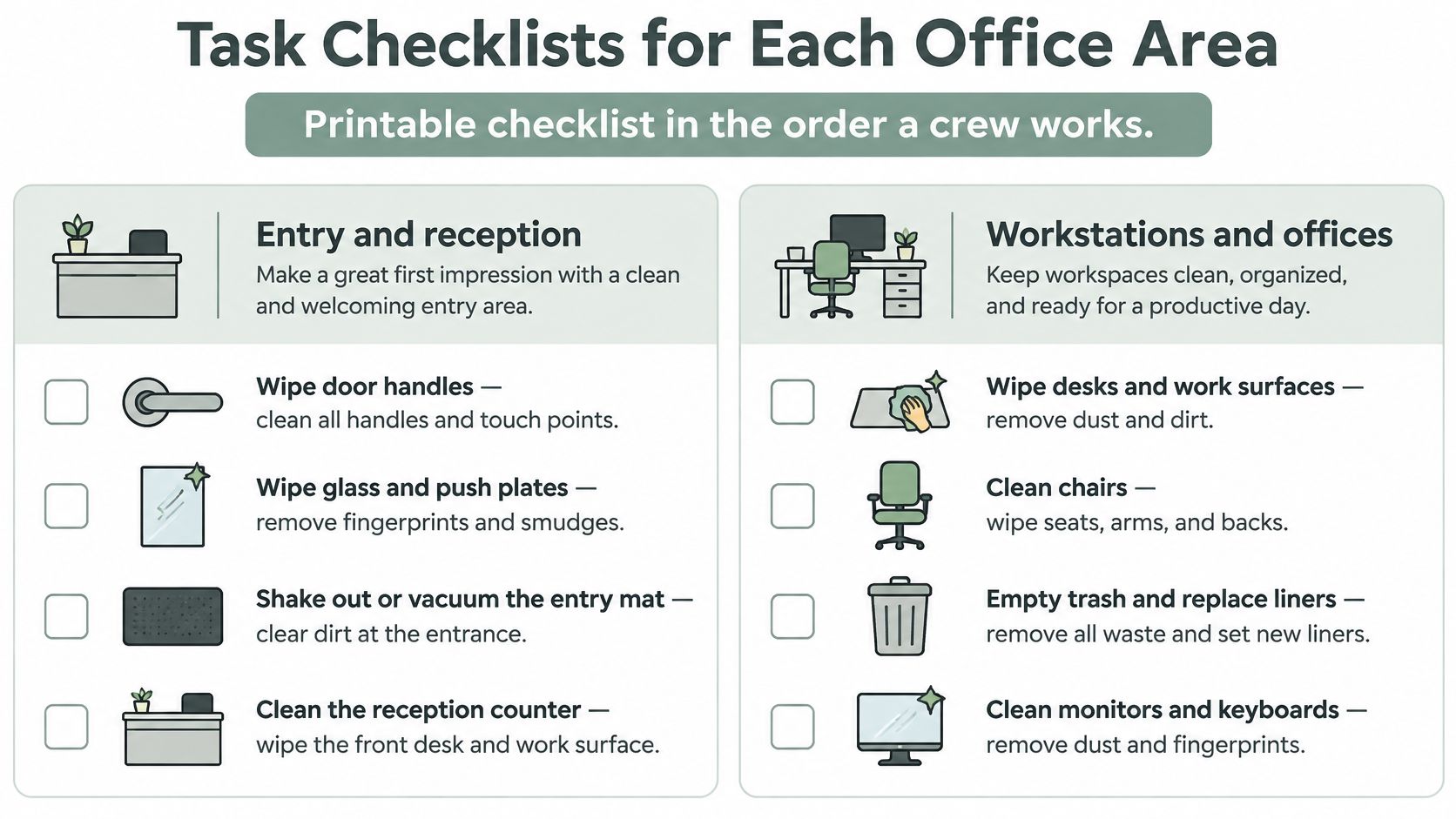
Entry, workstations, and meeting rooms
- Entry and reception: Wipe door handles, glass, and push plates, shake out or vacuum the entry mat, clean the reception counter, and empty trash.
- Workstations: Wipe desk surfaces, shared keyboards, phones, monitor stands, and chair arms, then dust shelves and partition tops.
- Conference rooms: Wipe tables, chair arms, and remote or screen controls, then vacuum, especially after client meetings and lunches.
- Shared equipment: Wipe the copier panel, printer buttons, and shared tablets, which get touched all day but rarely appear on homemade lists.
The daily list should center on the high-touch points named in CDC guidance on surfaces cleaned and disinfected at least daily, including door handles, desks, phones, light switches, and faucets. Frequency should increase with level of use, so a busy reception desk needs more than a private office does.
Restrooms, kitchen, and floors
- Restrooms: Sanitize sinks, toilets, faucets, and door handles, clean mirrors, restock paper and soap, mop floors, and check exhaust fans.
- Kitchen and break room: Wipe counters, the microwave inside and out, fridge handles, the coffee station, and sink, then sanitize tables and empty trash and recycling.
- Floors: Vacuum high-traffic paths on the daily route and mop hard floors on the scheduled day, paying attention to entry grit.
- Vents and windows: Dust with a damp cloth and vacuum instead of dry dusting, which pushes particles back into the air.
If you want the task side spelled out further, our guide to typical office cleaning duties by area breaks down who usually handles each job. For Gulf Coast offices, add a moisture check near restrooms and kitchens, looking for damp cabinet bases, musty smells, and slow drains.
Print these lists and tick the areas that apply to your space. Then add anything your team touches more often than the list assumes, because local use beats a generic template.
Weekly, Biweekly and Monthly Templates to Adapt
Every template sits on top of the daily touchpoint routine. Weekly, biweekly, and monthly work adds depth, but it doesn't replace daily restrooms, kitchens, and high-touch points.
| Template | Recurring tasks | Check-in |
|---|---|---|
| Weekly | Daily restrooms, kitchen and touchpoints; desks and shared equipment on two set days; detail dusting, partitions and edges on Friday; trash-area wash | Friday supervisor spot check |
| Biweekly | Daily touchpoints; alternating weeks cover glass, doors and break-room cabinets, then conference rooms and floors | Review the checklist every other week |
| Monthly | Upholstery, vents and return grilles, baseboards, interior windows, carpet spot treatment, supply-restock review | Monthly walk-through with the office manager |
How a sample week looks
- Monday, 6:00 p.m.: Daily restrooms and kitchen, touchpoints, desks, shared equipment, entry floors.
- Tuesday, 6:00 p.m.: Daily areas only, plus trash and a quick reception reset.
- Wednesday, 6:00 p.m.: Daily areas, desks and shared equipment again, hard-floor mop.
- Thursday, 6:00 p.m.: Daily areas, conference rooms, glass spot cleaning.
- Friday, 5:30 p.m.: Daily areas, detail dusting, partitions, edges, trash-area wash, and the Friday supervisor spot check.
Adapt by building type and use. A multi-suite building in Daphne needs more common-area frequency because hallways and shared restrooms serve several tenants. A single-entrance Fairhope suite may run lighter on floors, while any office with food service should keep its kitchen on a daily plan.
Don't copy a home routine into a business space. Our house cleaning schedule guide for recurring home service covers residential rhythms, and vacation rental turnovers follow guest departures, but an office runs on headcount, visitors, and shared equipment.
Coordinating Staff and Outside Cleaners
The most common failure isn't a bad checklist. It's a schedule that lives in one manager's inbox while staff never see it, so nobody knows what was supposed to happen or who missed it.
Visibility matters to employees. A 2021 survey reported by CNBC Make It found that 66% of U.S. workers considered improved office-cleaning practices extremely important. Post the schedule near the entrance or break room with service days and times, and combine after-hours cleaning with clearly communicated daytime touchpoint checks.
Three internal steps that hold the plan together
- Share the employee list. Name what staff wipe themselves, such as personal keyboards and phones, and put wipes where people can reach them.
- Keep a shared log. Record initials and time for each visit, plus anything skipped because a room was locked or occupied.
- Name one contact. Give staff one person who receives missed-task reports, and state how quickly that person should respond, ideally the same business day.
For outside cleaners, write a scope of work that lists tasks, frequency bands, access and alarm details, who supplies products, and what happens when a visit is missed. During the first month, ask for a short email or check-in after each visit so small gaps get fixed before they become habits. You can see how that scope fits our office cleaning service for local business spaces before you draft yours.
Some jobs belong with complementary local businesses. Use carpet cleaners for periodic extraction, pressure washers for entry walkways, property managers for building-wide HVAC and filter schedules, and professional organizers for storage rooms where dust gathers behind boxes.
Practical rule: The schedule belongs to the whole team, not just whoever holds the cleaning contract.
Fixing Common Schedule Problems on the Gulf Coast
Humidity and weak ventilation create the Gulf Coast problem generic templates miss. Mildew shows up near restrooms, kitchens, and vents, especially in Fairhope, Gulf Shores, and Orange Beach offices that stay closed up against the heat.
EPA guidance on caring for indoor air recommends keeping spaces clean and dry, using kitchen and bathroom exhaust fans, improving ventilation when weather permits, and cleaning up mold while eliminating excess moisture. It also warns that cleaning can temporarily resuspend fine particles, so timing matters.
Match the symptom to the schedule change
| Symptom | Likely cause | Fix |
|---|---|---|
| Mildew smell or dark spots near vents and restrooms | Humidity and weak ventilation | Run exhaust fans, improve airflow when weather allows, clean mold and fix the moisture source |
| Sand and grit on entry floors by mid-week | Beach trips and outdoor traffic | Add daily entry-mat cleaning and extra vacuuming |
| Dust on desks by Wednesday | Desks cleaned only once a week | Move desks to two or three visits a week |
| Dust in the air after vacuuming | Vacuuming during occupied hours | Dampen surfaces first and vacuum after hours |
| Checklist marked done, areas look untouched | No verification step | Add initials, timestamps and a weekly supervisor spot check |
| Shared phones and keyboards still dirty | Employee wipe-down never assigned | Name employee wipe-down tasks in writing |
| Odor returns in restrooms within the day | Missed midday restock or drain check | Add a midday restroom check |
Beach sand deserves its own line during busy season. Add daily entry-mat cleaning and extra vacuuming at entries before grit spreads to carpet, where it's harder and slower to remove.
After a storm during hurricane season, don't just resume the old calendar. Add a one-time reset visit, check for water intrusion and damp materials, coordinate with property managers on building-level repairs, and then rebuild the routine. In older Eastern Shore buildings, that moisture check prevents a small leak from turning into a recurring mildew complaint.
Change one frequency band at a time and track the result for two weeks before changing anything else. If you move three tasks at once, you won't know which change solved the problem.
Book Your Office Cleaning Schedule in Fairhope
A schedule holds up when tasks have clear owners and cleaning hours fit the way the office is used. Before contacting a cleaning provider, gather your headcount, a room list, the busiest shared areas, and preferred cleaning hours. Note which workstations and common areas need attention, along with restroom and sanitization priorities.
Sweet Home Cleaning Service offers Office Cleaning for offices, coworking spaces, and business suites, focused on workstations, common areas, and sanitization. Choose recurring weekly, biweekly, or monthly service, or ask about a one-time cleaning. Standard and deep cleaning, along with move-in/move-out cleaning, are also available.
For Gulf Coast offices, account for sand at entrances and humidity in restrooms when identifying priority areas. A practical schedule may need more attention at those touchpoints than in rooms with little daily traffic. Keep staff responsibilities and cleaner-assigned tasks distinct so shared spaces do not fall between them.
Contact Sweet Home Cleaning Service with your headcount, busiest rooms, and preferred cleaning hours to discuss a schedule. Use the Sweet Home Cleaning Service contact options to get in touch.

Let us handle the cleaning. Enjoy your home.

Sweet Home Cleaning Service
19940 State HWY 181, Suite E Fairhope, AL 36532
Phone: (251) 586-4081
sales@sweethomecleaningservice.com