Home Organization How to: A Practical Guide

On a busy morning in Fairhope, the problem usually isn't that a home is dirty. It's that the counter is covered, the pantry is packed, the hallway has beach bags and shoes in it, and nobody can find what they need without moving three other things first. Sweet Home Cleaning Service sees that pattern all the time across Daphne, Spanish Fort, Gulf Shores, and Orange Beach, and the fix usually starts with what should leave the house, not with another bin.
A strong home organization how to plan starts with that uncomfortable question. What belongs in daily use, what belongs in storage, what should be donated, and what should just go. Once those decisions are made, the rest of the work gets easier, because the room finally has a job again.
Table of Contents
Why Most Organization Projects Fail
A project usually goes sideways before the first shelf is cleared. People buy containers before they decide what the room is supposed to hold, so clutter gets dressed up and hidden. In a Fairhope kitchen, that can mean a pantry packed with snacks, paper goods, duplicate spices, and half-used supplies that only look under control until the next rushed weekday morning.
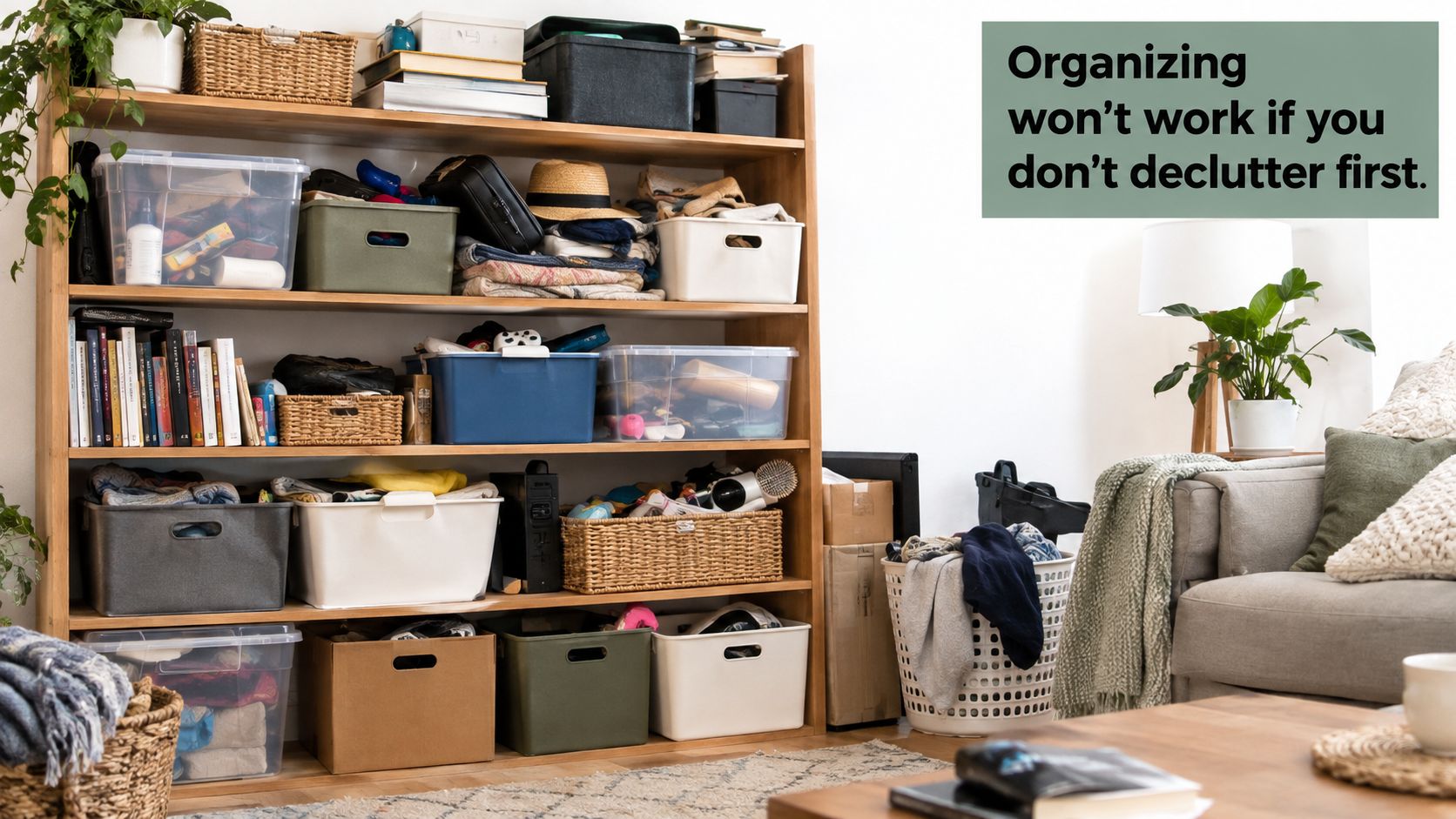
Start with function. The room needs a purpose, and every object needs a reason to stay there. Storage can postpone decisions, but it does not reduce household volume, and a house cleaning schedule is what keeps a reset room from sliding back. The national growth of self-storage shows how often people push the problem outward instead of dealing with it inside the home (Governing's report on U.S. storage units).
What I see in real homes
A hallway in Spanish Fort can become the holding area for school bags, sand-covered flip-flops, and mail. A guest room in Orange Beach can slowly turn into the place where “temporary” boxes go to disappear. Those are delay tactics, plain and simple.
Practical rule: if you can't say what a space is for in one sentence, you're not ready to organize it yet.
The emotional side matters too. The University of New Mexico research on clutter found that excessive possessions can disrupt people's sense of home and reduce well-being, while attachment to possessions can also provide security and identity (DePaul summary of the 2016 study). That is why a project cannot treat everything as trash. Some things stay because they matter. Others leave because they keep getting in the way.
A simple undecided container helps when that tension gets heavy. Put the hard items in one box, date it, and give yourself a deadline for a second pass. That is better than freezing in place while a pile grows on the floor.
Bins don't fix this. Decisions do.
The Zone-Based Decluttering Workflow
Start with the room's function, not the mess. A pantry is for food and food-related supplies. A mudroom is for the things that come and go every day. A storage closet is for items that are not needed on a daily basis, and if that space can't support the category, the category needs to get smaller.
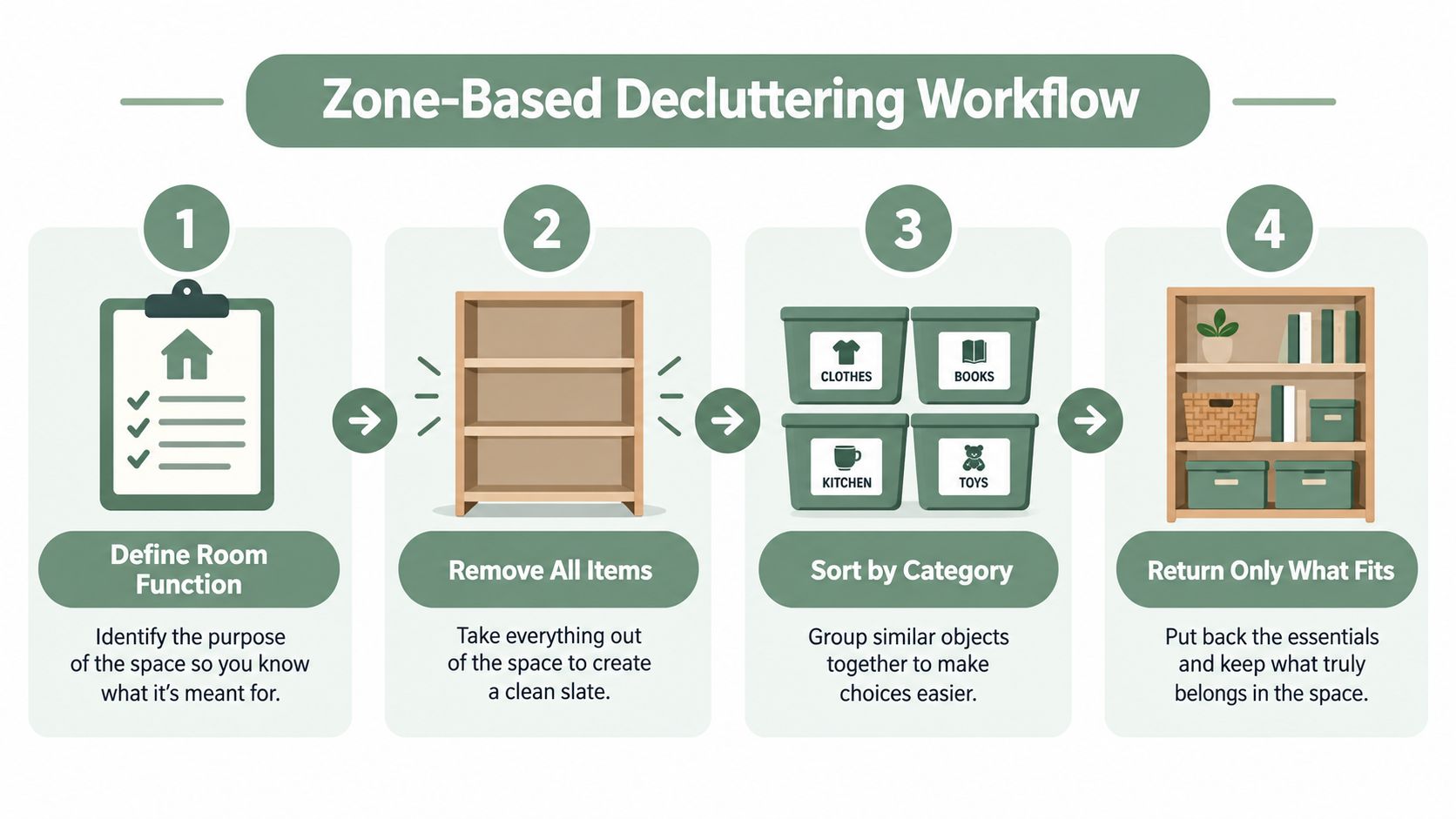
Process one bounded zone at a time
The cleanest way to work is by drawer, shelf, or a small section of floor, about 0.5 to 1 m². Pull everything from that zone, then sort it into keep, relocate, donate, recycle or trash, and undecided. Return only the items that support the room's job.
A big mistake is trying to sort the whole house at once. That usually creates “temporary” piles that spread into hallways, dining rooms, and bedrooms. A contained zone keeps the project visible and finishable.
Use labels after the sorting, not before
Labels work when they describe a real category that will stay in the space. They don't work when they're slapped onto a box before you know what belongs inside it. Once the keep pile is trimmed, label storage by category so the next person in the house can put things back without guessing.
For people who want another example of structured task flow, better task management tips can be useful because the logic is the same, break one large job into smaller decisions and close each loop before starting the next one.
Keep the work surface visible. If the floor disappears under piles, the system has already started to fail.
The final step is a short maintenance reset. Put a five-minute cleanup on the calendar for the room you just finished, because organization doesn't hold on its own. It holds because someone keeps returning items to the right place and stops new clutter at the door.
Building an Exit Plan for Clutter
The hardest part of decluttering is often not deciding what stays. It is deciding where the rest goes. In Daphne and Spanish Fort, that is where a lot of homes stall, because one box of unwanted items turns into a closet corner, then a garage stack, then a problem nobody wants to face again.
A YouGov survey found that 37% of Americans struggle with letting go of belongings, 46% cite insufficient storage, and 41% cite having too many possessions as organization barriers (YouGov survey on home organization barriers). The removal gap matters just as much as the sorting gap. If there is no exit plan, clutter merely waits for a new hiding place.
Make removal decisions by category
- Donate: Use this for usable items that no longer fit your household but still have useful life.
- Sell: Save this for higher-value pieces when the effort is worth the return.
- Recycle: Reserve this for materials local programs can take.
- Discard: Use this for items that are broken, worn out, or unsafe to keep.
- Archive: Keep only what has a clear long-term purpose, such as documents or meaningful keepsakes.
Holiday décor, outgrown children's gear, and seasonal clothing all need the same rule. If it comes out for one season, it needs a clear landing spot when the season ends. Without that, the same bin gets opened, closed, and ignored year after year.
Build a same-day exit routine
An exit plan needs a staging area and a deadline. That might be the trunk of the car, one labeled box by the back door, or a scheduled pickup with a local charity. The point is speed. The longer unwanted items sit inside the house, the easier it is for someone to start treating them like “maybe later” items.
If the item has already been sorted out, it should leave the living space quickly enough that nobody starts folding it back into daily use.
Families in Gulf Shores or Orange Beach feel this even more during turnover seasons and vacation rental resets. A slow exit process creates drift, from closet to garage and back again, and that is how a cleanout turns into another round of clutter. If the removal piece feels too big to handle alone, Sweet Home Cleaning Service's home organization support can fit into a broader cleanout plan when the home needs both sorting and reset work.
Managing Gulf Coast Climate in Storage
Humidity changes the rules in Fairhope, especially in closets, bathrooms, pantries, and storage rooms that do not get much air movement. The EPA recommends keeping indoor relative humidity below 60%, with an ideal target of 30% to 50% (EPA guide to mold, moisture, and your home). A small humidity meter removes the guesswork, because a room can feel fine and still hold too much moisture.
Put vulnerable items where air can move
Paper goods, clothing, bedding, and stored food all break down faster when they sit tight against walls or get packed into cramped cabinets. Leave space around damp-prone areas so condensation and leaks are easier to spot. That matters in older homes across the Eastern Shore, where storage spaces often lack proper sealing and ventilation.
If furniture is going into storage, plan for airflow, covers, and protection before the move. A practical guide on prevent furniture damage in storage helps with those choices when you want pieces to hold up over time.
Treat water-damaged items as a separate category
After heavy rain, a leak, or a storm, do not put damp belongings back with the dry ones. EPA guidance notes that standing water, water-damaged materials, and wet surfaces can support mold, mildew, bacteria, and insects (EPA inside story guide to indoor air quality). Sort those items into three groups, dry and retain, clean or restore, and remove according to local disposal guidance.
That rule matters after hurricane season too. Gulf Shores and Orange Beach homes often need fast visual resets, and our Gulf Shores cleaning service handles that kind of post-storm cleanup regularly. A quick reset should not hide unresolved moisture problems, because moisture control is part of organization here, not a separate issue.
Creating Functional Systems by Room
The rooms that stay organized longest are the ones that match daily behavior. A pantry in Fairhope should make breakfast and weeknight cooking easier. A kids' space in Spanish Fort should let children put things away without a long cleanup lecture. A vacation rental in Gulf Shores should survive repeated turnovers without the whole system collapsing.
Start with the highest-friction spots
In the kitchen, group food by use, not by wishful thinking. Keep frequently used items at eye level, and make the most-used shelf the easiest one to reach. That keeps everyday cooking from turning into a scavenger hunt, and it's the same logic Sweet Home Cleaning Service uses when it handles a room reset that includes sorting, decluttering, and designated placement.
Mudrooms and entryways need fewer categories than people think. One place for shoes, one for bags, one for beach gear, and one small catch zone for incoming mail is usually enough. If the house is full of sand from the coast, the answer isn't more containers, it's a clearer drop point and a better cleanup habit.
Build systems that can survive family life
Kids' spaces work best when the materials are visible, reachable, and easy to return. Open bins, simple categories, and a limit on how many groups live in one shelf work better than a perfect labeling scheme no child will follow. The goal is independence, not a showroom look.
For hurricane season, keep a labeled, accessible container for documents, medications, chargers, flashlights, radios, and pet supplies. Ready.gov advises households to create a family emergency communication plan, keep emergency supplies at home, identify evacuation routes, bring in outdoor furniture and other unsecured objects before a storm, and know whether flood insurance is needed because ordinary homeowners insurance does not cover flood damage (Ready.gov hurricane toolkit). Organizing by emergency function makes that prep faster.
If you want a broader framework for room systems, declutter your home with systems is a useful way to think about how categories, access, and maintenance all work together.
A good system should hold up on a tired Tuesday, not just on the day you set it up.
Maintaining Order with Professional Support
A home stays organized when someone keeps bringing it back to baseline. That takes regular cleaning, steady decisions, and a realistic exit plan for the items that keep piling up. In Fairhope, Daphne, Spanish Fort, Gulf Shores, and Orange Beach, that often means pairing recurring maid service with deep cleaning or move-in/move-out cleaning when the house needs a real reset.
Sweet Home Cleaning Service supports that kind of reset with standard house cleaning, recurring maid service, deep cleaning, move-in/move-out cleaning, and vacation rental cleaning. It also offers home organization service for closets, pantries, kids' rooms, and entryways that need more than a quick tidy.
That service fits the moments when clutter has to leave the house, not just get moved around. The work holds up better when the house is cleaned and the storage plan matches how the family lives.
If your Fairhope, Daphne, Spanish Fort, Gulf Shores, or Orange Beach home needs a cleaner reset and a more practical system, Sweet Home Cleaning Service can help with home organization, deep cleaning, and move-related cleaning. Visit Sweet Home Cleaning Service to book a service or request a free quote.

Let us handle the cleaning. Enjoy your home.

Sweet Home Cleaning Service
19940 State HWY 181, Suite E Fairhope, AL 36532
Phone: (251) 586-4081
sales@sweethomecleaningservice.com