Does Vinegar Disinfect Surfaces? What It Can and Can't Do

Spraying white vinegar and calling the counter disinfected overstates what a kitchen bottle can do. Vinegar cleans well and may reduce some microbes, but it is not a reliable household disinfectant. Use an EPA-registered product when pathogen reduction is the goal.
Laboratory acetic acid is often stronger, with contact time held steady. The bottle in a typical kitchen is weaker. That gap is why a useful cleaner still fails as a stand-in disinfectant.
Sweet Home Cleaning Service serves Fairhope and nearby Eastern Shore homes that want a simpler routine without treating a pantry staple as a disinfectant.
Table of Contents
- Vinegar Cleans Well but Does Not Reliably Disinfect
- How Acid Strength Changes the Lab Results
- Why Lab Results Do Not Carry Over to Your Kitchen
- Where Vinegar Falls Short on Viruses and Food Surfaces
- Safe Dilutions and Uses for Routine Vinegar Cleaning
- Choosing an EPA-Registered Disinfectant When It Matters
- Make Your Next Disinfecting Decision Today
Vinegar Cleans Well but Does Not Reliably Disinfect
Vinegar is a reasonable cleaner for hard-water deposits, soap scum, and some odors. It doesn't reliably disinfect because its antimicrobial effect depends on acid strength, contact time, and how much soil sits on the surface.
That's the distinction behind the question, does vinegar disinfect surfaces. Cleaning removes dirt and organic matter. Disinfecting requires a product tested and labeled for specific organisms, used exactly as directed.
Match the Task First
| Task | Vinegar alone | Better choice |
|---|---|---|
| Hard-water deposits on faucets and showerheads | Suitable on compatible surfaces | Vinegar is a suitable cleaner |
| Soap scum and light grime on counters | Cleans soil only | Detergent first, then rinse |
| Raw meat contact surfaces | Not sufficient alone | Clean, then use a labeled disinfectant |
| Illness-related or virus concerns | Not reliable | EPA-registered product with a virus claim |
| Pet accidents or diaper changes | Cleans soil and odor | Cleaner, then labeled disinfectant when germs are a concern |
Sort your own surfaces into those rows before you spray anything. A faucet with mineral spots is a cleaning problem. A counter after raw chicken is a disinfecting problem, and vinegar alone doesn't close that gap.
Homes in Fairhope, Daphne, and Spanish Fort deal with Gulf Coast humidity, spring pollen, and sand tracked in from the beach. The same counters and bathrooms work harder during hurricane cleanup and vacation rental turnovers in Gulf Shores and Orange Beach, which makes the cleaning versus disinfecting choice more consequential, not less.
If you prefer fewer harsh products for routine jobs, these room-by-room low-chemical cleaning tips help you separate everyday soil removal from jobs that need a labeled product.
Practical rule: Use vinegar where acid dissolves the problem, like mineral buildup. Don't ask it to prove a germ claim it hasn't earned.
How Acid Strength Changes the Lab Results
Laboratory acid and pantry vinegar are not interchangeable doses of the same chemical. In a 2020 peer-reviewed study of acetic acid, European quantitative microbiology standards showed the result shifting with concentration and formulation: 10% acetic acid plus 1.5% citric acid produced a greater than 5 log10 reduction in a suspension test, and 5% acetic acid produced a complete reduction greater than 5 log10 on a DIN EN 13697 surface test.
5 log10 means a 99.999% reduction. 3 log10 means 99.9%. That gap leaves far more organisms behind.
What the Formulations Actually Did
| Acid formulation | Test method | Organisms named | Result |
|---|---|---|---|
| 10% acetic acid plus 1.5% citric acid | Suspension test, 2020 peer-reviewed study | P. aeruginosa, E. coli, S. aureus, L. monocytogenes, K. pneumoniae, E. hirae, A. brasiliensis | Greater than 5 log10 reduction |
| 5% acetic acid | Surface test under DIN EN 13697 | P. aeruginosa, E. coli, S. aureus, E. hirae, A. brasiliensis, C. albicans | Complete reduction greater than 5 log10 |
| Vinegar, strength not stated | Short-contact testing, concentration not matched to the rows above | Not reported at a stated strength | Weaker activity than the concentrated formulations |
| Household vinegar, typical retail strength | Not covered by these tests | No organisms verified in these tests | No verified reduction claimed |
The first two rows are the lab ceiling: named organisms, a stated acid strength, and a method with a defined contact time. The third row drops the details that would let you copy the result. Strength is unstated, contact is brief, and activity is weaker than the formulated acids, with no figure you can treat as a product claim. The fourth row is the bottle under the sink. Typical retail vinegar was not the mixture those tests verified.
Retail vinegar is commonly less concentrated than the formulations in the first two rows, and products differ. Soil on a real counter adds a variable the suspension test does not include. Acid strength, formulation, and contact time decide whether a lab number means anything at home. A registered disinfectant is the right call when you need a labeled germ claim rather than a cleaning acid.
A lab result for one mixture doesn't transfer automatically to the bottle under your sink.
Why Lab Results Do Not Carry Over to Your Kitchen
Kitchen counters carry the soil a lab coupon never has. Grease blocks a wet rag from the metal under a pan. Food residue, soap film, dust, and mildew film do the same on a counter or a shower wall. That film sits between the liquid and the microorganisms. A result measured on a prepared surface does not describe the counter you just cooked on.
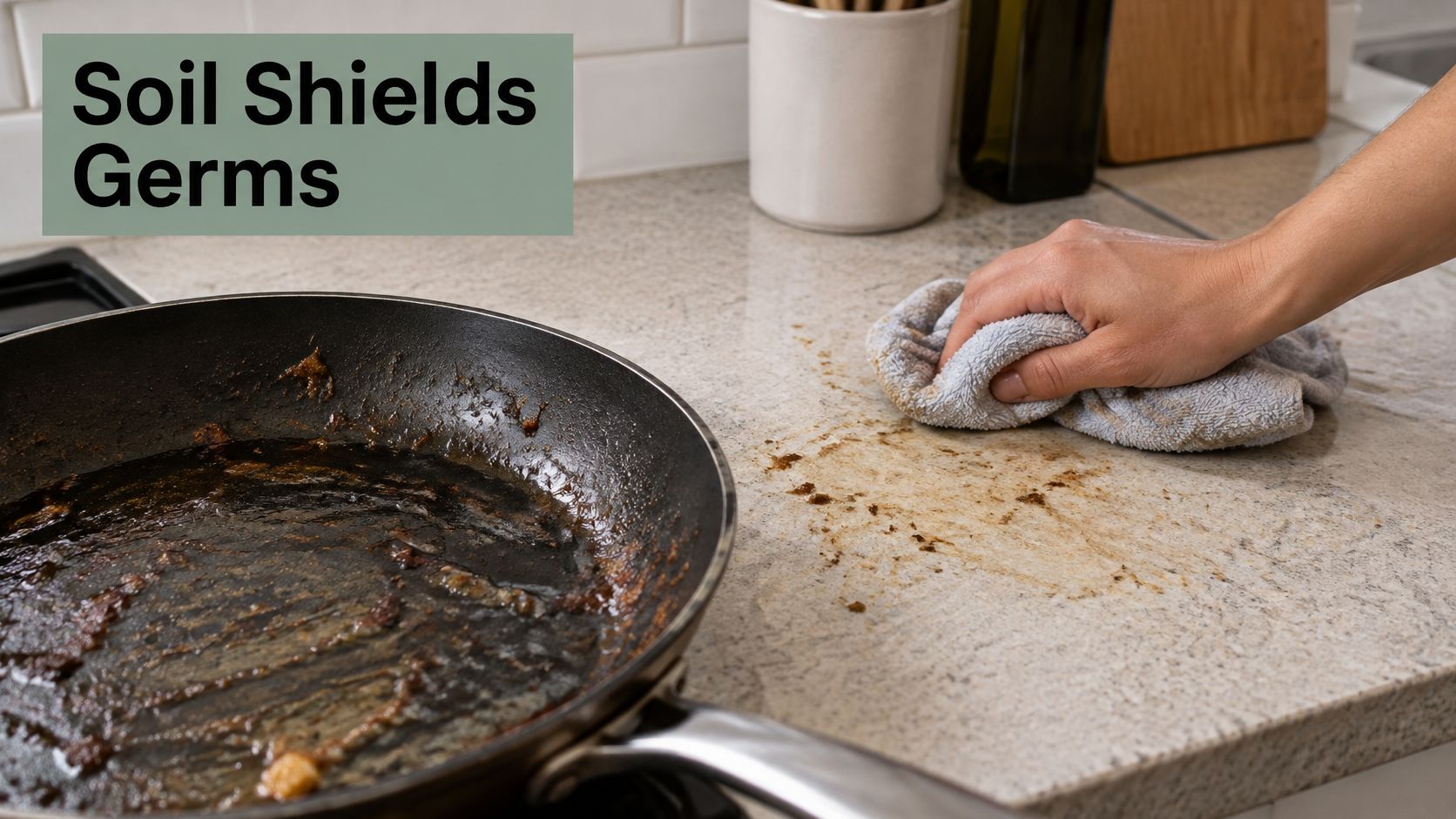
The U.S. Centers for Disease Control and Prevention cleaning guidance states that surfaces should be cleaned before sanitizing or disinfecting because dirt and other impurities can make it harder for chemicals to kill germs. Cleaning removes the shield. Sanitizing or disinfecting is a later task, and it only has a chance once the soil is gone.
Contact Time Is Not a Quick Wipe
A disinfecting product has to stay visibly wet for its validated period. Vinegar may affect some germs only when it remains on the surface that long, and it does not kill all germs. Spraying and wiping dry at once gives you cleaning action, not a verified kill step.
Household vinegar breaks from the lab in a second way. Dilution, age, and storage change the strength of a homemade mix, so two spray bottles labeled vinegar cleaner may not perform alike. Neither one is the timed, formulated acid a laboratory holds on a clean coupon.
Run the tasks in order. Wash with detergent and water until soil and film are gone. Rinse so leftover soap does not keep shielding the surface. If you still need a kill step, apply a product labeled for disinfecting and leave it wet for the time printed on the label. That wet time is the condition behind the label claim. A fast wipe is a different job.
Humid Gulf Coast kitchens and bathrooms collect soil and mildew film quickly, especially around sinks and grout. There, the wash decides whether any later chemical can reach the surface. Vinegar still fits routine soil removal after that wash. It is the wrong substitute when the job calls for a labeled disinfectant held wet for its full contact time.
Where Vinegar Falls Short on Viruses and Food Surfaces
Viruses are where a sharp-smelling spray stops being evidence. In a laboratory assessment of common household cleaning agents, vinegar and acetic acid were completely ineffective at inactivating the tested virus even at an exposure equivalent to 3.6% acetic acid.
That figure is a defined lab exposure, not a kitchen ritual. Acetic acid can damage or inhibit some bacteria and fungi, yet the same chemistry left this virus intact. A bottle from the pantry is still that acid in water. It is not a registered antiviral, and the lab result does not turn a wipe into a kill step.
Food Contact Raises the Bar
Food areas use a stricter pass mark than a counter that looks clean. The University of Minnesota Extension sanitizer guidance explains that an appropriate sanitizer should achieve a 5-log reduction, meaning 99.999%, and states that vinegar is not strong enough to meet that threshold.
Put that next to counters, cutting boards, and tables after raw chicken or beef in Fairhope and Spanish Fort homes. Clear the visible residue, then use a product labeled for the surface and the job. Separation and handwashing still belong in the routine, and staff training for safer food handling covers the cross-contamination habits that support the cleaning step. On laminate, follow how to clean laminate countertops so the finish is not the thing you sacrifice.
A surface has moved from cleaning into disinfecting when:
- Someone's been ill: High-touch points need a product with the right claim.
- Raw meat touched it: Cleaning alone isn't the final step.
- Diapers or pet accidents are involved: Odor removal isn't germ reduction.
- Guests rotate through: Rental turnovers need a defensible, labeled process.
Safe Dilutions and Uses for Routine Vinegar Cleaning
A kitchen bottle of vinegar belongs on routine soil, not on a germ-kill claim. Dilute it for scale and glass, keep it off stone that acid can etch, and leave it there. Those mixes do not carry over the results of stronger acetic acid tested in a lab.
| Task | Dilution | Contact | Caution |
|---|---|---|---|
| Hard-water deposits on faucets and showerheads | 1 part vinegar to 1 part water | Keep cloth wet until deposits soften | Test a hidden spot on the finish first |
| Glass and mirrors | 1 part vinegar to 3 parts water | Wipe on and wipe off | Dry with microfiber to avoid streaks |
| Acid-sensitive stone, such as marble, limestone or travertine | Do not use | No safe contact, use another cleaner | Choose a pH-neutral stone cleaner |
| Any surface near bleach or chlorine products | Never combine | No combined use at any time | Hazardous chlorine-containing vapors can form |
The contact column stays qualitative on purpose. The evidence does not set a household wet time that turns these dilutions into disinfectants. You wait until mineral deposits soften, then rinse the acid off. That endpoint is cleaning, not a counted reduction of organisms.
Small Rules That Prevent Damage
Test a hidden spot on metal, grout, sealed stone, and specialty finishes before you wet the whole surface. Rinse metal fixtures after descaling so leftover acid does not sit on the plating. Marble, limestone, and travertine can etch where the acid meets the stone, so switch to a pH-neutral stone cleaner.
Glass needs two cloths, not a stronger mix. Wipe with a damp microfiber cloth, then buff dry with a second cloth. Streaks usually come from leftover film. Baked-on oven soil is the same kind of job: dwell and scrub, which is how to clean an oven without harsh chemicals, rather than raising the acid strength.
Shared-equipment upkeep runs on its own schedule, which the Gym Membership Tips maintenance guide covers for gym gear. It does not change the household rule. Match the cleaner to the material, then repeat the cleaning on a schedule.
Label every spray bottle with its contents, dilution, and job. Your family shouldn't have to guess which bottle cleans glass and which one disinfects.
Store vinegar mixtures away from bleach and chlorine products. A clear label and separate storage block the mix that can release chlorine-containing vapors.
Choosing an EPA-Registered Disinfectant When It Matters
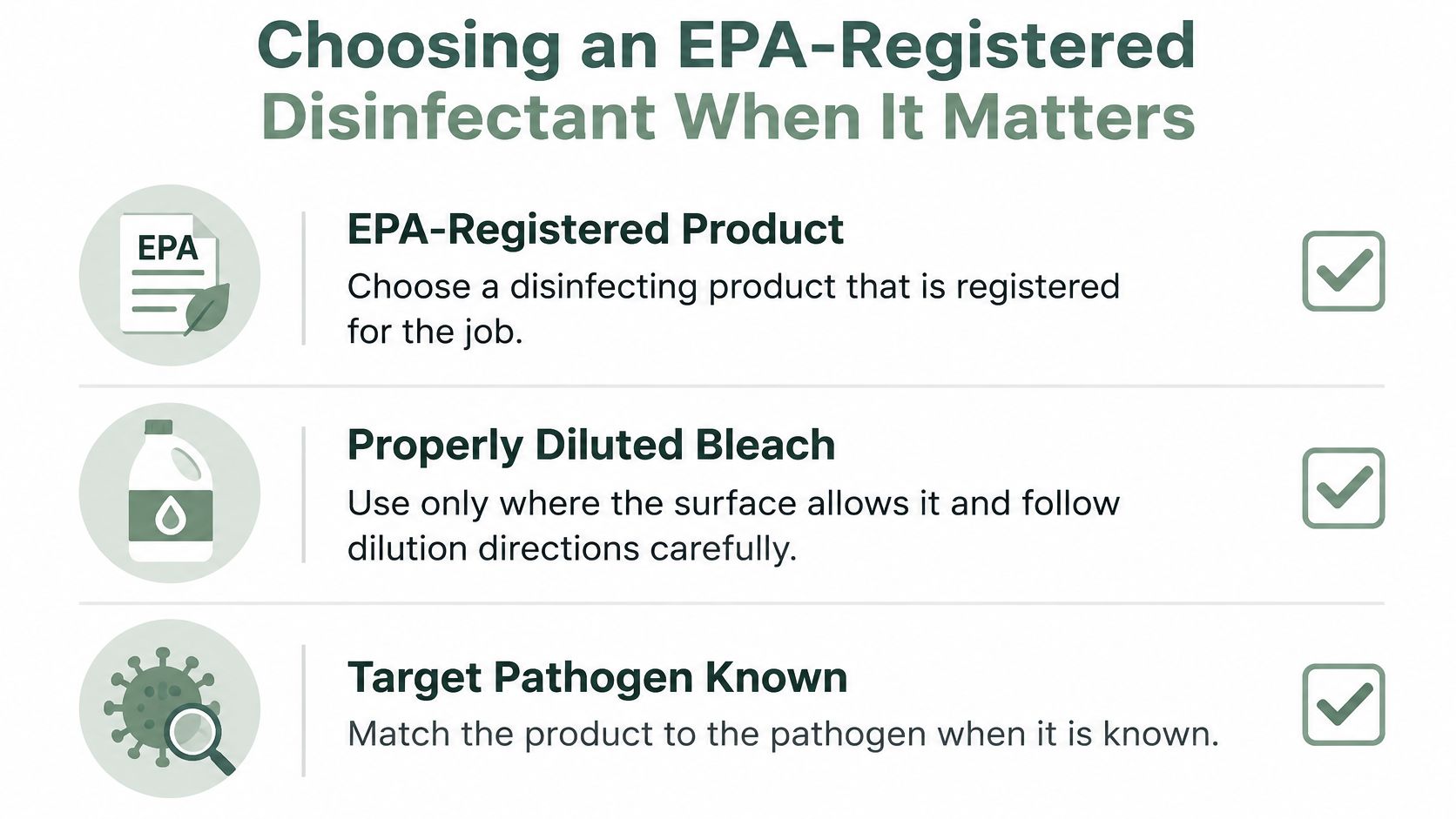
When germ reduction is the actual goal, the CDC home cleaning and disinfecting guidance recommends an EPA-registered disinfecting product or, where appropriate for the surface, a properly diluted bleach solution rather than vinegar, and it says bleach solutions can be effective against bacteria, viruses, and fungi when diluted correctly.
Run the Four-Step Label Check
- Find the named organism: Confirm the label lists the bacteria or virus you're targeting.
- Confirm the surface: Check that counters, tile, plastic, or another material is listed.
- Note the contact time: Keep the surface visibly wet for the full period.
- Follow the format: Dilute concentrates exactly, or use ready-to-use products as directed.
The back label sets the claim, not the marketing on the front. Words like natural, fresh, or powerful don't tell you which organisms were tested.
Say a family in Daphne is cleaning after someone's been sick. Door handles, faucet handles, and toilet flush levers need a product whose label fits that concern. A vacation rental in Gulf Shores or Orange Beach turning over between guests needs the same discipline on remotes, light switches, and bathroom fixtures.
A move-out cleaning in a Spanish Fort condo raises a different point. You don't know the prior occupant's routines, so kitchens and bathrooms deserve cleaning first, then a labeled disinfecting step where appropriate. After a storm during hurricane season, standing moisture and tracked-in soil make that order even more important.
If pets share the home, choose and store products carefully, and review our notes on non-toxic cleaning products for pets. If you'd like specific products used during a visit, you can let us know in advance or leave them on the kitchen countertop with a note for our cleaning techs. Our team otherwise brings all necessary supplies and equipment.
Before any disinfecting job, ask three questions. What's the organism or risk, what's the surface, and can you keep it wet for the label time? If you can't answer all three, you're cleaning, not disinfecting.
Make Your Next Disinfecting Decision Today
Keep the short answer in view. Vinegar cleans well, but it's a poor substitute for a registered disinfectant.
Work in order. First, clean with detergent, or use a routine vinegar dilution where mineral deposits or glass are the problem. Second, rinse away soil and residue. Third, if the surface falls into a disinfecting row, apply an EPA-registered product and follow its label for the named organism, listed surface, and contact time.
Sweet Home Cleaning Service is a house cleaning company based in Fairhope, Alabama, serving Fairhope, Daphne, Spanish Fort, Gulf Shores, Orange Beach, and nearby Eastern Shore communities. We offer standard house cleaning, recurring maid service on weekly, biweekly, or monthly schedules, deep cleaning, move-in and move-out cleaning, and vacation rental cleaning.
Our goal is plain. Attention to detail and reliable visits give busy families their time back while kitchens, bathrooms, and high-touch surfaces get handled in the right order. If you're in Fairhope or the surrounding Eastern Shore and Gulf Coast area, book a visit or request a free quote from Sweet Home Cleaning Service today.
If deciding what to clean, what to disinfect, and which product belongs on each surface is taking up your weekends, Sweet Home Cleaning Service can handle the routine for your Fairhope, Daphne, Spanish Fort, Gulf Shores, or Orange Beach home. Request a free quote for recurring maid service, a deep cleaning, a move-in or move-out cleaning, or vacation rental cleaning, and get reliable help that gives your family time back.

Let us handle the cleaning. Enjoy your home.
Sweet Home Cleaning Service
19940 State HWY 181, Suite E Fairhope, AL 36532
Phone: (251) 586-4081
sales@sweethomecleaningservice.com