Non Toxic Cleaning Products for Pets: A Practical Guide

The label on the front of the bottle is the least useful part when you choose non toxic cleaning products for pets. I judge a cleaner by exposure route, concentration, and drying time. Natural does not automatically mean safe for a dog or cat.
Sweet Home Cleaning Service, a Fairhope-based cleaning company, uses non-toxic, eco-conscious products across its Eastern Shore and South Baldwin County service area.
Table of Contents
- Why Non-Toxic Means More Than a Marketing Word
- Ingredients to Avoid Around Dogs and Cats
- Reading Labels and Certifications That Matter
- Safer Product Choices for Each Cleaning Task
- DIY Alternatives and Where They Fall Short
- How to Clean Safely With Pets in the Home
- Gulf Coast Seasons That Change Your Routine
- Book a Pet-Safe Cleaning Visit in Fairhope
Why Non-Toxic Means More Than a Marketing Word
The ASPCA Animal Poison Control Center report for 2025 counted calls involving more than 376,000 pet-exposure items, with household products ranking eighth among toxin categories at 6.4% of exposures and cleaners and paints forming a substantial portion of that category. Those figures cover reported calls only. Treat them as a documented minimum, not a tally of every dog that crossed a wet floor.
How Pets Actually Meet a Cleaner
In an ordinary home, contact happens four ways. Pets walk on treated floors, lick residue off their paws, breathe vapors in a closed room, or drink from a bowl, bucket, or bottle left within reach. A spray that barely stays on your hands can still reach a cat's mouth during grooming.
Concentration and drying time decide the dose. Full-strength product left on tile stays available longer than the same product mixed to the label rate and wiped until the surface is dry. A plant-based or natural claim does not change the route, the strength, or how long the film stays wet.
I use a working test instead of the front label. Ingredients are disclosed, you mix to label dilution, you ventilate, the pet stays off the surface until it is dry, and the container stays sealed and out of reach.
Ask one question before you spray anything. What will touch the animal, and for how long?
On the humid Gulf Coast, floors in Fairhope, Daphne, and Spanish Fort stay damp longer after a mop, so pets that live on tile and wood get more contact time. In Gulf Shores and Orange Beach, sand and muddy paws push floor cleaning even higher. Sweet Home Cleaning Service serves homes across the Eastern Shore and South Baldwin County. For those homes, I weigh route, concentration, and dry time before I treat a cleaner as acceptable around a dog or cat.
Ingredients to Avoid Around Dogs and Cats
Start with the table, then check any bottle you own against it. A pleasant scent or a plant-based claim doesn't remove a single ingredient below.
Ingredients to avoid around pets and how to handle them
| Ingredient or Family | Where It Usually Appears | Main Pet Concern | Safer Handling |
|---|---|---|---|
| Bleach (sodium hypochlorite) | Disinfectant sprays, mildew cleaners, laundry boosters | Undiluted product injures mouth and esophagus | Use only when labeled; dilute, rinse, and air out before pets return |
| Ammonia | Glass cleaners, some all-purpose sprays | Never combine with bleach; fumes irritate airways | Use alone, ventilate well, and keep pets out of the room |
| Quaternary ammonium compounds | Disinfecting sprays and wipes | Cats are especially sensitive; corrosive injury possible at low concentrations | Reserve for a defined disinfecting need; keep cats out until dry |
| Phenols | Some disinfectants and all-purpose sprays | Can injure tissue if swallowed, inhaled, or on skin; cats are sensitive | Avoid for routine cleaning in homes with cats |
| Concentrated acids and alkalis | Descalers, drain openers, some oven products | Corrosive burns to mouth, esophagus, skin, eyes | Avoid in pet homes; if used, follow label and keep pets away |
| Concentrated tea tree oil | DIY sprays, some scented cleaners | Problems possible after limited concentrated exposure | Leave out of pet-home recipes |
| Undiluted vinegar | DIY cleaners, descaling solutions | Can irritate the stomach | Dilute as directed and rinse where needed |
| Detergents and soaps | Dish soap, floor soap, laundry detergent | Usually mild stomach upset when used as directed | Rinse residue from floors and pet bowls |
The Ingredients That Cause the Most Trouble
The Pet Poison Helpline guide to utility room hazards identifies bleach, ammonia, quaternary ammonium compounds, and phenols as common cleaning ingredients with different toxicity mechanisms, ranging from gastrointestinal distress to corrosive injury to the mouth, skin, eyes, or lungs. Read that list against your bottles rather than trusting the front panel.
Bleach sits in most mildew sprays and disinfectants. Undiluted, it injures a dog's or cat's mouth and esophagus. Diluted, rinsed, and aired out, it's a different situation, which is exactly why concentration matters more than the word bleach alone.
Ammonia turns up in glass cleaners and some all-purpose sprays. Never combine it with bleach. The mixture releases toxic chloramine gas, and that rule has no exceptions. Don't use one product right after the other on the same surface either.
Where Cats Need Extra Caution
Cats are especially sensitive to quaternary ammonium compounds, the active ingredient in many disinfecting sprays and wipes. Corrosive injury is possible even at very low concentrations, and a discarded wipe in an open trash can is an exposure route people forget. Phenols in some disinfectants and all-purpose sprays can injure tissue when swallowed, inhaled, or left on skin, and cats are sensitive to those too.
Concentrated acids and alkalis in descalers, drain openers, and some oven products cause corrosive burns. These aren't everyday cleaners in a pet home. If you must use one, close the room and follow the label exactly.
The natural aisle has its own traps. According to animal-poisoning guidance cited by Davis Packing Supply, concentrated tea tree oil may cause problems after exposure to as few as seven or eight drops, so leave it out of DIY sprays. Undiluted vinegar can irritate the stomach, while plain detergents and soaps usually cause only mild gastrointestinal upset when used as directed and rinsed away.
Do a simple scan today. Read each ingredient list, match it against the table, and move any concentrated corrosive or cat-sensitive product out of your everyday rotation.
Reading Labels and Certifications That Matter
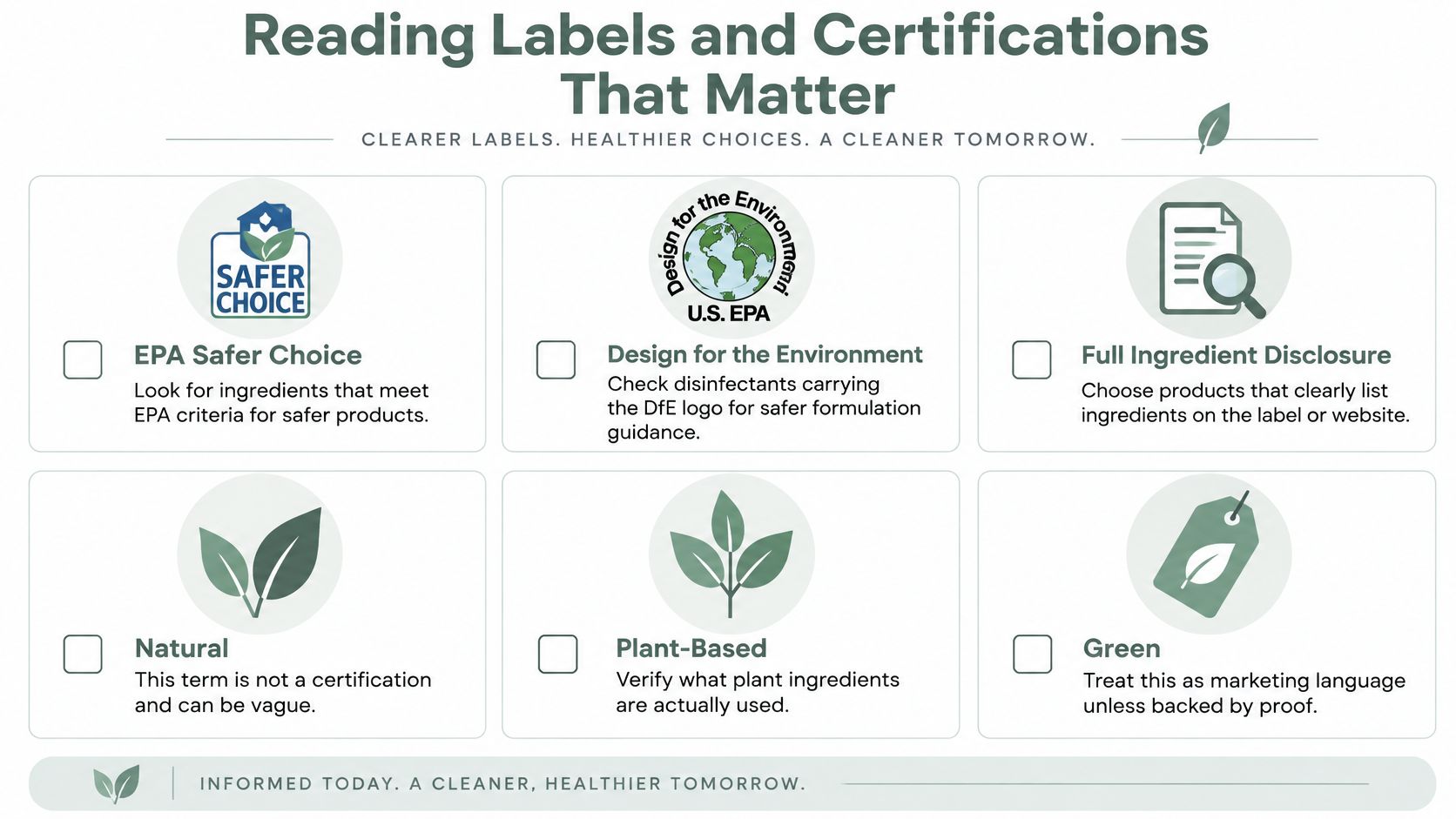
Labels fall into two groups. Some describe a review someone performed. Others are just words a brand chose. The table separates them.
What each label checks and what it leaves out
| Label or Term | What It Checks | What It Does Not Guarantee |
|---|---|---|
| EPA Safer Choice label | Every ingredient against carcinogenicity, reproductive and developmental toxicity, aquatic toxicity and persistence; ingredient disclosure, performance, VOCs and packaging | Does not replace label directions or keeping pets away until surfaces are dry |
| Design for the Environment logo on disinfectants | Ingredients meet standards for human, environmental and pet protection | Does not confirm the product suits your specific germ or use; check intended use |
| Full ingredient disclosure | Lets you match each listed ingredient against known hazards | Disclosure alone does not rate how safe each ingredient is at your dilution |
| Natural, plant-based or green | Marketing wording with no shared standard | Not proof that every ingredient is low toxicity to animals |
| Safety data sheet (SDS) | Hazard and handling information written for professional users | Not written for pet owners; read it for dilution and first-aid guidance only |
Why Safer Choice Earns Its Place
The EPA Safer Choice label overview explains that every chemical ingredient in a certified product is evaluated regardless of its percentage against criteria covering carcinogenicity, reproductive and developmental toxicity, aquatic toxicity, and environmental persistence. Certified products also have to meet requirements for performance, ingredient disclosure, volatile organic compounds, and packaging.
Coverage is practical for a pet household. The program includes all-purpose, bathroom, carpet, floor, glass, kitchen, laundry, and pet-care cleaners, so you can match a reviewed product to each task instead of using one harsh spray everywhere. Households in Fairhope, Daphne, Spanish Fort, Gulf Shores, and Orange Beach can check the Safer Choice database before buying.
The Design for the Environment logo on a disinfectant signals that ingredients meet human, environmental, and pet-protection standards. It doesn't excuse sloppy use. A disinfectant still has to match its intended antimicrobial purpose and be used at labeled dilution for the full wet contact time.
Natural, green, and plant-based have no shared standard, so they can't carry the decision alone. Use this checklist at the store instead.
- Find the logo or the full list. Pick Safer Choice where you can, or a complete ingredient list you can check.
- Match the intended use. Confirm the product is made for the surface and job in front of you.
- Read dilution and contact time. If you won't follow them at home, choose a simpler product.
- Verify hidden lists. Check Safer Choice listings or the manufacturer's site when the bottle doesn't disclose ingredients.
Safer Product Choices for Each Cleaning Task
Use the least hazardous cleaner that does the job. That single rule prevents most mistakes, because routine soil removal and disinfection aren't the same task.
Pet-safer product choice by cleaning task
| Cleaning Task | Suitable Choice | Pet Precaution |
|---|---|---|
| Daily floors | Diluted mild cleaner or Safer Choice floor cleaner | Keep pets off until dry; wipe residue away |
| Kitchen counters and food-prep surfaces | Mild detergent solution, rinsed with water | Move bowls and food first; rinse so no residue remains |
| Bathrooms and tubs | Safer Choice bathroom cleaner; mildew product only when needed | Keep pets out, ventilate, store products sealed and high |
| Disinfecting after illness or contamination | Registered disinfectant used at labeled dilution and wet contact time | Remove pets, bowls and bedding; rinse or air out as directed; never mix |
| Pet beds, toys and bowls | Mild soap wash followed by a full rinse | Dry completely; diluted bleach only if aired out before use |
| Carpet spot treatment | Enzyme or Safer Choice carpet cleaner | Test a hidden spot first; keep pets off until fully dry |
| Litter area | Unscented mild soap and hot water | Avoid strong-scented sprays nearby; ventilate the room |
Where People Reach for the Wrong Product
Floors and counters cause the most everyday exposure because pets live on them. A diluted mild cleaner handles daily floors, and a mild detergent solution rinsed with clean water suits counters after you move bowls and food. Reaching for a disinfectant here adds residue without adding benefit.
Bathrooms are the opposite problem. Gulf Coast humidity feeds mildew, so homes in Daphne, Spanish Fort, and Orange Beach often need a real mildew product, and many are bleach-based. Keep pets out, ventilate, and dry the room fully. If you're working on tubs and tile, our guide to cleaning bathtubs and showers step by step walks through the scrubbing sequence.
Reserve disinfectants for a reason. Illness, fecal contamination, or a multi-animal household qualifies. Tuesday does not.
ASPCA guidance on household cleaning agents states that diluted bleach may be used for pet toys or kennels only when followed by thorough rinsing and airing until the bleach odor has dissipated, while most household cleaners are considered safe when label directions are followed. A disinfectant also has to stay wet for its labeled contact time. Wiping it dry early defeats the purpose.
For pet beds, toys, and bowls, a mild soap wash and full rinse come first. For carpets, test a hidden spot and keep pets off until the area is fully dry, since enzyme cleaners can still upset a stomach while wet. For litter areas, unscented mild soap and hot water beat a strong spray in a small, enclosed space where your cat has to return.
DIY Alternatives and Where They Fall Short
A homemade cleaner can lift everyday grime. It can't be relied on to kill germs the way a registered disinfectant does at labeled dilution and wet contact time. Keep those two jobs separate and DIY makes sense.
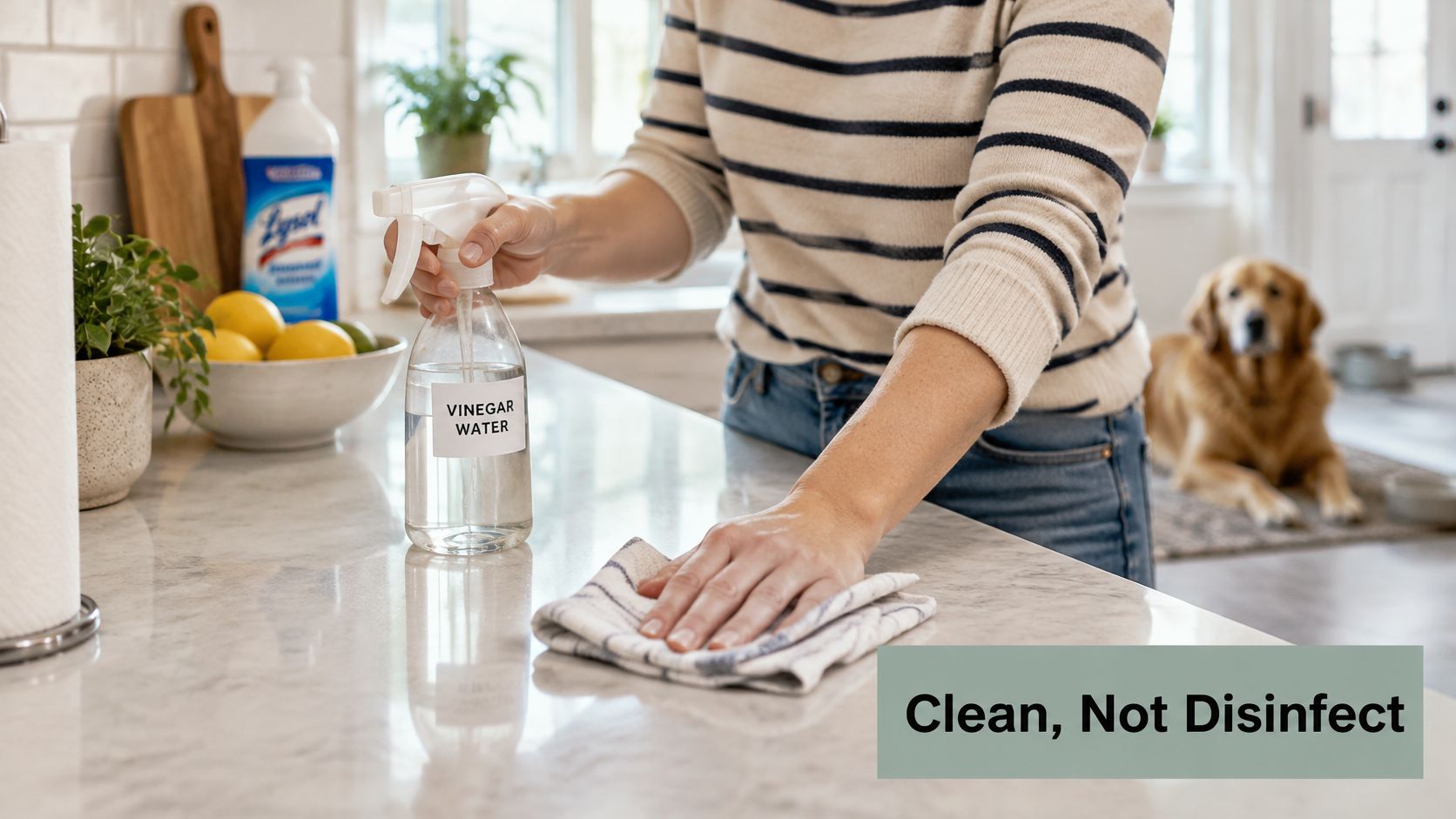
Floors and counters need very little. Stir a small amount of mild, unscented dish soap into warm water, apply it with a damp cloth or mop, then rinse with clean water. The rinse is the step people skip, and it's the step that keeps soap residue off paws.
Glass and tile respond well to diluted white vinegar for light soap film. Dilute it, keep pets off wet surfaces, and rinse where needed. Skip vinegar on natural stone, since acid can etch it.
Sinks and stovetops suit a baking soda scrub. Make a paste with a little water, scrub gently, and rinse thoroughly so no gritty film remains. If a pet eats a large amount of baking soda, have a veterinarian check the animal.
What to Leave Out of the Recipe
Leave essential oils and tea tree oil out of pet-home recipes altogether. The concentrated oils that make a homemade spray smell finished are the same kind of ingredient the hazard table warns against. I'd rather have a cleaner that smells like nothing.
Simple doesn't mean automatically safe. Dilution, rinsing, and drying still control the risk.
DIY also has honest limits. Set-in stains, baked-on oven grease, heavy mildew, and post-illness disinfection still need a labeled product. For the oven specifically, see our method for cleaning an oven without harsh chemicals before you reach for a caustic spray.
Treat homemade cleaners like store-bought ones. Label the bottle with contents and date, store it sealed, and keep it out of reach.
How to Clean Safely With Pets in the Home
Product choice is half the work. The other half is sequence. Follow these steps in order and you remove most exposure before it happens.
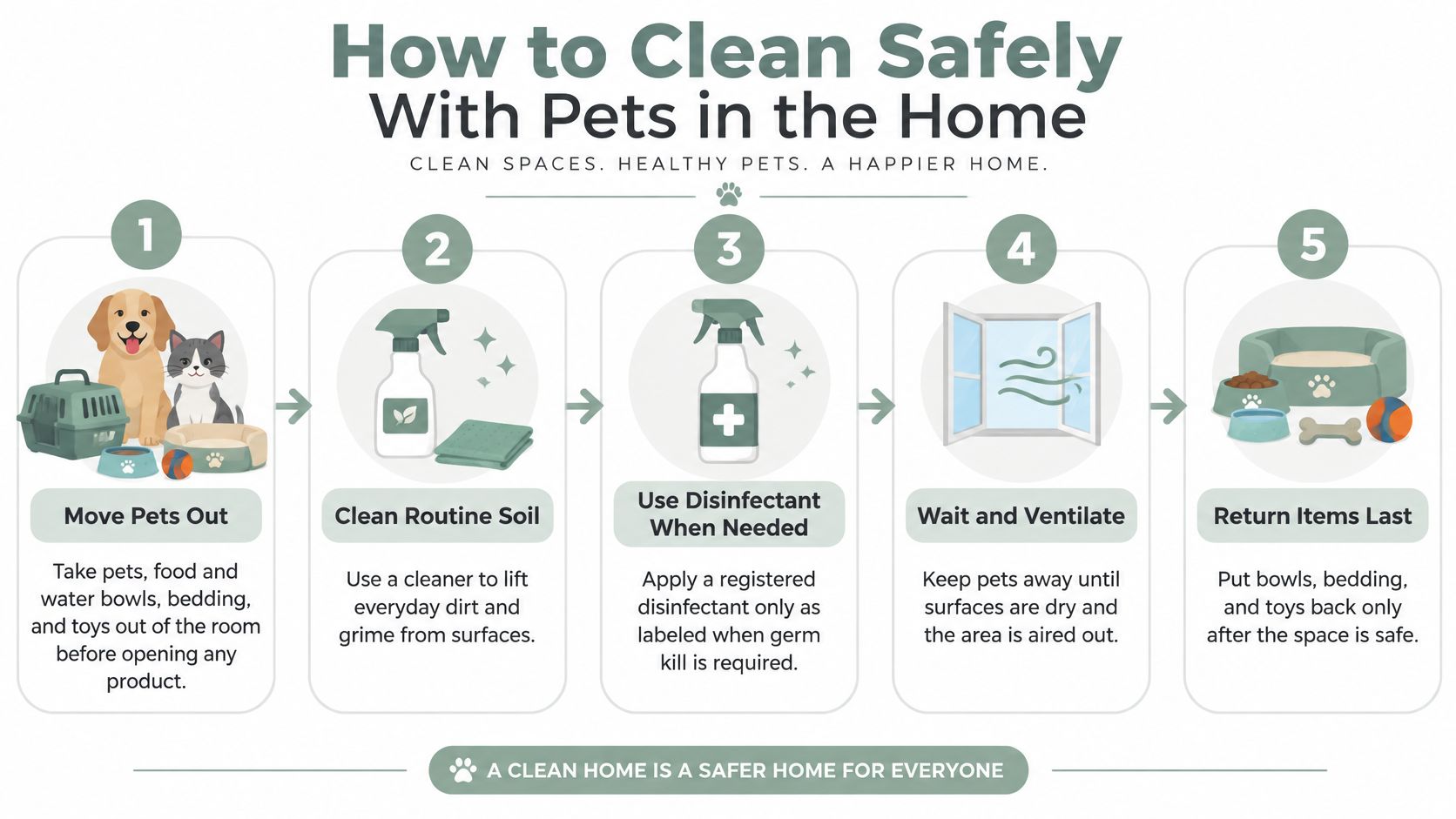
- Move pets and their gear out first. Take animals, food and water bowls, bedding, and toys out of the room before you open any product. Licking and mouthing are the main pathways, so remove what gets licked.
- Mix fresh at label dilution. Check the label and make only the amount you need. Stored mixtures lose strength and are easy to confuse with something else.
- Ventilate before you start. Open windows or run a fan before spraying so fumes clear while you work, not after your pet has breathed them.
- Apply with a cloth, not a cloud. Spray the cloth or wipe the product on rather than misting the air near furniture and pet beds. Less airborne product means less settling where animals sleep.
- Respect wet contact time. On a disinfectant, keep the surface wet as long as the label directs. Wipe or rinse only where the label tells you to.
- Let everything dry completely. Run a fan, because humid Gulf Coast air slows drying in Fairhope, Daphne, and Spanish Fort. A surface that looks dry at a glance can still transfer residue to paws.
- Check for odor before pets return. Bring animals, bowls, and bedding back only when surfaces are dry and the room smells neutral.
The Bleach Rule and Safe Storage
Pet Poison Helpline guidance on cleaning products and pets warns that bleach must never be mixed with ammonia because the combination can generate toxic chloramine gas that is corrosive to the lungs. Undiluted bleach can injure a dog's or cat's mouth and esophagus, and diluted bleach used on toys or kennels needs thorough rinsing and airing until the odor is gone.
Storage finishes the job. Keep every product in its original sealed container on a high shelf or in a closed cabinet, away from bowls, toys, and bedding. Never decant a cleaner into an unlabeled bottle. Someone will guess wrong eventually, and the label is what a veterinarian needs.
If a pet does lick, chew, or swallow a cleaner, act promptly. Move the pet away from the product, keep the container or label handy so you can report the ingredients, and call your veterinarian or the ASPCA Animal Poison Control Center right away. Don't induce vomiting unless a veterinarian directs it.
Gulf Coast Seasons That Change Your Routine
The right routine in Fairhope shifts with the calendar. Each local condition changes either the product you'd choose or how long you need to dry a room.
Humidity runs most of the year. Mildew builds in bathrooms, closets, and under sinks in Fairhope, Daphne, and Spanish Fort, and the mildew product you reach for is often bleach-based. Keep pets out, ventilate during and after, and dry the room thoroughly with a fan rather than closing the door on damp air.
Spring pollen settles everywhere. Pollen coats floors and furniture, then pets track more of it inside. A damp-wipe routine with a mild cleaner lifts it without leaving a heavy spray residue on the surfaces your dog naps against. Wipe entry floors first, where the load is heaviest.
Beach sand and muddy paws grind grit into hard floors and carpets, especially in Gulf Shores and Orange Beach. Vacuum first to remove the abrasive sand, then clean with a diluted mild product and dry completely before pets walk over it. Mopping grit around just scratches the finish.
Storm Season and Rental Turnovers
Hurricane season cleanup is not a DIY-cleaner situation. Keep pets away from standing water and wet debris, and use a registered disinfectant at labeled dilution and wet contact time on contaminated surfaces. A homemade mix can't do that job.
Older Eastern Shore homes often have older tile, grout, and stone that strong acids can damage. Mild cleaners with a rinse are the safer default there, for the surfaces and the animals.
Vacation rental turnovers in Gulf Shores and Orange Beach add one wrinkle. A guest's pet may have used the unit, so wash pet bedding and bowls separately and dry the unit fully before the next arrival. Recheck your product storage and labels each spring, before the busy season starts.
Book a Pet-Safe Cleaning Visit in Fairhope
A cleaner is only pet-safe once you know how the animal meets it. Licking a damp floor, walking across a wet film, and breathing residue are three different exposures, and a natural or plant-based label does not settle any of them. Concentration and drying time decide the dose. A mild product left wet on tile can matter more than a stronger one that is rinsed and fully dry before the dog comes back in.
Sweet Home Cleaning Service, based in Fairhope, uses safe, eco-friendly products to protect customers' spaces and belongings. The cleaning team is fully trained, background-checked, and insured, and brings the supplies and equipment, so you do not need to provide them. If you want specific products used, say so in advance, or leave them on the kitchen countertop with a note for the cleaning techs.
Standard cleaning fits apartments and family homes that need routine upkeep of surfaces, floors, bathrooms, and kitchens. Recurring visits run weekly, biweekly, or every 3 weeks, and a plan can focus on the high-traffic paths your pets use most. Deep cleaning is the better fit when a home needs a full refresh or has gone a while without a thorough clean. Move-in and move-out cleaning can be timed so floors and fixtures are dry before animals move through the space. See detail-oriented house cleaning and maid service in Fairhope for local scheduling.
The company serves Fairhope, Daphne, Spanish Fort, Orange Beach, Gulf Shores, and neighboring communities on the Eastern Shore and South Baldwin County.
I recommend you name the pets, the rooms they occupy, and any ingredient you want kept out before the first visit. Ask for labeled dilution, a rinse where the product calls for one, and closed rooms until surfaces are dry and the odor is gone. That check is what makes the visit pet-safe.
Book a visit or request a free quote at Sweet Home Cleaning Service and include the animals who share the home.

Let us handle the cleaning. Enjoy your home.
Sweet Home Cleaning Service
19940 State HWY 181, Suite E Fairhope, AL 36532
Phone: (251) 586-4081
sales@sweethomecleaningservice.com