Commercial Cleaning Services: Scope, Pricing and Booking

The U.S. Census Bureau profile for janitorial services counts 67,799 employer establishments in the category and about $77.47 billion in 2024 revenue. Compare commercial cleaning quotes line by line: only written scopes that match let you assess what each service includes.
Sweet Home Cleaning Service is based in Fairhope and offers house cleaning for homeowners and renters in Fairhope, Daphne, Spanish Fort, Gulf Shores, Orange Beach, and neighboring communities. Supported services include standard house cleaning, recurring cleaning, deep cleaning, and move-in/move-out cleaning. For a local office or shop, ask each provider to put the tasks and service frequency in writing before booking. That makes scope, rather than a one-line price, the basis for comparison.
Table of Contents
- What Commercial Cleaning Covers by Facility Type
- Scope of Work to Write Into Your Agreement
- What Drives Commercial Cleaning Prices
- Scheduling Options From Weekly to One-Time
- Chemical Safety and Verifying Cleaning Results
- Credentials and Staffing to Verify Before You Hire
- Commercial Cleaning Questions Answered
- Request a Quote From Sweet Home Cleaning Service
What Commercial Cleaning Covers by Facility Type
Commercial cleaning is recurring or one-time cleaning for workplaces and business properties. It is a different job from house cleaning because the crew works around staff, customers, and opening hours.
A Fairhope shop and a Daphne office do not share one task list. We offer office cleaning and commercial cleaning for businesses of all sizes, from retail stores to large facilities. The overlap with household work shows up most clearly on short-term rentals. Hosts reading about professional cleaning for rental properties will notice the same rule we use on the Gulf Coast: the handoff is timed to checkout, and the reset is written down.
| Facility type | Typical scope | Usual schedule |
|---|---|---|
| Office or coworking space | Workstations, common areas, restrooms, kitchen, trash | Weekly or nightly |
| Retail store | Sales floor, entry mats, glass, restrooms, stockroom | After close or before opening |
| Multi-tenant or managed property | Lobbies, hallways, restrooms, stairwells | Weekly to monthly |
| Short-term rental | Full reset, linens, restock, inspection | Timed to checkout |
One manager, two properties
Say a property manager on the Eastern Shore looks after a small office suite and a Gulf Shores rental. The office needs desks, a shared kitchen, and restrooms on a weekday the staff is out. The rental needs linens changed, supplies restocked, and a walk-through before the next guest. Same owner, two scopes, two clocks.
Scope sets both the price and the schedule.
Consistent upkeep keeps entries and restrooms usable between busy days. Predictable visits let owners, managers, and staff plan the week. Fewer hours spent on the floors is time the business gets back.
Scope of Work to Write Into Your Agreement
A written scope protects the business and the crew. You can compare two quotes only when they name the same rooms, the same tasks, and the same rhythm.
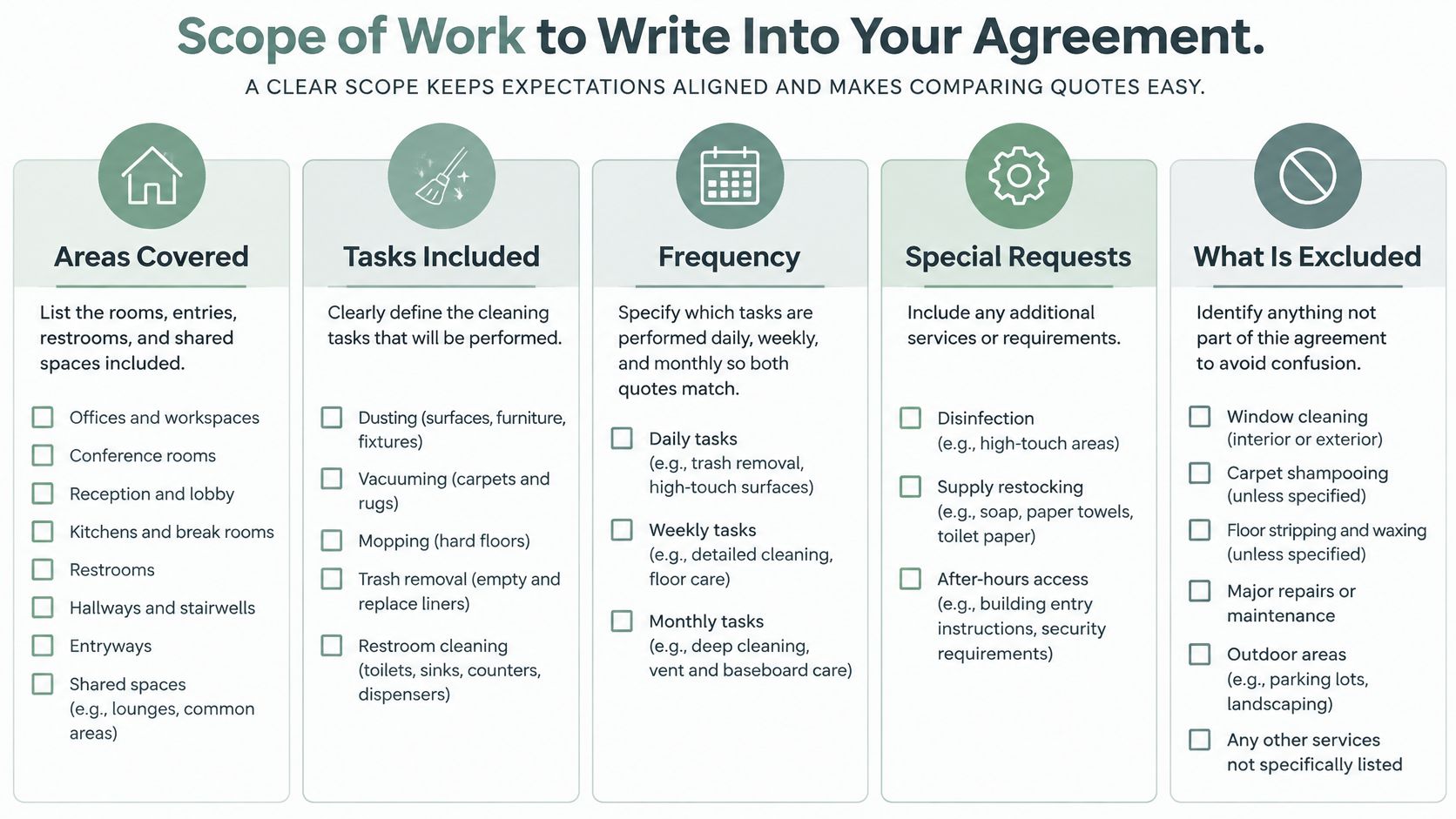
| Area | Core tasks | Frequency |
|---|---|---|
| Restrooms | Sanitize sinks, toilets and mirrors; restock supplies | Daily |
| Workstations and desks | Dust and wipe high-touch surfaces | Daily |
| Kitchen and break room | Counters, sinks, microwave and appliance exteriors, trash | Daily |
| Floors | Vacuum carpets, mop hard floors, spot-clean entries | Daily in high traffic; deep pass monthly |
| Glass and doors | Glass doors, interior glass, fingerprints | Weekly |
| High dusting | Vents, ledges, light fixtures | Monthly |
| Trash and recycling | Empty and reline containers | Daily |
Office cleaning for us means dust-free desks, sanitized restrooms, and attention to common areas, workstations, and sanitization on the agreed visits. A commercial cleaning checklist is the short version of that list. Put the long version in the agreement.
Two buildings, one task list
A 12-person office in Fairhope with two restrooms and a shared kitchen uses nearly every daily row: desks, both restrooms, the kitchen, and the floors. A retail shop in Spanish Fort with a sales floor and a stockroom drops most desks and adds entry mats, interior glass, and the stockroom floor. The list does not shrink just because the square footage looks similar. The rooms change the labor.
Gulf Coast adjustments
Sand tracked into storefronts and offices in Gulf Shores and Orange Beach needs extra entry passes, not a single mat shake. Humidity in restrooms and kitchens means vents and damp corners stay on the monthly high-dusting row. Spring pollen settles on glass and entry doors, so the weekly glass pass matters more in March and April than it does in a dry inland office. Post-storm cleanup is its own scope. Do not bury it inside the weekly visit.
Write it down: areas, tasks, frequency, who brings supplies, what is excluded, and the access hours.
If a task is missing from that sentence, it is not part of the price you are comparing.
What Drives Commercial Cleaning Prices
A flat headline rate hides the scope. A quote reflects labor time, equipment, supplies, and access, so no single rate fits every building. This guide does not list prices.

| Driver | How it changes the quote | Question to ask |
|---|---|---|
| Size and layout | More floor area and more separate rooms add labor time | Was the quote based on a walk-through? |
| Visit frequency | Recurring visits usually lower the per-visit cost compared with one-time jobs | What is the rate for each frequency? |
| Restrooms and kitchens | More fixtures and food-prep areas mean more sanitizing time | How many fixtures and kitchen areas are included? |
| Floor types | Carpet, tile and hard floors need different equipment and passes | Which floor methods are included? |
| Starting condition | Heavy buildup needs a reset clean before routine service | Is an initial deep clean needed? |
| Access and hours | After-hours work, alarms, lockboxes and tight windows add setup time | What hours and access are required? |
| Supplies and products | Who supplies products, and which dilution system is used | Which products are used, and who buys them? |
How to read the quote
Recurring contracts usually lower the per-visit cost because the crew learns the space. A one-time job carries setup time every time someone new walks the floor.
A retail store with one large stockroom and an office of the same square footage with many small rooms will not take the same hours. Each small room needs its own setup, its own surfaces, and a walk back to the cart. After-hours work, alarm codes, lockboxes, and a tight window before opening add minutes that never show up in a square-foot guess. Glass is a separate trade. If exterior glass is wearing you down, it helps to compare commercial window washing costs beside the interior scope, not inside it.
I would start with a walk-through, then ask for line items by area, and a reset clean when buildup is heavy.
Ask three things before you accept a quote. What is included? What is excluded? What happens when a visit is missed?
Scheduling Options From Weekly to One-Time
Frequency should follow foot traffic, not habit. A busy retail floor needs more visits than a small suite used two days a week.
Count daily visitors. Note how much sand or pollen comes through the door. Check whether the space stays humid or sees heavy kitchen use. Plans can focus on high-traffic areas or on a detailed pass. An office cleaning schedule is easier to hold when those three checks are written next to the frequency.
| Schedule | Best fit | Trade-off |
|---|---|---|
| Weekly | Most small offices and suites | Balances cost and upkeep |
| Biweekly | Light-traffic offices | Needs spot checks between visits |
| Monthly | Storage areas, low-use suites, periodic detail work | Dust and buildup can accumulate between visits |
| One-time | Move-out and seasonal deep cleans | Priced by the job, not by a recurring plan |
We offer weekly, biweekly, and monthly recurring service, plus one-time deep cleaning and move-out cleaning. Vacation rental turnovers are timed to checkout, which is a different clock from an office week.
An office in Gulf Shores with sand from a beach-side entrance usually needs weekly floor passes and a monthly deep clean. A Fairhope accounting office with light traffic often holds on biweekly service, with a spot check if pollen coats the entry glass. Appointments can be rescheduled per our policy. Confirm the schedule in writing before the first visit.
Chemical Safety and Verifying Cleaning Results
Chemicals are a workplace safety issue, not only a cleaning issue. Product handling belongs in the written scope.
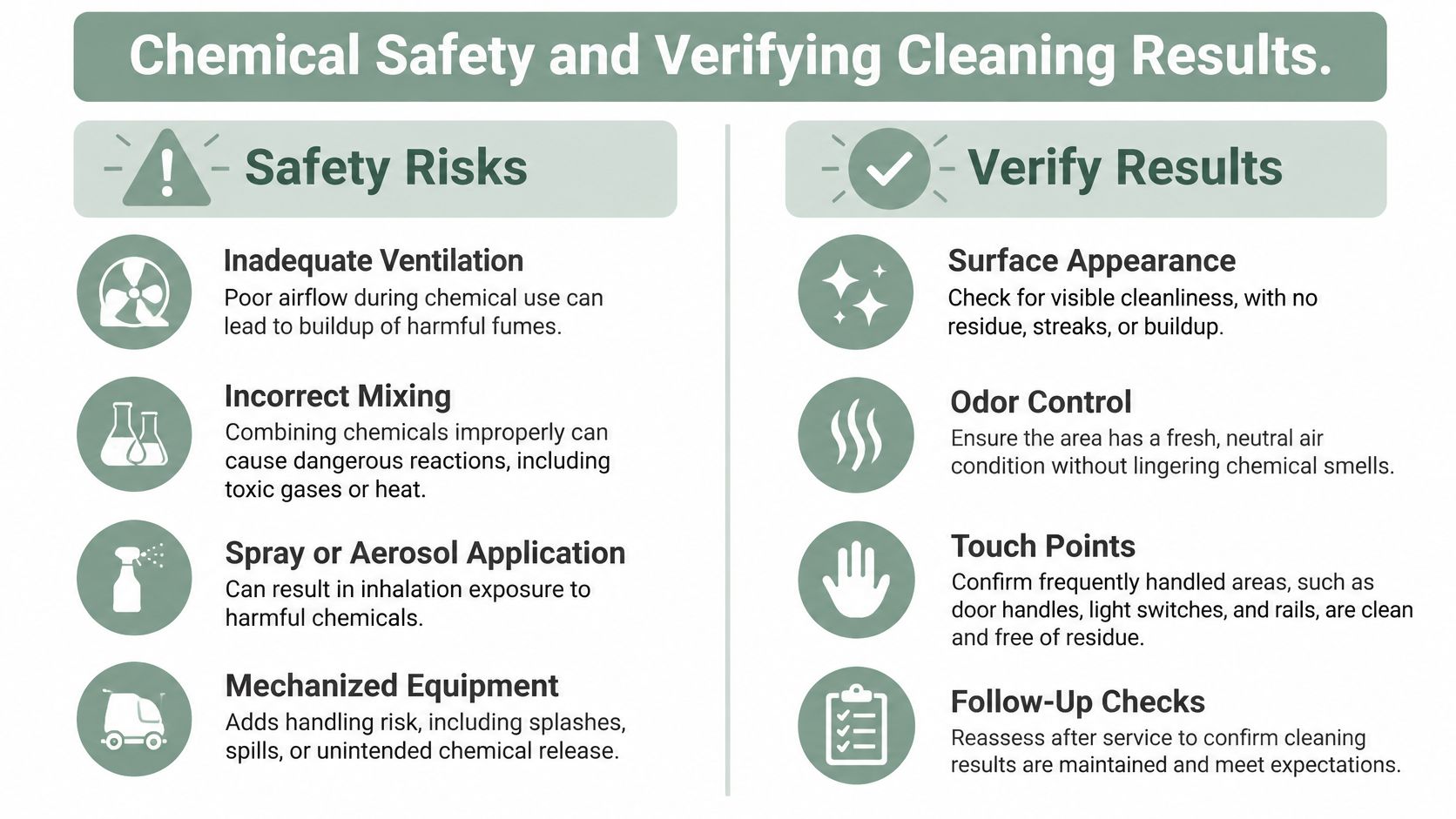
OSHA's chemical hazards guidance for cleaning names inadequate ventilation, incorrect mixing, spray or aerosol application, and mechanized equipment such as burnishers, buffers, and carpet washers as exposure pathways. Those paths can raise airborne vapors, mists, and particulates.
Do this:
- Label every container. A relabeled spray bottle is how the wrong product lands on a break-room counter.
- Dilute by the product label. Guessing "a little extra" wastes product and loads the air.
- Keep safety data sheets on site. The crew and the manager should both know where they are.
- Ventilate during and after use. Open the outdoor-air path available to you.
- Schedule heavy chemical work in low occupancy. A closed shop after hours beats a lunch rush.
- Use microfiber or a HEPA-filtered vacuum. Both cut the dust you would otherwise blow around.
Don't do this: never mix bleach with ammonia. The reaction can release dangerous gases.
We use safe, eco-friendly products. Disinfect high-touch surfaces, restroom fixtures, and food-contact areas. In a break room, soil removal and a wipe are usually enough. More product rarely improves the result, and it adds handling and waste. A plain-language pass through chemical insights from The Green Advantage is a useful cross-check when a label sounds greener than the directions.
What gets disinfected
A restroom gets a full disinfecting pass on the schedule you wrote. The break room gets soil removal and wiping of counters, the sink, and appliance exteriors. Cloths change between those zones so a toilet pass does not travel to the microwave.
Monthly verification
A peer-reviewed indoor study found bacterial and fungal counts on surfaces declined significantly after systematic cleaning, while cleaning significantly affected volatile organic compound concentrations and did not significantly affect formaldehyde. Visible cleanliness is not the whole result. Product choice, how it is applied, and ventilation sit beside it.
Walk restrooms, the break room, entries, and workstations once a month with a written checklist and photos. Use ATP or microbial testing only where the risk justifies the cost of the test. Keep a short complaint log for odors, irritation reports, sticky surfaces, or missed areas. Log each one, set a fix window, and check that spot on the next visit.
Ask which products are used, how they are diluted, and whether the safety data sheets are available before the first night on site.
Credentials and Staffing to Verify Before You Hire
A cleaning agreement is only as reliable as the people entering the building and the rules they follow. The Bureau of Labor Statistics estimated 2,172,500 workers in “Janitors and Cleaners, Except Maids and Housekeeping Cleaners” in May 2023. For a business buyer, the practical question is how a provider recruits, trains, supervises, and retains its crew.
Sweet Home Cleaning Service says its staff are trained, insured, and bonded, and follow defined safety and security protocols. Ask for documents and written procedures before booking, including from Sweet Home Cleaning Service. Use these questions to ask a cleaning company before hiring to keep the discussion focused on responsibilities and proof.
- General liability insurance. Request a current certificate showing coverage is in force when the crew works on site.
- Proof of bonding. Confirm what the bond covers and how to report a loss involving property or access.
- Training and safety procedures. Ask for written procedures that apply to the work in your scope, not only a verbal assurance.
- Key and alarm-code handling. Put in writing who can access codes, how keys are stored, and when access is removed.
- Staffing continuity. Ask whether the same crew is expected at each visit and how substitutions are communicated.
- Supervision and quality checks. Identify who reviews completed work and how missed tasks are recorded and corrected.
- Missed or rescheduled visits. Agree on notice, make-up visits, and communication before service begins.
- Screening before entry. Ask what screening the provider uses before staff receive keys or enter after hours.
Staff continuity has a practical trade-off: a familiar crew can learn the property's access routine, while substitutions may require renewed instructions. Put the process for crew changes and alarm procedures in the agreement. Ask for clear answers in writing so the responsibilities remain easy to check against the agreed scope.
Before signing, request the insurance certificate, proof of bonding, and written scope together. These records clarify coverage, access expectations, and the work the crew is responsible for completing.
Commercial Cleaning Questions Answered
Is commercial cleaning different from house cleaning?
Yes. It works around staff, customers, and opening hours, and the scope is written for a business property. A family home in Fairhope can run on a weekly maid visit. A shop cannot pause the sales floor at 2 p.m. because that hour is convenient.
Do I need a walk-through before a quote?
A quote based on a walk-through lets you compare line items by area, so it is the safer basis. Photos help, but they miss a cramped stockroom and a second restroom behind the office.
Can cleaning happen after hours?
Many businesses schedule visits after close or before opening. Alarm codes, lockboxes, and key handling should be confirmed before the first visit. A tight 45-minute window before the doors open is a different job from an empty evening.
What is the difference between cleaning and disinfecting?
Cleaning removes soil. Disinfecting is reserved for high-touch surfaces, restroom fixtures, and food-contact areas. Wiping a dusty shelf is cleaning. Treating a restroom sink on a set pass is disinfecting. They are not interchangeable, and using a disinfectant on every ledge does not make the building safer.
What should a Gulf Coast property do after a hurricane?
The National Weather Service hurricane guide for the Gulf Coast states that Atlantic hurricane season runs from June 1 through November 30. Return only after authorities issue an all-clear. Wear boots, gloves, and safety glasses when handling debris. Clean walls, floors, and countertops with soap and water, and discard water-contacted items that cannot be disinfected. Scope that work separately from the weekly contract. Vacation rental hosts in Gulf Shores and Orange Beach can ask for a turnover checklist that includes the reset, top-to-floor cleaning, restocking, a damage check, and a final walk-through with photos.
Request a Quote From Sweet Home Cleaning Service
Two commercial cleaning quotes are comparable only when they cover the same rooms, tasks, and schedule. Put the scope in writing, including products, access rules, and any credentials your facility requires.
Other trades may work alongside a cleaning visit. A mover may clear a suite, while a carpet crew handles extraction outside the recurring cleaning scope. Confirm who is responsible for each task so the written janitorial scope sets a clear routine afterward.
- Share your property type, square footage, number of restrooms and kitchen areas, floor types, and preferred frequency at sweethomecleaningservice.com, by phone, or by email.
- Ask for a quote that identifies the rooms, tasks, and schedule. Compare it line by line with other bids using the same scope.
- Confirm the schedule and access details, and review the booking confirmation before the first visit.
Businesses in Fairhope, Daphne, Spanish Fort, Gulf Shores, and Orange Beach can request a quote from Sweet Home Cleaning Service. The company provides office and commercial cleaning for businesses of different sizes, from retail stores to larger facilities.
To compare a quote for an office, retail space, or vacation rental, visit Sweet Home Cleaning Service and share the details of the property and cleaning needs.

Let us handle the cleaning. Enjoy your home.
Sweet Home Cleaning Service
19940 State HWY 181, Suite E Fairhope, AL 36532
Phone: (251) 586-4081
sales@sweethomecleaningservice.com