Residential Post Construction Clean Up: A Practical Guide


You open the door to your remodeled Fairhope home and see the kitchen you've been waiting for. Then sunlight catches a gray film across the counter, there are footprints on the new floor, and the ceiling fan already needs attention. Sweet Home Cleaning Service, a house cleaning and maid service based in Fairhope, AL, helps homeowners approach that handoff with a practical distinction: construction may be finished, but the house still needs careful preparation before everyday living resumes.
Table of Contents
Walking Back Into a Newly Remodeled Home
There's painter's tape on the window, a dusty shelf inside the pantry, and a faint smell from fresh finishes. You might be ready to put dishes away or bring the children home, but wiping the countertop won't answer every question about what's left behind.
Residential post construction clean up starts with identifying the mess, not choosing the strongest cleaner. A kitchen remodel in Daphne may need cabinet interiors cleaned and adhesive residue evaluated. A Gulf Shores rental may need the same attention, plus a clear handoff between the contractor, property manager, and turnover crew.

A different starting point from routine cleaning
Standard house cleaning deals with the residue of daily life. After remodeling, the starting conditions are different: unfamiliar materials, newly installed finishes, unfinished contractor tasks, and dust in places that weren't part of the work zone.
Before anyone starts, separate the concerns:
- Cleaning work: Accessible surface dust, ordinary debris, cabinet interiors, fixtures, and compatible floor cleaning.
- Contractor work: Unfinished installation, damaged surfaces, loose trim, excess building material, and questions about curing.
- Specialist assessment: Suspected hazardous dust, contaminated ductwork, or unresolved water damage.
Practical rule: A clean-looking room isn't the same thing as a completed contractor handoff.
A useful plan moves through rough, light, and final cleaning rather than treating everything as a single oversized appointment. Equipment matters, but so does timing. A detailed final clean won't stay final if another trade returns to sand, drill, or cut.
On the Eastern Shore and Gulf Coast, the conversation should also include moisture, tracked-in sand, and hurricane-season repairs. Those conditions don't justify harsher products. They call for a better inspection and a sensible order of work.
The Three Phases of a Real Post-Construction Cleanup
Think of a remodeled Eastern Shore kitchen with new cabinets, tile, and lighting. The installer needs clear access before finishing the trim, the electrician may still need a return visit, and you want the cupboards ready for dishes. Those are different stages, so they need different cleaning expectations.
Rough cleaning opens the work area
Rough cleaning handles the obvious material first: approved packaging waste, loose scraps, and debris that blocks access. Agree beforehand on who removes heavy construction waste, sharp objects, and leftover building materials. Don't assume a residential cleaning appointment includes hauling everything the contractor leaves.
Keep unopened supplies, spare tile, labeled touch-up paint, and installation paperwork separate from rubbish. A bag beside the back door may contain waste, or it may contain the hardware needed to finish the job.
Light cleaning makes the remaining work visible
Once the dust-producing trades are mostly finished, light cleaning removes the first layer from accessible horizontal surfaces, trim, and fixtures. This pass also makes it easier to distinguish removable residue from defects that belong on the contractor's punch list.
The order matters. Cabinet installation can leave wood residue inside storage spaces; tile work can leave material that needs the installer's attention. Don't ask a cleaner to improvise a treatment before the material is identified.
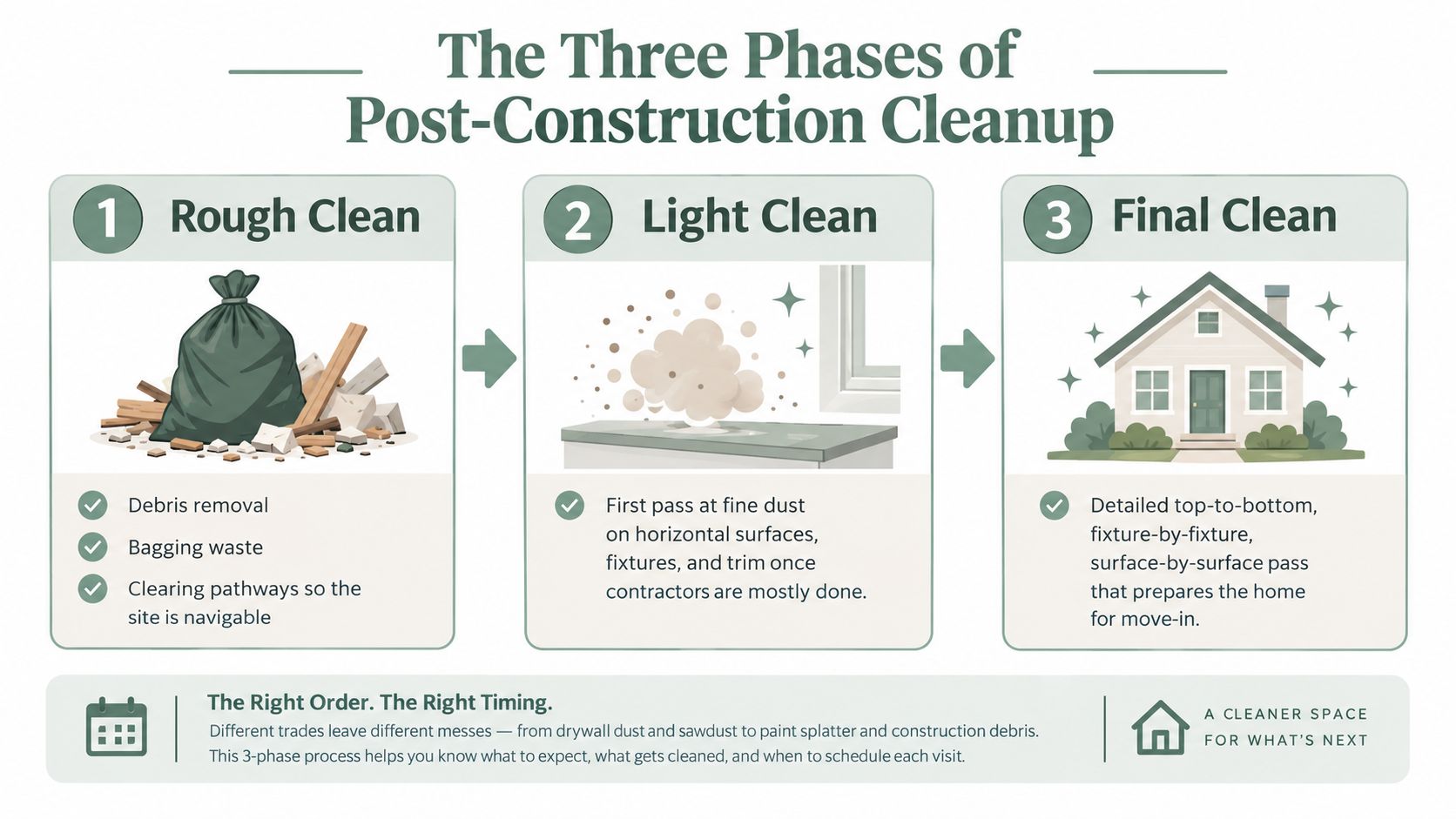
Final cleaning is the detailed pass after the remaining work is complete and finishes are ready for cleaning. The agreed scope should name cabinet interiors, doors, baseboards, accessible fixtures, glass, bathroom fittings, and floors rather than relying on “everything.”
- Before booking: Confirm whether more cutting, sanding, or installation is scheduled.
- Before the final pass: Get finish-care instructions and identify surfaces that aren't ready to touch.
- At handoff: Walk the agreed areas together and record anything that needs contractor correction.
These phases describe a sequence, not a promise that every project needs separate visits. The right schedule depends on the work remaining and how much of the home is occupied.
What Is Actually in Construction Dust and Debris
A gray film doesn't tell you what produced it. Drywall finishing, wood cutting, masonry work, and installation adhesives require different decisions, even when the residue looks similar from the doorway.
For perspective, the EPA's historical building-debris analysis estimated 136 million tons of building-related debris in 1996, with residential sources accounting for 43%. Those are historical waste-stream figures, not an estimate for your remodel, but they reinforce an important distinction: construction cleanup involves building materials, not just household dust.
Match the method to the material
| What you find | What to establish before cleaning |
|---|---|
| Fine drywall residue | Where sanding occurred and how far residue spread beyond the work area |
| Sawdust or wood fragments | Whether cabinet interiors, drawer tracks, and floor edges are included |
| Concrete, mortar, or stone dust | What was cut or ground and what dust controls the contractor used |
| Adhesive residue or grout haze | The product involved and the installer's approved removal method |
| Paint specks | The underlying surface, finish condition, and whether removal belongs to the painter |
| Packaging and scraps | What is rubbish and what the homeowner needs to keep |
Don't treat unidentified residue as a reason to experiment. Adhesive cleanup is particularly easy to turn into a finish-repair problem if the cleaner isn't compatible with the surface underneath.
Fine-particle collection also needs a broader view than the floor. EPA's renovation-vacuum guidance explains why the complete vacuum design matters, including preventing air from bypassing the final filter. Follow the residue into accessible corners, cabinet interiors, and surfaces near ventilation openings rather than assuming the visible pile represents the whole job.
Homeowners considering supplemental equipment can compare portable dust removal units from EcoQuest Purifiers as a starting point for reviewing specifications. A product listing isn't evidence that a unit is suitable for renovation dust, and portable air treatment doesn't replace collection from surfaces or assessment of an unresolved source.
When requesting help, describe the work performed. “The contractor cut stone indoors” is more useful than “the house needs a deep clean.”
Equipment and Methods a Professional Crew Brings
The first thing worth checking on a post-construction job is the vacuum the crew carries through the door. A household machine that accepts a HEPA replacement filter isn't the same thing as a sealed unit built for fine renovation dust. Ask about the whole system: seals, collection bags, prefilters, and how the machine gets maintained between jobs. Whatever slips past the final filter ends up back in the room.
That gear earns its place on the truck because the visible film on counters and sills is only where the job starts. The fine particles that ride the air and settle into cabinet interiors and around vent openings are what occupants end up breathing.

Method matters as much as machinery. Damp microfiber on compatible surfaces collects residue; a feather duster just relocates it. Color-coded cloths keep bathroom work separate from kitchen and finish detailing, and the cleaning chemistry stays gentle and surface-specific, since "non-toxic" on a label says nothing about compatibility with your finish. Plastic scrapers can suit some approved tasks, while razor blades have no business being the first move on unfamiliar glass or coatings.
On a typical job, the working route runs in a fixed order:
- Start on the highest accessible surfaces and work down toward the floor.
- Move from cleaner areas toward dirtier ones so finished zones stay finished.
- Collect loose material on hard floors before any damp cleaning begins.
- Swap flat-mop pads as soon as they load up instead of pushing a dirty pad across new flooring.
- Test any residue-removal method somewhere discreet before touching a prominent surface.
The flooring manufacturer's instructions set the moisture limits, the cleaner compatibility, and whether new flooring is ready to be cleaned at all. A microfiber flat-mop system gives a crew real control, provided the pad gets changed.
Ask what the crew will do if ordinary cleaning doesn't remove a mark. "Stop and check" is a better answer than "scrub harder."
Equipment supports attention to detail. It can't replace judgment, and some marks belong to the installer or to a specialist rather than to one more cleaning product.
How Gulf Coast Homes Change the Cleanup Equation
A crew can open the door of a remodeled condo in Gulf Shores and find beach sand tracked down the same hallway where drywall dust settled. Two kinds of grit, two different responses, one small space. In an older Fairhope home, the remodeled room often sits beside occupied bedrooms and established furnishings, so containment and the working route have to match the actual house rather than a generic checklist.
Humidity deserves attention here, but it shouldn't become an all-purpose explanation for dust. A room that feels air-conditioned isn't automatically ready, and a musty smell or unexplained dampness isn't a normal renovation leftover. Around the Eastern Shore, humidity mostly changes how dust behaves: fine particles cling to surfaces longer, residue on glass and fixtures sets faster, and damp spots hold odors that a dry climate would release.

When moisture sets the schedule
If hurricane-season water intrusion overlaps with remodeling, the wet materials get addressed before any routine cleaning starts. FEMA recommends drying a flooded home and its contents as quickly as possible, ideally within 24 to 48 hours, and removing items that can't be completely cleaned and dried in that window, according to its flooded-home cleanup guidance. That timeline belongs to restoration and repair professionals, and it determines what remains suitable for an ordinary cleaning visit.
Local conditions also change what an inspection is looking for, and some findings get mistaken for construction residue:
| What turns up on a Gulf Coast job | What it actually means | The right response |
|---|---|---|
| Damp debris or suspected mildew | An active moisture problem may still exist | Stop and confirm the source was corrected |
| Spring pollen at open entries | The deposit may predate the remodel | Include entry-adjacent surfaces in the inspection |
| Beach sand along the work route | Loose grit that can scratch finishes | Collect it before any floor detailing begins |
| Uncertain adhesive condition | Curing time the installer knows best | Ask the installer before reaching for a solvent |
For vacation rental hosts, the decision is whether the property is ready for a turnover at all. A guest's arrival date shouldn't push unfinished repairs or moisture concerns off the checklist.
After the construction handoff is complete, detail-oriented house cleaning and maid service in Fairhope can handle ordinary upkeep. Keep that maintenance conversation separate from unresolved construction conditions, since a busy family gets its time back more easily when the initial reset has a clear finish line.
Why the Cleanup Is Not Really About Scrubbing Harder
I've watched homeowners wipe the same windowsill four times and wonder why the grit keeps coming back. The effort was fine. The source was still active.
A cleaning crew can remove whatever residue it can reach. It cannot make an uncured coating harden faster, seal a leaking component, or tell you the air is fine because a countertop looks clean. If a trade is still generating dust, or a finish is still off-gassing, harder scrubbing just redistributes the problem.
The EPA's home-remodeling indoor-air guidance recommends isolating work areas with protective barriers, protecting HVAC openings in the work zone, and using exhaust ventilation to limit pollutant movement. For materials such as paints, finishes, and flooring, it recommends maximum ventilation during installation and for at least 72 hours afterward. That window covers the installation period; individual products and households may need longer.
The silica question needs the same honest boundary. Under OSHA's construction silica standard, the occupational action level sits at 25 micrograms per cubic meter and the permissible exposure limit at 50 micrograms per cubic meter, both measured as eight-hour time-weighted averages. Nobody can judge those numbers by looking at a countertop; they are workplace exposure measures. The same standard generally prohibits dry sweeping or brushing where it could add to silica exposure, unless exposure-minimizing methods aren't feasible, and it restricts compressed-air cleaning as well. That rules out the old habit of blowing residue out of corners.
A sensible boundary: Don't let a cosmetic cleaning promise stand in for an assessment of unidentified construction dust.
Before anyone calls the home ready, three conditions should hold. Every dust-generating task is finished. The contractor has handed over curing, ventilation, and cleaning restrictions for the new finishes. And anything unusual (persistent odors, deposits that keep returning, dust showing up inside ducts) has gone to the professional who owns that problem.
Get those three settled and visible dust becomes what it should have been all along: the starting point, not the finish line.
What Homeowners Should Do Before the Crew Arrives
Walk the home before the appointment with your phone and a short written list. Take photographs of anything that could be either residue or damage, especially on new floors, cabinet fronts, glass, and fixtures.
Send construction defects to the contractor before cleaning begins. That protects the handoff and prevents a cleaner from being asked to remove what turns out to be a scratch, incomplete installation, or finish problem.
Prepare a useful handoff
- Confirm the remaining work: Ask whether any trade will return to drill, sand, cut, or apply finishes.
- Identify high-dust rooms: Tell the crew where drywall sanding, tile cutting, masonry work, or stone fabrication occurred.
- Gather product instructions: Leave flooring, countertop, coating, and fixture-care information available.
- Clear personal belongings: Keep dishes, bedding, and everyday items out of the cleaning route where practical.
- Share access details: Explain parking, keys, pets, occupied rooms, and any areas the crew shouldn't enter.
- Discuss household concerns: Mention asthma-related concerns without expecting the cleaning crew to provide medical advice or air-quality certification.
EPA guidance recommends cleaning debris, dust, and scraps at least daily during a project, using temporary barriers, and covering supply and return grilles where renovation areas share an HVAC system with occupied rooms, as described in its indoor-air-quality action checklists. Those checklists address schools, but they provide a useful project-management reference rather than a residential clearance standard.
Decide what belongs in the appointment
Leave HVAC fan-setting decisions, filter replacement questions, and portable-air-equipment placement for a coordinated conversation with the crew lead and contractor. Don't change a work-zone ventilation arrangement without understanding why it's there.
If you're moving into the home, distinguish renovation residue from move-in/move-out cleaning. The tasks may overlap, but the booking still needs to identify construction materials and unfinished work. Renters should also establish with the owner or property manager who authorizes contractor corrections and specialist services.
Booking a Post-Construction Cleanup on the Eastern Shore
Start the booking conversation with the project, not just the bedroom count. Explain what was remodeled, which materials were worked on, whether the home stayed occupied during the work, and what the contractor still needs to finish. A crew quoting from square footage alone will miss what drives the labor. Drywall compound residue behaves nothing like sawdust, plaster dust settles into texture and grout lines, and Gulf Coast humidity keeps fine particles clinging to surfaces long after the visible film is gone.
Sweet Home Cleaning Service serves Fairhope, Daphne, Spanish Fort, Gulf Shores, and Orange Beach. Established in 2010, the company works the Eastern Shore and South Baldwin County from its Fairhope office.
Ask for a scope you can use
A useful discovery call establishes whether a walkthrough or photographs are needed before quoting. Push for an estimated appointment duration only after condition and scope have been reviewed, and get the answers in writing where you can:
- Describe the phase: debris collection, an intermediate pass, or final detailing.
- Name included surfaces: cabinets, drawers, accessible fixtures, trim, glass, and floors, confirmed individually.
- Clarify exclusions: hauling, hazardous materials, duct interiors, high-access work, and residue that needs specialized removal.
- Coordinate the punch list: agree on what happens if a trade has to come back after cleaning.
- Arrange the walkthrough: decide who reviews completed work, which matters most for rentals or an out-of-town owner.
One question worth asking outright: does the company treat this as a construction cleanup or a routine visit? Those are different jobs. A standard maid service pass will not touch what is inside cabinet tracks, supply vents, or window channels.
For a move following renovation, the discussion of move-in cleaning cost considerations can help frame questions about scope. It is not a substitute for evaluating the construction conditions in your home.
Plan ordinary upkeep separately
Once the construction work and cleaning handoff are complete, decide what fits your household next. That may be standard house cleaning, deep cleaning, weekly, biweekly, or monthly recurring maid service, or vacation rental cleaning between stays.
The goal is a clean break back to ordinary life. Everyone involved should know what was cleaned, what sits outside the scope, and who to call about an unresolved issue.
Sweet Home Cleaning Service offers residential cleaning, including cleanup after remodeling, with attention to the dust, residue, and surface details that need an agreed plan. If you are in Fairhope or the surrounding Eastern Shore and Gulf Coast communities, visit Sweet Home Cleaning Service to book or request a free quote, and share your project photos, remaining contractor work, and preferred move-in date.

Let us handle the cleaning. Enjoy your home.



Sweet Home Cleaning Service
19940 State HWY 181, Suite E Fairhope, AL 36532
Phone: (251) 586-4081
sales@sweethomecleaningservice.com